The roof is tired, the siding is faded, two windows are draughty and the gutters sag. The budget covers one of them this year.
Which one is not a matter of taste. Some of these decisions constrain the others, and getting the order wrong means paying for the same work twice.
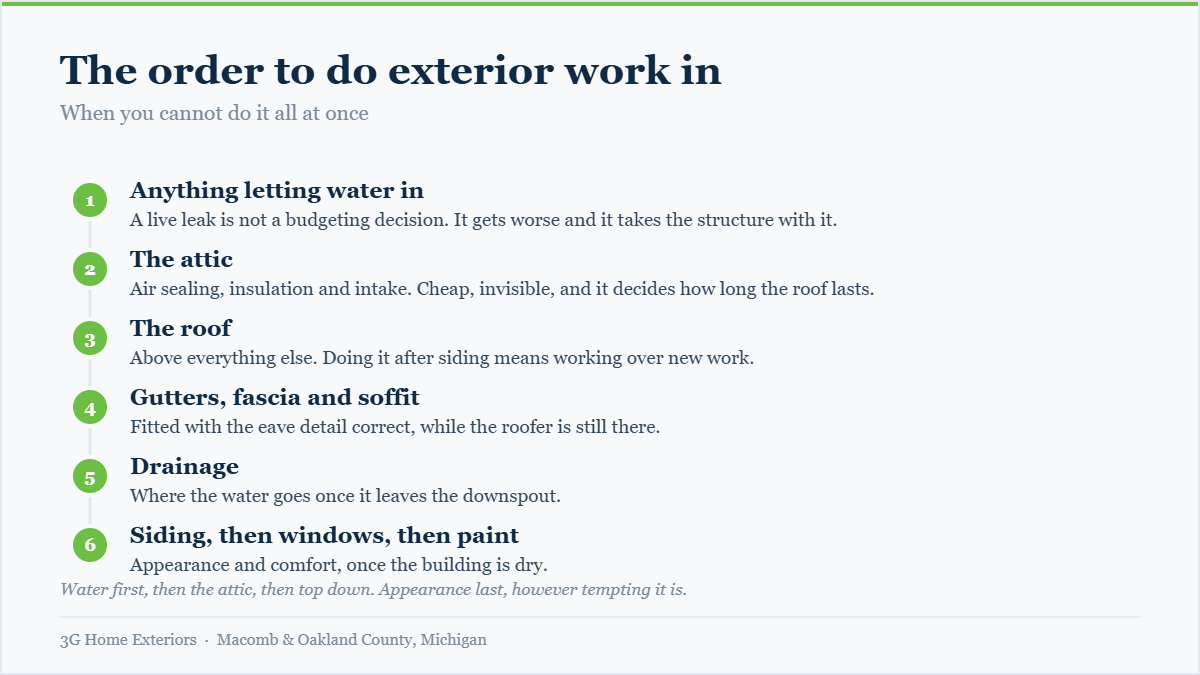
First: anything actually letting water in
This is not part of the ranking. A live leak gets worse, and it takes decking, framing, insulation and interior finishes with it on the way.
Which does not mean every stain is a leak. A brown mark on a ceiling in January is very often attic condensation rather than a hole in the roof, and those have completely different fixes. Establish which before spending anything. See roof leak or condensation.
Second: the attic
This is the one that gets skipped, and it is the highest-return work on most Michigan houses.
Air sealing, adequate insulation and a clear intake path at the soffit cost a fraction of any of the other projects. They also determine how long your next roof lasts, whether you get ice dams, and whether you get winter condensation staining ceilings.
Putting a new roof over a blocked soffit buys the same problem again on a longer timer. Doing the attic first means the roof you buy next reaches the life you paid for. See the attic ventilation calculation.
Michigan code minimum for a ceiling with attic in Zone 5a is R-38. A great deal of Metro Detroit housing stock is below it.
Third: the roof
The roof sits above everything else, which means everything else depends on it and work on it happens over the top of whatever is below.
Replace siding first and then the roof, and a crew is tearing off, moving ladders and dropping debris over new siding. Do the roof first and that risk disappears.
Two things to settle while making the decision. How many layers are up there, because two means your next roof is a tear-off regardless of preference — see two layers of shingles. And whether it is a tear-off or an overlay, which is one of the six lines that explain most of the gap between competing bids — see how to compare three estimates.
Fourth: gutters, fascia and soffit
These belong with the roof, and ideally immediately after it, because the eave detail is shared between the two trades.
The metal at the eave — drip edge, and a gutter apron where the conditions call for it — is roofing work that decides whether your gutters actually catch the water or send it down the back of the fascia. When the roofer and the gutter installer are different people on different days, this is the detail that falls between them. See gutter apron versus drip edge.
It is also the moment the fascia is visible. Soft wood there has to be dealt with before new gutters go on, because fixings need something to hold. See what a failed gutter really costs.
And while the gutters are being sized, count the outlets properly. See how many downspouts a roof needs.
Fifth: drainage
Everything above moves water to the ground. This decides whether it then leaves.
Adding a downspout without planning where the water lands simply creates a new discharge point against the foundation. The two decisions belong in the same conversation. See where does the water go.
Often the cheapest part of this is grade — the fall of the ground in the first few feet from the wall — and it is the part nobody sells.
Sixth: siding, then windows, then paint
Now the building is dry and the envelope works. This is where appearance and comfort come in.
Siding before windows where both are planned, since window trim and flashing tie into the siding and doing it the other way round means disturbing new work. Paint last, obviously.
One exception worth naming: a window that is genuinely failing — rot in the frame, water coming in — moves up to the top of this list with the other water items. A draughty window does not. Draughty is comfort, and comfort loses to water every time.
Where the honest exceptions are
Rules like this are useful until they are not. Three situations reorder it.
Storm damage with a claim. The claim has a deadline. Michigan sets the window to bring an action at one year after the loss, or longer if the policy provides. That timetable outranks your preferred sequence. See the deadline.
Selling within a year or two. The calculation changes from durability to presentation, and the answers are different. A written roof assessment and permit record in hand removes more friction from a sale than most cosmetic work does. See what a roof inspection tells a buyer.
Two jobs on the same elevation. If the siding and the gutters on one side both need doing, doing them together saves a mobilisation. Ask whether combining work reduces the total.
The tax question, removed
One thing that should not factor into the sequence at all: property taxes.
Michigan statute lists roof, siding, gutters and downspouts, masonry, outside painting, insulating and weatherstripping, and storm windows and doors as normal repair and maintenance, not treated as additions when determining value. Structural additions are different. See what the statute says.
What deferral actually costs
Two of these get dramatically more expensive when postponed.
Gutters, because the failure mode is fascia, then soffit, then rafter tails. What starts as a gutter becomes carpentry.
The attic, because every winter of ice dams is water at the eave and a roof ageing faster than it should.
Siding, windows and paint largely stay where they are. Faded siding next year is faded siding. That asymmetry is the real argument for the order above.
Across Macomb and Oakland
We do all of this, which means we have no reason to tell you the thing we happen to sell is the thing you need first. Ask us what we would do in your position and you will get the honest sequence, even when that puts our largest job at the back of the queue.
Book a free assessment, or see where we work across Macomb, Oakland and St. Clair counties.
Common questions
Should I do the roof or the siding first?
The roof. Work on it happens above the walls, and doing siding first means a crew working over new material.
Do gutters go on before or after a new roof?
After, and ideally straight after, because the eave metal is shared between the two trades and the fascia is visible while the gutters are off.
Is attic insulation really more urgent than a roof?
Unless the roof is leaking, usually yes. It costs less and it determines how long the next roof lasts.
What if everything needs doing at once?
Then sequencing within one project year matters rather than across years, and combining work on the same elevation can reduce the total. Ask for it to be priced both ways.
Sources: MCL 211.27, Michigan General Property Tax Act; MCL 500.2833; Michigan EGLE residential energy code checklist, Climate Zone 5a.