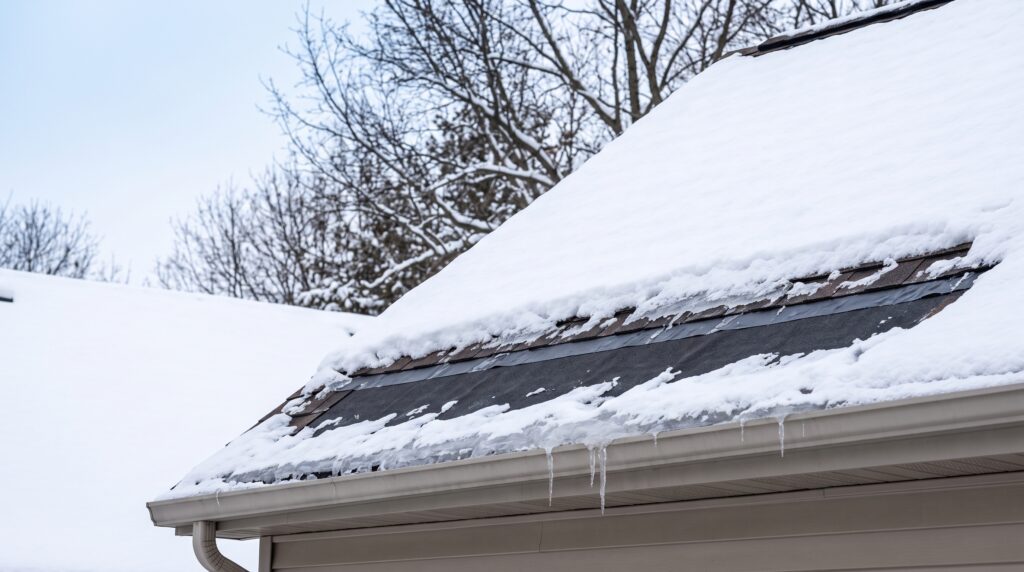
It is one of the most common reasons homeowners put off exterior work, and in Michigan it is based on a misunderstanding.
A new roof does not raise your property tax assessment. Neither does new siding, new gutters, exterior paint, or repointed masonry. This is not an interpretation or a rule of thumb. Michigan statute lists those items by name.
What the law says
Michigan General Property Tax Act, at MCL 211.27, deals with how true cash value is determined. Subsection 2 lists normal repair, replacement and maintenance for residential property that is not to be treated as a loss or an addition when determining value.
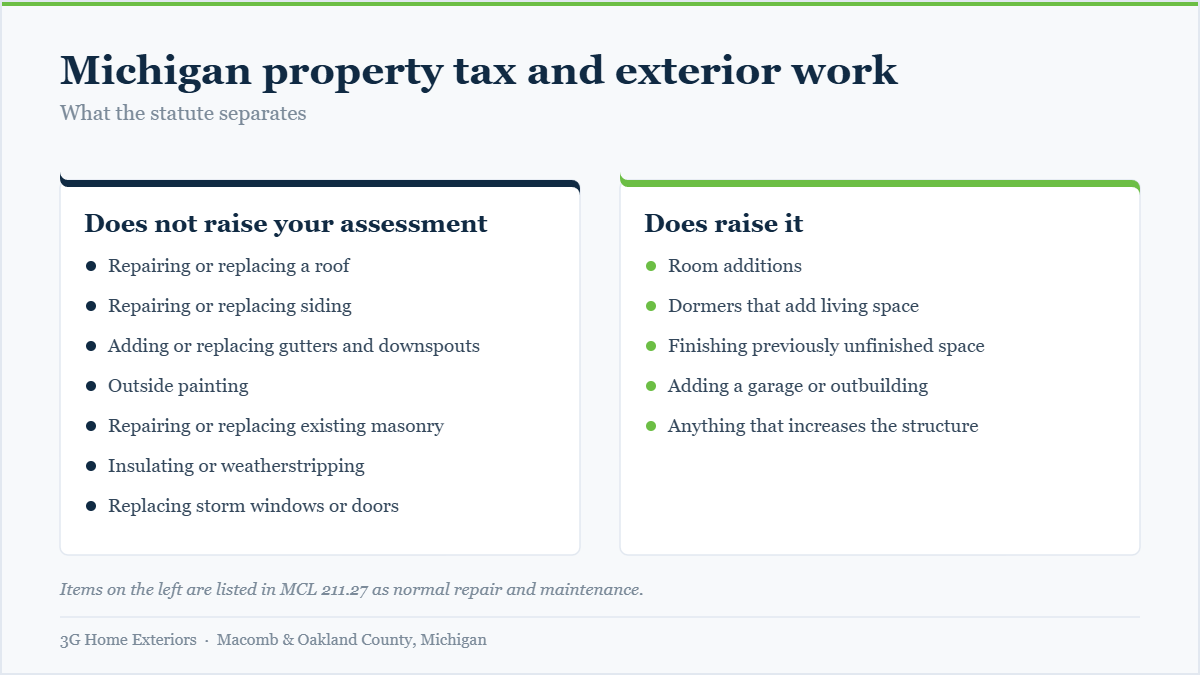
The items on that list relevant to a house exterior include:
- Outside painting
- Repairing or replacing siding, roof, porches, steps, sidewalks or drives
- Repainting, repairing or replacing existing masonry
- Adding or replacing gutters and downspouts
- Replacing storm windows or doors
- Insulating or weatherstripping
- Replacing awnings
Read through it. Roof, siding, gutters, masonry, paint, insulation. That is very nearly the whole of exterior contracting, named in a tax statute as work that does not move your assessment.
Michigan municipalities state it in plainer language. One township FAQ puts it as: normal repairs and maintenance will not increase the assessment on your home. Another city explains the provision as protecting the homeowner from an increased tax assessment because of repair or replacement of portions of the home.
What does raise an assessment
The distinction the statute draws is between repairing what exists and adding something new.
Work that generally does increase assessed value:
- A room addition
- A dormer that creates new living space
- Finishing a basement or attic that was previously unfinished
- Adding a garage, outbuilding or enclosed porch
- Anything that increases the size or the finished area of the structure
The logic is consistent. Replacing a failing roof restores the house to what it already was. Building a new room makes a bigger house.
Where the confusion comes from
Three things keep this myth alive.
The permit. Roofing work requires a permit, and permits are filed with the municipality. People reasonably assume anything the assessor can see gets valued. The permit record and the assessment are separate things.
Out-of-state experience. Not every state handles this the same way. People who have owned property elsewhere often bring a different rule with them.
Assessments change anyway. Your assessment moves with the market, on its own schedule, whether or not you touched the house. A homeowner who replaces a roof in May and sees a higher assessment the following year naturally connects the two. Usually the market did that.
The terms on your assessment notice
Three numbers appear and they are not the same.
Assessed value is the assessor figure, ordinarily around half of what the assessor considers true cash value.
State equalized value is the assessed value after county and state equalization.
Taxable value is the number your bill is actually calculated on. Its year-to-year growth is capped while you own the property, which is why a long-time owner can have a taxable value well below the assessed value. It uncaps on transfer of ownership.
If you disagree with what is on the record for your property, that information can be challenged. Your municipality can explain the review process and the deadlines.
What this actually means for a decision
The tax question is frequently the thing that turns a needed repair into a deferred one. Take it off the table and the arithmetic changes.
Deferring a roof does not save money. Water gets into a deck, a deck repair becomes part of the scope, and what would have been a straightforward tear-off becomes a larger job. Deferring gutters means fascia and soffit, which we wrote about in the eave detail most installs skip.
There is also the insurance side. A roof at the end of its life is treated differently by insurers than one with years left, and some policies schedule roof coverage by age.
One thing to check for yourself
We are a contractor, not a tax adviser, and your municipality and your assessor are the authority on your specific property. What is written above is what the statute says and what Michigan municipalities publish about it.
If you want certainty for your address, call your city or township assessor before the work and ask directly whether the scope you are planning is treated as normal repair. It is a short call and they answer it regularly.
Common questions
Will a new roof increase my property taxes in Michigan?
Repairing or replacing a roof is named in MCL 211.27 as normal repair and maintenance, which is not treated as an addition when determining value. Confirm with your local assessor for your property.
What about new siding?
Siding appears in the same list, alongside roof, porches, steps, sidewalks and drives.
Do new gutters affect my assessment?
Adding or replacing gutters and downspouts is listed by name in the statute.
What exterior work does raise an assessment?
Work that adds structure or finished living space, such as a room addition, a dormer creating new space, or finishing an unfinished area.
Why did my assessment go up the year after I replaced my roof?
Assessments track the market and are reviewed on their own cycle. A change in the same year is not necessarily connected to the work. Your assessor can explain what drove the change on your record.
Get the work priced
If the tax question was the thing holding a project back, it should not be. We will look at the roof, the gutters or the siding and tell you what actually needs doing and what can wait.
Book a free inspection, or see what we cover across Macomb, Oakland and St. Clair counties.
Sources: MCL 211.27, Michigan General Property Tax Act; Michigan municipal assessing FAQ pages referencing Public Act 293. This article is general information about Michigan statute and is not tax advice. Consult your local assessor.