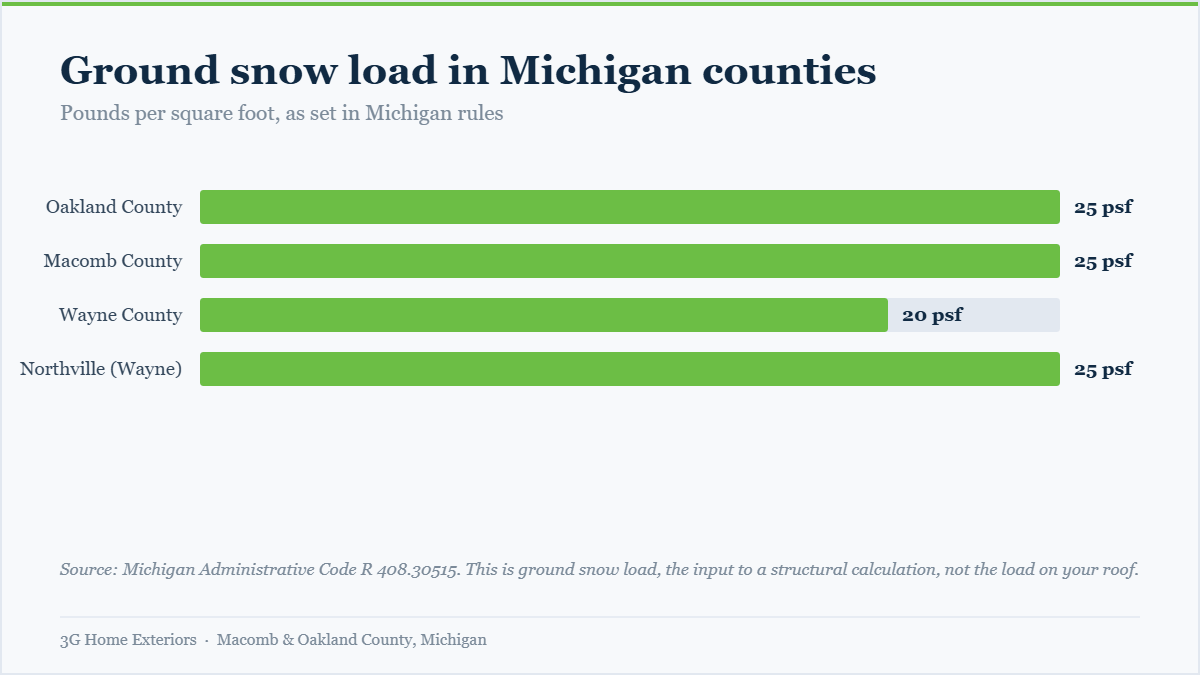
Michigan Administrative Code sets ground snow load by county. Oakland County is 25 pounds per square foot. Macomb County is 25. Wayne County is 20, except Northville which is 25.
It is a precise-looking number that gets quoted a great deal and understood rarely. Here is what it is, what it is not, and when snow on your roof is actually a concern.
What ground snow load is
It is a design input, not a measurement of your roof.
The figure represents the snow load used for structural design at ground level in that county. A structural calculation then converts it into a roof load, and that conversion depends on the roof — its slope, its exposure to wind, whether it is heated beneath, its shape, and where snow will drift or slide.
So 25 psf is not the weight sitting on your roof. It is the starting number for working out what your roof was designed to carry.
Why depth tells you little
The instinctive question is how many inches of snow equals 25 pounds per square foot, and there is no fixed answer, because snow density varies enormously.
Light dry powder weighs a fraction of what wet packed snow weighs at the same depth. A roof carrying two feet of light snow may be under less load than the same roof carrying eight inches of heavy wet snow.
Two situations to watch for in Michigan specifically:
Rain on snow. An existing snow pack absorbs rainfall and the load climbs quickly without the depth changing at all. This is the scenario that causes problems.
Thaw and refreeze. Snow that partially melts and refreezes becomes dense ice. The Great Lakes region averages around 42 freeze-thaw cycles a year, so this happens repeatedly rather than occasionally. Detroit averages 45 inches of snow a year, with January at 14 inches and February at 12.5.
Where load concentrates
Snow does not sit evenly, and the places it piles up are where problems appear.
- Valleys, where snow from two planes collects in one line
- Below a higher roof, where snow slides off the upper section onto the lower one
- Against dormers, chimneys and walls, where drifting builds depth
- Low-slope and flat sections, where nothing sheds naturally
- The lee side, sheltered from wind, where drifts form — a real factor on the open lots common in Washington Township and Oakland Township
Porch roofs, additions and attached garages are worth particular attention, because they are frequently lower, flatter and framed lighter than the main house, and they are often where upper-roof snow lands.
Warning signs worth taking seriously
- Doors or windows that suddenly stick, particularly interior ones
- New cracks in ceiling or wall finishes
- Visible sagging in a ceiling or a roof line
- Creaking or popping sounds from the structure
- A sprinkler head or light fitting that has moved relative to the ceiling
- Any visible deflection in an unfinished space
If you see these under heavy snow, leave and call someone. This is not a wait-and-see situation.
Clearing snow, carefully
Most houses never need it. When they do:
From the ground, with a roof rake. The only method most homeowners should use. Pull snow from the lower roof and work outward, and stay clear of what comes down.
Do not get on a snow-covered roof. There is no useful version of this advice with a caveat attached.
Remove evenly. Clearing one section completely while leaving the adjacent section loaded creates an uneven load the structure was not designed for.
Do not chip at ice. Cold shingles break. We went through the removal question in ice dam removal, what works and what damages the roof.
The connection to layers
This is where the snow load figure meets a decision people actually make.
A second layer of shingles roughly doubles the dead load of the roof covering on framing sized for one, and that dead load is permanent — it is there before any snow arrives. Michigan municipalities cap the total at two layers, and weight is one of the reasons. See two layers of shingles and what it costs you later.
It is also why proposals to add a heavier covering over an existing roof deserve a structural question rather than only a price comparison.
Roofing in Washington Township
Washington Township has large parcels, open exposure and a good number of outbuildings. Open exposure cuts both ways for snow — wind scours some roofs clear and piles drifts against others, and outbuildings such as pole barns are often framed to different assumptions from the house. It is worth looking at them separately rather than assuming the house answer applies.
See roofing in Washington Township, or everything we handle in Washington Township.
Common questions
What is the snow load in Macomb County?
Michigan Administrative Code R 408.30515 sets ground snow load at 25 pounds per square foot for Macomb County, and the same for Oakland County.
How much snow is 25 pounds per square foot?
There is no single depth, because snow density varies widely. Wet, packed or rain-soaked snow weighs far more per inch than fresh dry snow.
Should I clear snow off my roof?
Most Michigan roofs handle a normal winter without intervention. Watch low-slope sections, valleys and areas below an upper roof, and act if you see structural warning signs.
Does a second layer of shingles matter for snow load?
It adds permanent dead load to framing designed for a single layer, before any snow arrives. It is one reason the layer count is capped.
Ask us before winter, not during
If you have a low-slope section, a porch roof that takes slide-off from above, or an outbuilding you are unsure about, October is the month to have it looked at.
Book a free roof inspection, or read about residential roofing across Metro Detroit.
Sources: Michigan Administrative Code R 408.30515; NOAA 1991-2020 U.S. Climate Normals, Detroit Metro Airport; GLISA, University of Michigan, Great Lakes freeze-thaw cycle data. Structural questions about a specific building are for a licensed structural engineer.