Commercial Roofing Planned Around the Building and Its Operations
3G Home Exteriors inspects, repairs and replaces commercial and low-slope roofs on a schedule built around keeping your building open and your tenants working.
Free on-site inspection and a written, itemized scope before work begins
Top-Rated in Michigan for Quality and Service
Commercial roof problems corrected at the details that matter
Low-slope commercial roofs fail differently than a residential shingle roof. Most problems trace back to a seam, a penetration, a drain or a flashing detail rather than the field of the roof itself, which is why a walk-on inspection tells you far more than a repair quote written off a photo. We evaluate the full assembly, put the findings in writing, and plan the work around your building’s schedule rather than ours.
Signs your commercial roof needs attention
Recurring leaks around drains or penetrations
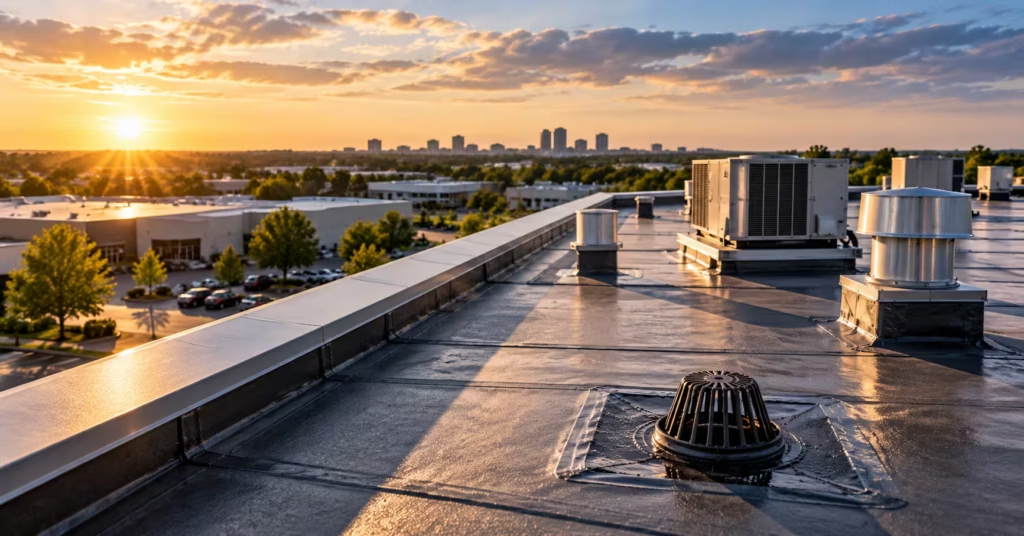
Drains, HVAC curbs, and pipe penetrations are the most common failure points on a low-slope roof.
Open seams, punctures or displaced flashing
Membrane seams and flashing details fail before the field membrane typically does.
Wet insulation or interior staining
Interior staining on a commercial roof often means moisture has already saturated the insulation layer below the membrane.
Standing water still on the roof days after rain
Ponding puts sustained load on the assembly and accelerates seam failure in exactly the areas that are hardest to reach.
A roof approaching the end of its service plan
Low-slope systems tend to give warning before they fail outright: seams that need attention every year, flashing repairs that no longer hold, patches accumulating in the same corner. An aging system is worth evaluating on a planned schedule rather than during a shutdown.
Equipment changes that disturbed the roof assembly
New HVAC units, satellite dishes, or other rooftop equipment installs are a common, overlooked source of new leaks.
Working on an occupied building
The roof is rarely the expensive part of a commercial roof project. The expensive part is a tenant who couldn’t open, a production line that stopped, or a customer entrance blocked by a staging area on a Friday afternoon. Those are scheduling decisions, and they get made before the first crew shows up, not during.
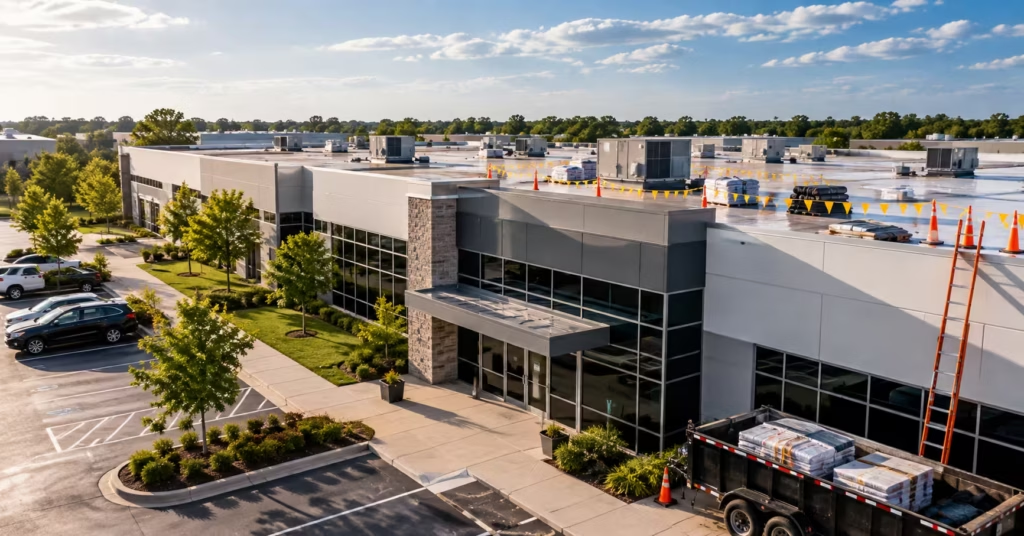
Before we quote, we want to know how the building is used and when it is least disruptive to work: whether crews can stage in a section of the lot without cutting off access, whether tear-off noise needs to happen outside business hours, which entrances have to stay clear, and whether the work can be phased by roof section so only part of the building is affected at a time. Where the roof layout and the building allow it, phasing is usually the difference between a project you plan around and a project that shuts something down.
Commercial roof scopes we quote
Inspection and condition report
A walk-on evaluation of membrane, seams, drains, penetrations and flashing, written up so you can budget from it.
Targeted repair
Correcting the specific seam, penetration or flashing detail causing the leak, on a roof with remaining service life.
Drainage and ponding correction
Addressing why water is sitting on the roof rather than patching the area it’s sitting on.
Full replacement
When the assembly has reached the point where repairs stop returning value.
Standing seam metal roofing
Confirmed on completed work including pole-barn and light-commercial structures — see the project photos below.
Membrane systems
Single-ply and modified bitumen low-slope systems, evaluated on the details that decide whether the roof lasts: how the membrane is attached, how seams are made, and how it terminates at parapets, curbs and drains.
How we work with your building and your schedule
Schedule your free estimate
Tell us about the building, roof type, and what you’re seeing.
Meet with a 3G specialist
We inspect the roof assembly — membrane, seams, drains, flashing — and discuss how work needs to be phased around your operations.
Receive your quote
A clear, itemized scope covering repair, restoration, or full replacement.
We complete your project
Work is scheduled and phased to minimize disruption to tenants, staff, or operations.
Reviews below come straight from our Google Business Profile, so what you are reading is what other property owners in these towns actually wrote.
Posted on Google
Marguerite Johnson
Stellar Team and Amazing Response Time.
Posted on Google
Sarah McCullough
Great experience with Jamie and his crew for gutter replacement. Jamie gave a no nonsense quote, very straight forward. He scheduled me and got the crew out within a week. They finsihed in a few hours. I paid the final invoice. Done! Previously, I had requested four quotes from four different contractors. 3G was the cheapest and most qualified in my opinion. It's ridiculous the amount of nonsense other contractors display not knowing I'm a woman with 13 years in construction. I always play dumb, because I want to see who NOT to hire. Jamie treated me fairly and with respect from the start. He gave an appropriate price, clear terms, and provided his license and insurance without hesitation. Wonderful experience and I will be calling 3G back for my garage siding project. Very pleased with their work and professionalism.
Posted on Google
Ramsey Khalid
3G Home Exteriors completed a tuck-pointing job on my front porch and my back walk-out steps. Quote was fair, crew was on time, professional and courteous. After they completed the job, they cleaned up the job site leaving no trace. Overall, it was a very good experience and I would recommend them for the same work.
Posted on Google
Dana Lawrence
Windy weather bent the aluminum siding on the peaks of our home. 3G came out and fixed it like new. Friendly people and easy to work with.
Posted on Google
Steve Wegner
In Troy, MI, I hired 3G to install gutter guards and additional downspouts. In addition to a job well done I was most impressed with their excellent customer service, responsiveness and timeliness.
Posted on Google
Jill Severini
3G was excellent to work with. They kept appointment times, did everything they promised. We love our new micro mesh gutter guards. No more water overflowing onto our porch. No more locust leaves or seeds to clean. Best of all, no more climbing on the roof. Would highly recommend.
Posted on Google
Sean Weaver
Second time using 3G. Reasonably priced and great work.
Posted on Google
Milton Brownlee
3G gave me a fair price to repair approximately 12 pieces of Siding that was blown off due to heavy winds. I would highly recommend 3G services great customer service.
Posted on Google
Leslie Lloyd
Jamie was very pleasant individual to speak with and made sure to call to update me on any details. The roofing itself is amazing, the group that was here did a great job with clean up and taking off the old roof. No more leaking in my backroom!!!
Proudly serving Macomb, Oakland & St. Clair counties
Based at 31097 Fraser Dr in Fraser, we cover most of Metro Detroit within a comfortable drive — which matters when a roof is open and the forecast changes. Don’t see your city? Ask us, coverage depends on distance and project scope.
Why property owners and managers keep us on the list
Work scheduled around your operating hours
Tear-off noise, staging and access get planned around when the building is actually in use. A quiet Saturday is often worth more to a tenant than a day saved.
One point of contact, not a rotating account manager
The person who inspects the roof stays with the project. You are not re-explaining the building’s history to somebody new every quarter.
A scope that separates repair from replacement honestly
Many low-slope roofs have five good years left in most of the field and a failing detail at one curb. We price both paths so the decision is yours to make on real numbers.
A family-run company since 2011, so the same names answer next year
Commercial roofs are a decade-long relationship. Ours has been under the same ownership since 2011, which means the maintenance history stays with the people who wrote it.
Roof, drainage and masonry handled by one contractor
Parapet flashing, scupper and drain work, and the masonry around them are one water path. Splitting them between trades is how responsibility for a leak gets lost.
After a commercial job closes out, the number in your file reaches the same Fraser office that scoped it. That continuity is the point of hiring a local family business rather than a national outfit: when a seam needs looking at three winters from now, nobody has to reconstruct what was installed, because the people who installed it are still answering the phone.
Commercial Roofing FAQs
What types of commercial roof systems do you work on?
We work on low-slope membrane systems as well as standing seam metal roofing. The right system for a given building depends on its slope, its rooftop equipment, how it drains and how the space below it is used, so the specific recommendation comes out of the inspection rather than out of a brochure.
Do you offer maintenance inspections?
Ask about scheduled inspections when you request your estimate. On a low-slope roof, most expensive failures start as something small at a seam, a drain or a curb, and looking twice a year is far cheaper than reacting once.
Can work be phased to avoid shutting down my business?
Yes — we plan commercial work around occupied buildings and can phase a project by section where the roof and building layout allow it. Tell us your operating hours and access constraints when you request the estimate so they’re built into the schedule from the start.
How does ponding water get corrected?
Ponding is usually a sign the roof’s drainage slope or drain placement needs correcting, not just a membrane patch. We evaluate the water path across the roof before recommending a fix.
Will I get something in writing I can budget from?
Yes — the estimate is an itemized scope covering what we found and what we recommend, so it can go to an owner, a board or a budget cycle without translation.
Request a commercial estimate
Tell us about your building and roof system, and we’ll schedule a walk-through around your operating hours. You can also request a commercial estimate from our contact page.
Related guides
From the Learning Center
U-Factor, SHGC and the Ratings That Matter in Michigan