For several years the federal Energy Efficient Home Improvement Credit, section 25C, was part of every conversation about windows and insulation. It is worth being direct about where it stands.
The statute now provides that section 25C does not apply with respect to any property placed in service after 31 December 2025. The termination came through Public Law 119-21. The IRS page describes the credit as applying to property placed in service on or after 1 January 2023 and before 31 December 2025.
If someone is still quoting that credit as a reason to buy this year, they are working from old material, and that is worth noticing.
What the credit had been
For context, since the terms still circulate. Windows and skylights were capped at $600 and required ENERGY STAR Most Efficient certification. Other categories had their own caps.
Two practical consequences of it ending. The obvious one is that the money is not there. The less obvious one is that the certification requirement is no longer forcing a specification — which means the performance decision is now entirely yours to make rather than partly made by the tax code.
That is the part worth spending time on.
The numbers that still apply
Southeast Michigan is IECC Climate Zone 5a, and Michigan EGLE publishes a residential energy code checklist specifically for it, separate from the 6a version used further north.
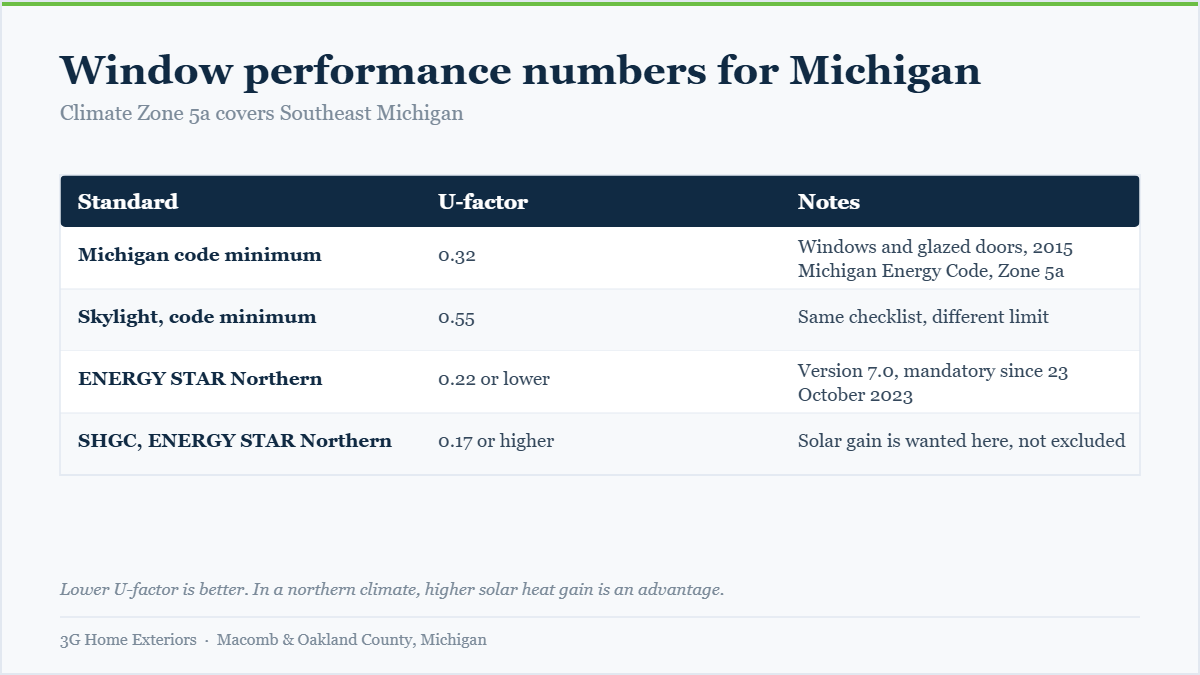
Under the 2015 Michigan Energy Code for Zone 5a, code minimums include:
- Windows and glazed doors: U-0.32
- Skylights: U-0.55
- Ceiling with attic: R-38, with R-30 permitted where a raised-heel or energy truss allows full depth over the wall plate
- Wood-frame wall: R-20, or R-13 plus R-5 continuous
ENERGY STAR sets a considerably higher bar. Version 7.0 for the Northern zone requires U-factor of 0.22 or lower and SHGC of 0.17 or higher, mandatory since 23 October 2023.
The gap between 0.32 and 0.22 is the gap between legal and good.
Why SHGC has a floor rather than a ceiling here
This is the part that gets applied backwards in Michigan.
Solar heat gain coefficient measures how much solar energy the glazing lets through. In a hot southern climate you want it low, to keep heat out.
In the Northern zone, ENERGY STAR sets a minimum. Winter solar gain is useful here — it is free heat during the months that dominate our energy use. Specifying southern-climate glass on a Michigan house means paying to exclude heat you wanted.
We went through the ratings in more depth in U-factor, SHGC and the ratings that matter in Michigan.
Where the money actually is now
With the federal credit gone, the honest ranking of what returns most per dollar on a Michigan house is not windows.
Air sealing. Closing the gaps where conditioned air leaves and cold air enters. Almost always the cheapest meaningful improvement in the building, and the one nobody sells door to door because there is no product in it.
Attic insulation, done with baffles. Code minimum for Zone 5a is R-38 in a ceiling with attic. Many older Metro Detroit houses are well below that. But insulation blown in without baffles packs against the soffit and blocks ventilation intake, which creates condensation and ice dams. Insulation and ventilation are one job, not two. See the attic ventilation calculation.
Then windows. Windows matter, and they are also the most expensive way to buy a given amount of comfort. On a house that is leaking air at the ceiling plane, new windows are a visible improvement to a building that is still losing heat upward.
Two other things worth checking
Utility programmes. Energy utilities operate their own efficiency programmes, and terms change. Ask your own utility directly what is currently available for insulation, air sealing and windows rather than relying on a contractor summary.
Property taxes. Michigan statute lists insulating or weatherstripping and replacing storm windows or doors among normal repairs that are not treated as additions to value. So the efficiency work itself does not move your assessment. See what the statute says.
What to ask for on a window quote
- The U-factor and SHGC for the exact units being quoted, from the NFRC label rather than from a brochure
- Whether they meet ENERGY STAR Northern zone criteria, and by how much
- Whether it is a full-frame replacement or an insert into the existing frame
- How the opening will be flashed and sealed, because installation decides more of the outcome than the glass does
- What happens to the exterior trim
That last pair matter more than most product comparisons. A well-specified window installed badly performs worse than a modest window installed properly.
Windows across Metro Detroit
Much of our area was built in eras with very different expectations about glazing, and the right answer varies accordingly. A 1960s ranch, a 1990s colonial and a historic Birmingham house are three different problems, and only one of them is mainly about the glass.
See window replacement in Michigan, or find your city.
Common questions
Is the 25C tax credit still available in 2026?
The statute provides that section 25C does not apply to property placed in service after 31 December 2025.
What U-factor should windows have in Michigan?
Michigan code minimum for Zone 5a is U-0.32 for windows and glazed doors. ENERGY STAR Northern zone requires 0.22 or lower.
Should SHGC be high or low in Michigan?
ENERGY STAR sets a minimum of 0.17 for the Northern zone. Winter solar gain is an advantage here rather than something to exclude.
What gives the best return now that the credit is gone?
Air sealing first, then attic insulation done with proper ventilation baffles, then windows. That order reflects cost against effect on most Michigan houses.
Ask us what we would do first
If you are weighing windows against insulation against something else, we will look at the house and tell you which one we would do first in your position, including when that is not the thing you called about.
Get in touch, or read about window replacement across Metro Detroit.
Sources: 26 U.S.C. 25C, as amended by Pub. L. 119-21; IRS Energy Efficient Home Improvement Credit guidance; Michigan EGLE residential energy code checklist, Climate Zone 5a; ENERGY STAR residential windows key product criteria, Version 7.0; MCL 211.27. General information, not tax advice.