Everyone says get three estimates. Nobody explains what to do when they arrive and the numbers are thousands apart with no obvious reason.
The instinct is to assume the expensive one is padded or the cheap one is cutting corners. Usually it is simpler than that: they are pricing different work. Here are the six lines where the difference nearly always lives.
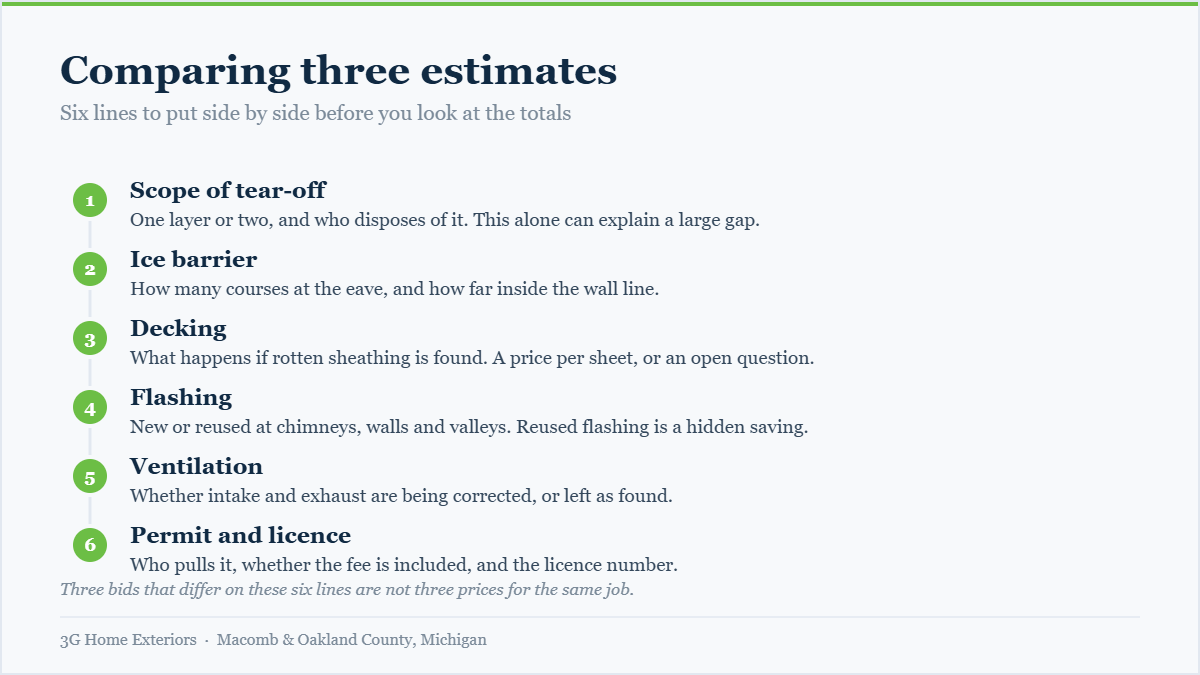
1. What is coming off, and who takes it away
A tear-off costs more than an overlay because of labour and disposal. If one bid proposes going over the existing layer and another proposes removing it, you are not comparing prices — you are comparing decisions.
Michigan municipalities cap the total at two layers, so an overlay now may commit you to a tear-off next time. See two layers of shingles and what it costs you later.
Ask: is this a tear-off or an overlay, how many layers are on there now, and is disposal included?
2. Ice barrier at the eaves
Metro Detroit building departments require ice barrier from the roof edge to at least 24 inches inside the exterior wall line. On a house with a deep overhang or a shallow pitch, one 36-inch course frequently does not reach that line and a second is needed.
This is invisible once the roof is on, which makes it one of the easiest places for a bid to be quietly cheaper. See the 24-inch rule.
Ask: how many courses, and how far inside the wall line on this roof?
3. What happens when they find bad decking
Nobody knows what is under the shingles until they come off. What separates a good estimate from a bad one is whether that uncertainty is handled openly.
A good estimate states a price per sheet for replacement decking. A bad one says nothing, and the conversation happens on day two with a crew on your roof and your negotiating position gone.
Ask: what is your price per sheet for replacement decking, and how will you show me what needed replacing?
4. Flashing, new or reused
Flashing at chimneys, at walls, around skylights and in valleys is where most roofs actually leak. Reusing old flashing is faster and cheaper and it is a real difference in the work.
Ask: is flashing being replaced or reused, and what is specified at the chimney?
5. Ventilation
The cheapest approach is to put the roof back exactly as found. If the attic intake is blocked by insulation packed against the soffit, as it very often is, the new roof begins ageing early on day one.
An estimate that addresses intake and exhaust is doing more work and costs more. It is also the difference between a roof that reaches its expected life and one that does not. See the attic ventilation calculation.
Ask: did you go into the attic, what did you find, and is anything about ventilation included here?
6. Permit and licence
A permit is required and in most Metro Detroit municipalities the licensed contractor must pull it, not you. The fee may be included or added.
Ask: who pulls the permit, is the fee included, and what is your Michigan licence number? Verification takes a minute — see how to check it — and see what the permit covers.
Two things that are not line items
Payment terms. Michigan Attorney General guidance suggests a deposit of around one third of the contract price should generally suffice, and advises never paying in cash or in full up front. A bid requiring most of the money before work starts is telling you about the business, not about the roof.
Anything only said aloud. The same guidance is direct: do not let work start without a signed written contract that includes all verbal promises. A warranty described enthusiastically at the kitchen table and absent from the document does not exist.
Build the comparison on paper
Write the six lines down the side and the three contractors across the top. Fill it in, calling each one back for anything missing.
Two things happen. You find out that the cheapest bid was cheap because it excluded two things you need — or that it genuinely was the same job for less, which does happen and is worth knowing. And you learn how each one responds to a direct question, which is information you will be relying on when something unexpected appears on day two.
When the cheap bid is actually fine
Worth saying plainly, because this article could read as an argument for paying more.
Sometimes a lower bid reflects lower overheads, a gap in the schedule, or a crew that is simply efficient. If all six lines match and the licence and insurance check out, the lower number is the lower number and you should take it.
The point of the exercise is not to justify a higher price. It is to find out whether you are comparing the same job.
Across Macomb and Oakland
We will put our scope next to anyone else and go through it line by line with you. If a competing bid is doing the same work for less, we will tell you that.
Get a written estimate, or see where we work.
Common questions
Why are roofing estimates so different?
Usually because they describe different work — tear-off versus overlay, eave detail, flashing, decking allowance and ventilation. Compare the scope before the total.
How much deposit is normal?
Michigan Attorney General guidance suggests around one third of the contract price should generally suffice, and advises against paying in cash or in full up front.
Should I always take the middle estimate?
No. That rule substitutes for reading the scope. Compare the line items and the middle bid may be the worst of the three.
What if a contractor will not itemise?
That is your answer. An itemised scope is normal, and a refusal to provide one on the most expensive component of your house is information.
Sources: Michigan Attorney General, Building and Remodeling advice for homeowners; City of Sterling Heights Building Department FAQ; Charter Township of Macomb residential re-roof requirements.