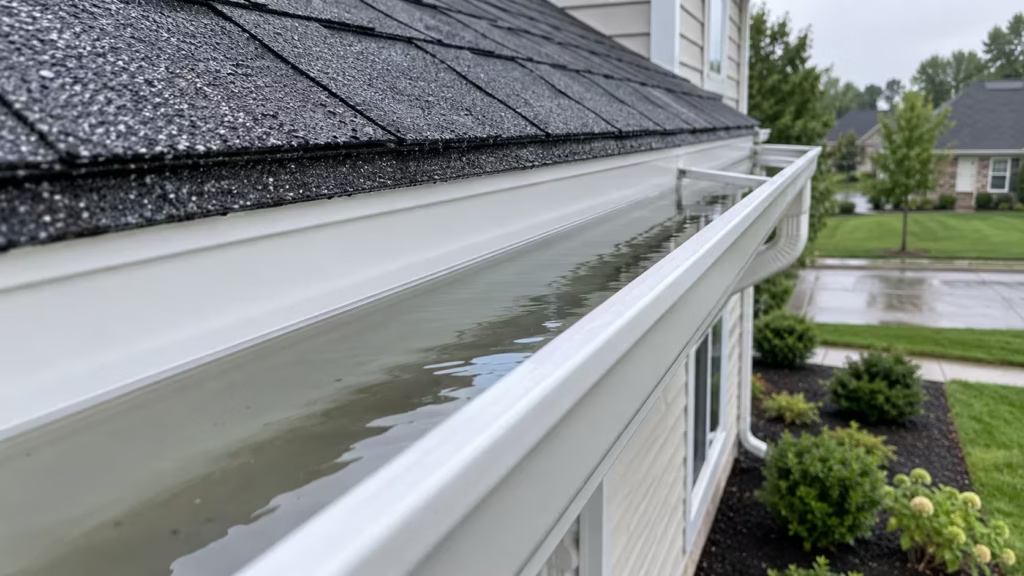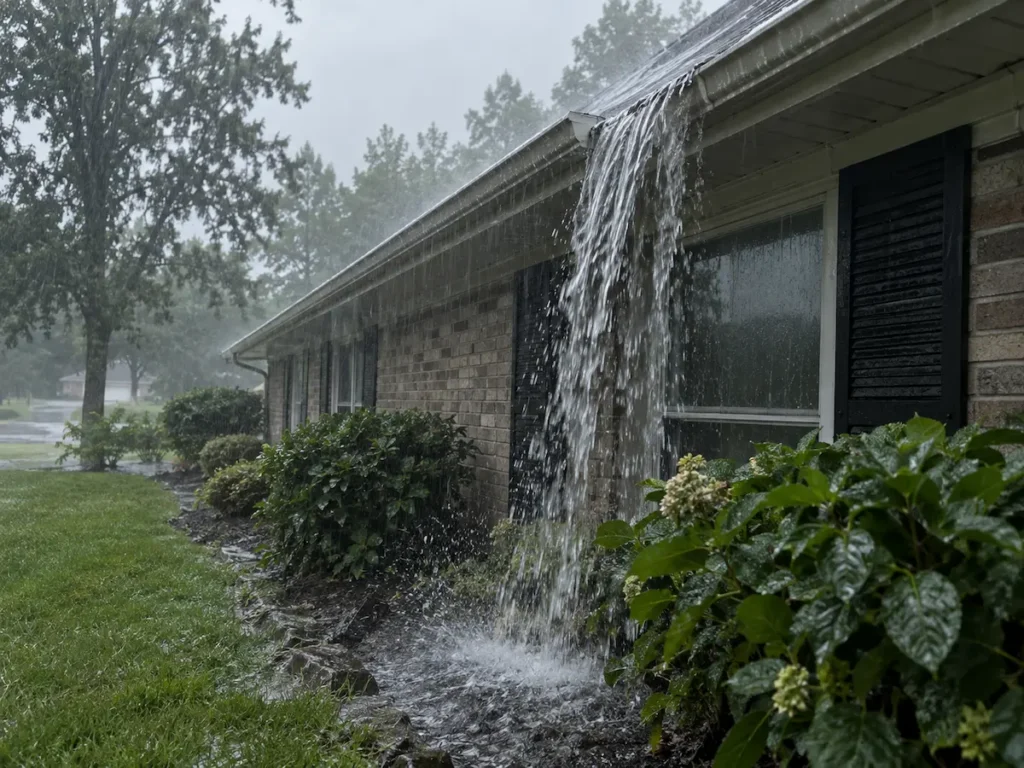
Here is a problem that hides for years: water that runs off the roof edge, misses the gutter entirely, and goes down the back of it instead.
The gutter is clean. The gutter is pitched correctly. The gutter is the right size. And the fascia behind it is quietly turning to pulp, because for every rain of the last six years a portion of the roof runoff has been travelling down the back face of a board nobody can see.
The fix is a strip of bent metal costing very little. It is left off constantly.
What drip edge does
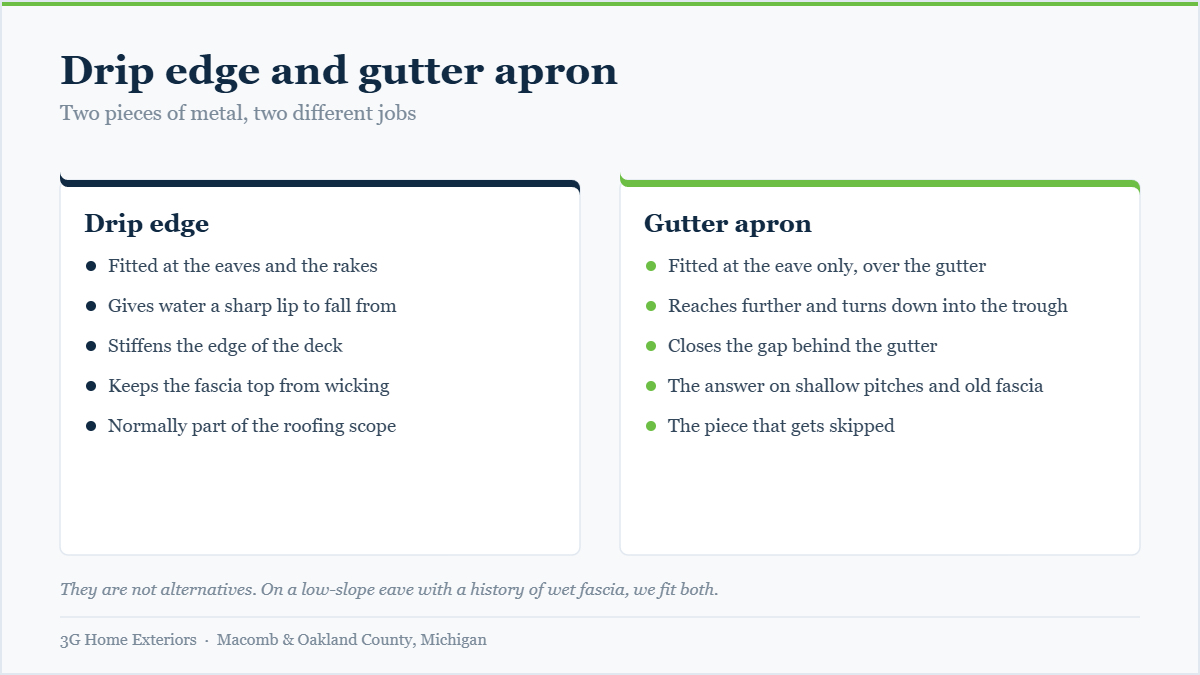
Drip edge is an L-shaped metal flashing fitted along the edges of the roof deck, at the eaves where the gutters are and at the rakes, the sloped edges running up the gable.
Its job is to make water let go. Water running down a shingle will, left to itself, curl around the edge and track back underneath, along the deck edge and onto the top of the fascia. Surface tension does this. It is not dramatic and it is relentless. Drip edge gives the water a sharp metal lip to fall from instead.
It also stiffens the edge of the deck, gives the first course of shingles something solid to sit against, and keeps the top edge of the fascia board from soaking up moisture.
What a gutter apron does differently
A gutter apron is also bent metal at the eave, but longer, with a more pronounced bend that reaches out over the back edge of the gutter and turns down into the trough.
The difference is what happens to water that does not behave. Standard drip edge points water downward at the edge of the deck. If the gutter sits slightly low, or the roof pitch is shallow, or wind is driving the rain, some of that water still finds its way behind the gutter back wall.
A gutter apron closes that gap physically. Water coming off the deck has nowhere to go but into the trough, because the metal extends past the point where it could escape.
Why it is missed so often
Three reasons, and none of them are good.
Trade boundaries. On many jobs the roofer and the gutter installer are different people on different days. Drip edge is roofing. The gutter is gutters. The apron sits exactly on the seam between the two scopes, and things on seams fall through.
It is invisible once installed. Nobody inspects the back of a gutter from the ground. A job with no apron looks identical to a job with one.
The failure is slow. Fascia rot from behind takes years. By the time the symptom appears, whoever installed it is long gone and the cause is not obvious.
How to tell whether yours has one
You can check this from a ladder at the eave without going onto the roof.
- Look at the gap between the back of the gutter and the fascia board.
- You should see metal continuing from the roof edge over that gap and turning down into the gutter.
- If you can see straight down onto the top of the fascia board, nothing is directing water into the trough.
- Look for dark vertical streaking on the fascia behind the gutter, or soft spots when you press the board.
Staining behind the gutter is the tell. Water has been running there.
Where Michigan makes it worse
Ice. When a gutter holds ice, meltwater backs up and looks for any route out. A gap behind the gutter is the easiest one available, and it leads directly onto the fascia and into the soffit. This is how gutter ice turns into a wood repair.
Freeze and thaw. The Great Lakes region averages around 42 freeze-thaw cycles a year. Wood that is repeatedly wetted and frozen fails faster than wood that simply gets wet, and a fascia board taking runoff from behind stays damp for most of the winter.
The result shows up as soft fascia, gutters that will not hold a fixing, and eventually soffit damage.
When we fit both
Drip edge and gutter apron are not alternatives. They can be fitted together, and on certain houses we do.
Both go on when:
- The roof pitch is shallow, so water leaves the edge slowly rather than shooting clear
- The fascia already shows staining or softness from previous runoff
- The eave faces prevailing weather and takes wind-driven rain
- The run has a history of ice, which most north-facing eaves in Macomb and Oakland County do
- The gutter is being hung to a fascia that is not perfectly straight
On a steep pitch with sound fascia and good drainage, drip edge alone is usually sufficient.
Ask about it before the work
This is a short conversation and a revealing one.
- Is drip edge included at both the eaves and the rakes?
- Is a gutter apron included where the gutters go?
- If the roof and the gutters are separate jobs, who is responsible for the metal at the eave?
- Can I see the fascia condition before the new gutters go on?
Eave detailing is one of the things a building inspector looks at on a re-roof. Confirm the requirement for your address with the local department, and see what a Michigan roofing permit covers.
Gutters in Fraser
Fraser is our home city and the housing stock is largely postwar ranches, long low rooflines with shallow pitches and generous overhangs. Shallow pitch is exactly the condition where water leaves the deck edge slowly and finds the back of the gutter, which is why the apron detail matters more here than on a steep colonial.
See gutter installation in Fraser, or everything we do in Fraser.
Common questions
Do I need both drip edge and gutter apron?
Not always. Drip edge is the baseline at eaves and rakes. A gutter apron is the addition worth making on shallow pitches, exposed eaves, or where the fascia has taken water before.
Can a gutter apron be added without replacing the roof?
Often yes, when the gutters are coming off anyway. It is fitted at the eave and tucked under the existing first course. Far simpler during a gutter replacement than as a standalone job.
Is water behind my gutter serious?
It is slow rather than dramatic, and that is what makes it expensive. Fascia and soffit repair costs considerably more than the metal that would have prevented it.
Will a gutter apron stop ice dams?
No. Ice dams are caused by heat escaping into the attic. An apron limits where meltwater can go, which reduces the damage, but the dam itself is an attic problem.
We will look behind the gutter
On any gutter estimate we check the eave detail and the fascia behind the existing run, and we tell you what is there. If the apron is missing and the board is still sound, that is the cheapest moment you will ever have to fix it.
Book a free inspection, or read about seamless gutters across Metro Detroit.
Source: GLISA, University of Michigan, Great Lakes freeze-thaw cycle data.