Copper gutters cost several times what aluminium costs. Sometimes that is money well spent and sometimes it is money spent on a house that did not ask for it.
Here is how we think about the decision, and the installation details that matter far more than the material choice itself.
What copper actually gives you
It does not rust and it is never painted. Copper oxidises rather than corroding through. The surface changes from bright metal to a deep brown and eventually, over many years, toward the green patina people picture. That layer is protective rather than destructive, which is the fundamental difference from a steel gutter rusting.
It is rigid. Copper holds its shape better than aluminium under the weight of water, ice and debris. On a Michigan roof, where a gutter can carry ice for weeks at a time, stiffness is a real functional advantage rather than a talking point.
Joints can be soldered. A soldered copper joint is a continuous metal seam. A sealed aluminium joint relies on a sealant that has a service life of its own. On long runs and at corners this is where copper quietly pulls ahead.
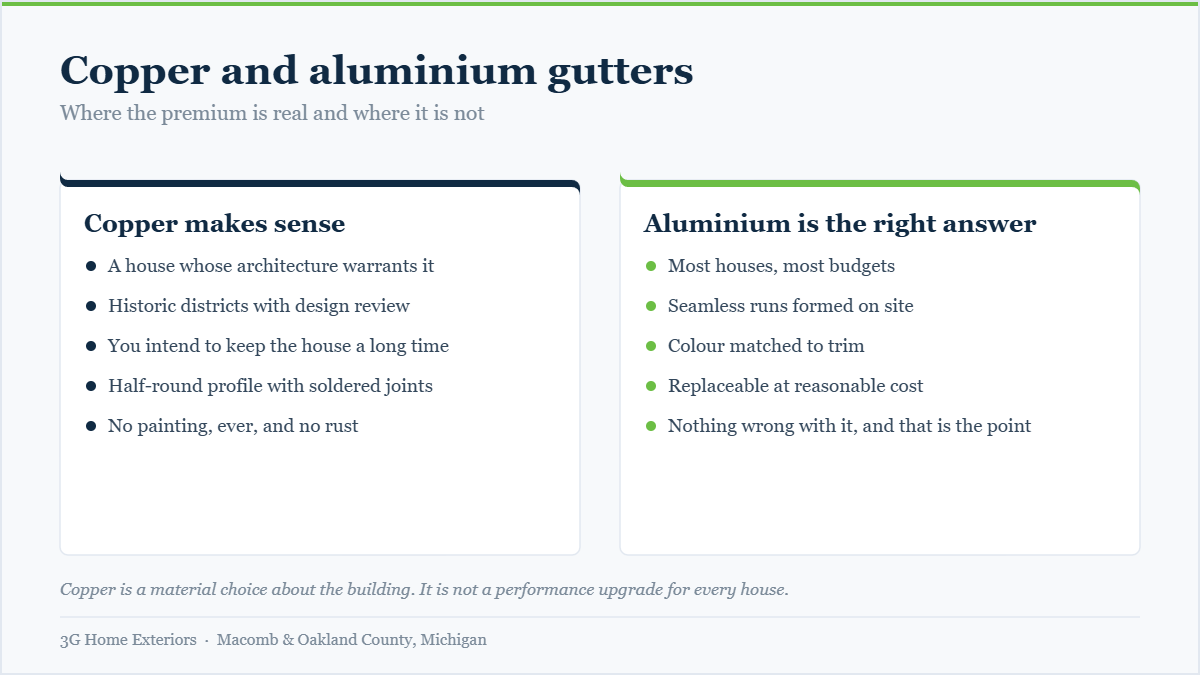
It suits certain buildings. On a period house, a half-round copper gutter on visible brackets is correct in a way that a painted K-style profile is not. This is the reason most copper goes on, and it is a legitimate reason.
What it does not give you
Copper does not improve drainage. A copper gutter that is short an outlet overflows exactly like an aluminium one that is short an outlet. It does not prevent ice dams, which are an attic problem. It does not compensate for poor pitch.
Every rule about sizing, spacing and fall applies unchanged. See how many downspouts a roof needs and why water stands in a new gutter.
Three details that decide whether it lasts
1. Galvanic corrosion. This is the one that ruins copper installations, and it is entirely avoidable. Copper in contact with aluminium or with ordinary steel in the presence of water sets up a reaction that corrodes the other metal. Fasteners, hangers, brackets and flashing in contact with the gutter must be copper or a compatible material.
The same applies upstream. Water running off a copper roof detail onto aluminium components will work on them over time. Ask directly what every fastener and bracket is made of.
2. Soldered or sealed. Copper can be joined either way. Soldering is the reason to use copper. If the joints are being sealed with the same sealant used on aluminium, you have paid for the material and not for what makes it worth having. Ask which, and ask about corners and outlets specifically.
3. Expansion. Metal moves with temperature, and on a long run in a climate with our range that movement is significant. Copper runs need to be detailed to allow it. On very long elevations that can mean expansion joints. A rigidly fixed long run will work at its own joints through every winter.
The staining question
Worth knowing before rather than after. Copper runoff stains what is below it, particularly in the first years while the patina is establishing. Light stone, painted surfaces, concrete and light-coloured siding directly beneath a copper run can pick up green or brown marking.
It is manageable with planning — where the downspouts land, what the water crosses on its way — but it is a real consideration and it is rarely mentioned at the quoting stage.
There is a small side benefit worth noting. Copper runoff suppresses algae growth, which is the same mechanism behind fitting a copper strip at the ridge to deal with roof streaking. See black streaks on the north side of your roof.
Patina, and the impatience problem
Copper goes on bright and shiny. Most people who chose it were picturing the green.
That transition takes years, moving through a dark brown stage first, and it is affected by exposure — sheltered sections change more slowly than exposed ones, so the run can look uneven for a while. Lacquered copper holds the bright finish for a period and then the coating fails unevenly, which usually looks worse than either state.
If you want copper, plan on the patina and be patient with it.
Where it makes sense in our area
Concentrated in a few places, honestly. Birmingham and Bloomfield Hills have the architecture and, in Birmingham, historic districts where exterior changes can require design review and where a correct half-round profile matters. Parts of Royal Oak have older homes with original detail worth matching.
On a postwar ranch in Fraser or a newer colonial in Macomb Township, seamless aluminium formed on site, correctly pitched, with the right number of outlets, is the right answer. There is no shame in that sentence — most of what we install is aluminium and it performs.
A practical note
Copper has scrap value, and installations have occasionally been targets for that reason. Worth a conversation about downspout fixings at ground level on a property that is empty for long periods.
Gutters in Bloomfield Hills
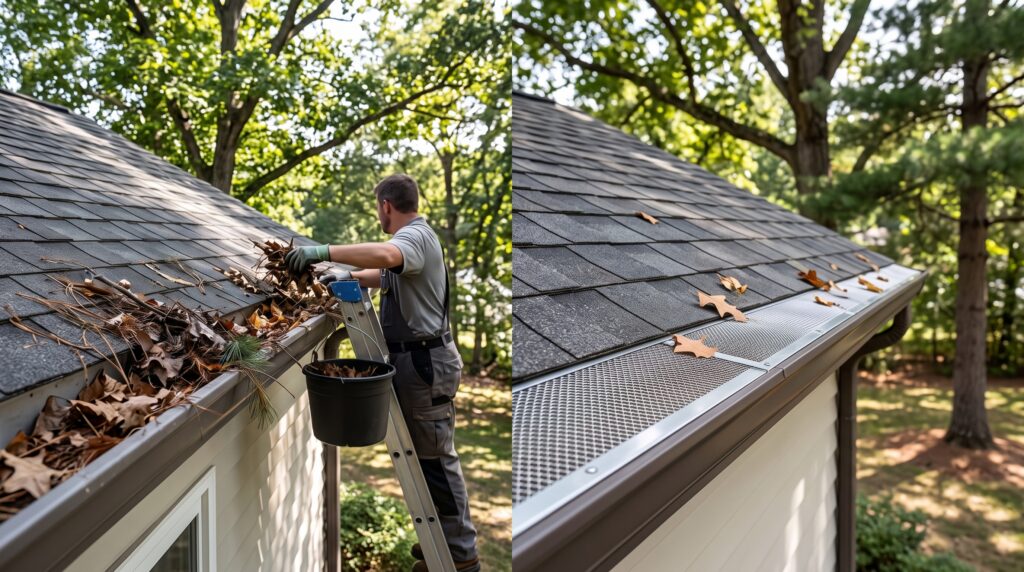
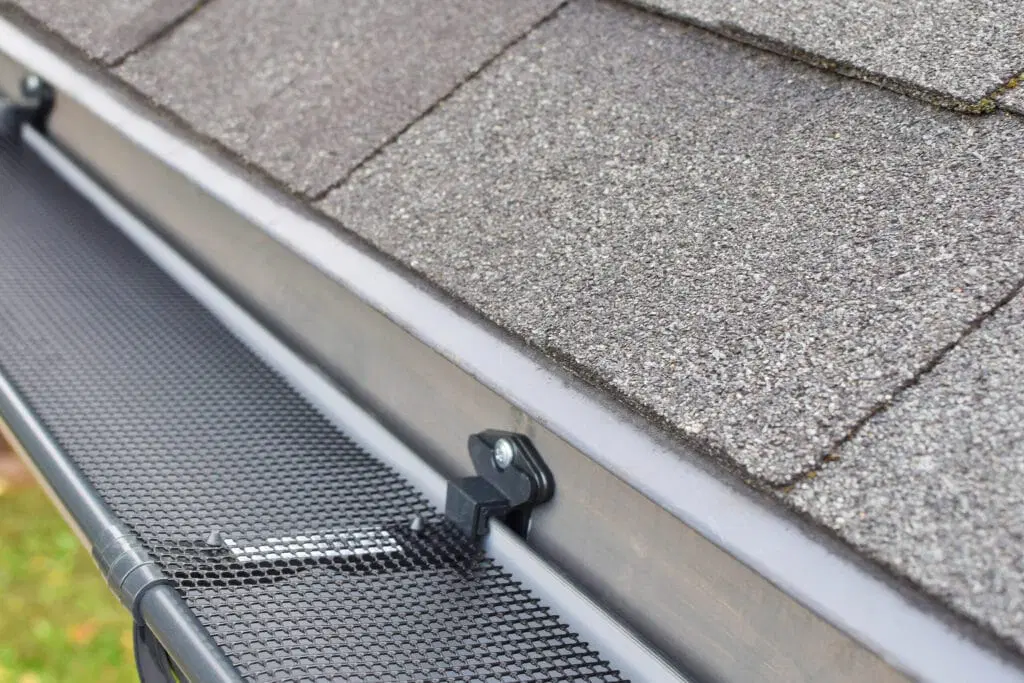
Bloomfield Hills has large wooded lots and long elevations, which is where two copper considerations meet. Long runs mean expansion detailing matters, and heavy tree cover means the gutters will carry a real debris load, so the rigidity advantage is genuine rather than theoretical. It is also where leaf protection is worth specifying at the same time, in a compatible material.
See gutter installation in Bloomfield Hills, or everything we handle in Bloomfield Hills.
Common questions
How long do copper gutters last?
Considerably longer than aluminium when correctly installed with compatible fasteners and soldered joints. The material does not rust through. Service life is decided by the detailing rather than by the metal.
Do copper gutters turn green?
Eventually, through a brown stage first, and the rate depends on exposure. Sheltered sections change more slowly, so a run can look uneven for a period.
Can copper gutters be fitted to any house?
Technically yes. Whether they suit the building is a separate question, and on many houses aluminium is the better-judged choice.
Do copper gutters need different downspouts?
Yes. Mixing copper gutters with aluminium downspouts or fasteners invites galvanic corrosion. The whole system should be compatible.
We will tell you if aluminium is the better call
If copper suits your house we will detail it properly, with soldered joints and compatible fasteners. If it does not, we will say so rather than sell you the more expensive option.
Get a free gutter assessment, or read about copper gutter installation and repair.