One side of the roof has dark streaks running down it. The other side is clean. Nothing about the house is different between the two, and the streaks have been spreading a little each year.
It is algae. It is cosmetic. And the most common response to it does more damage than the algae ever would.
What it is
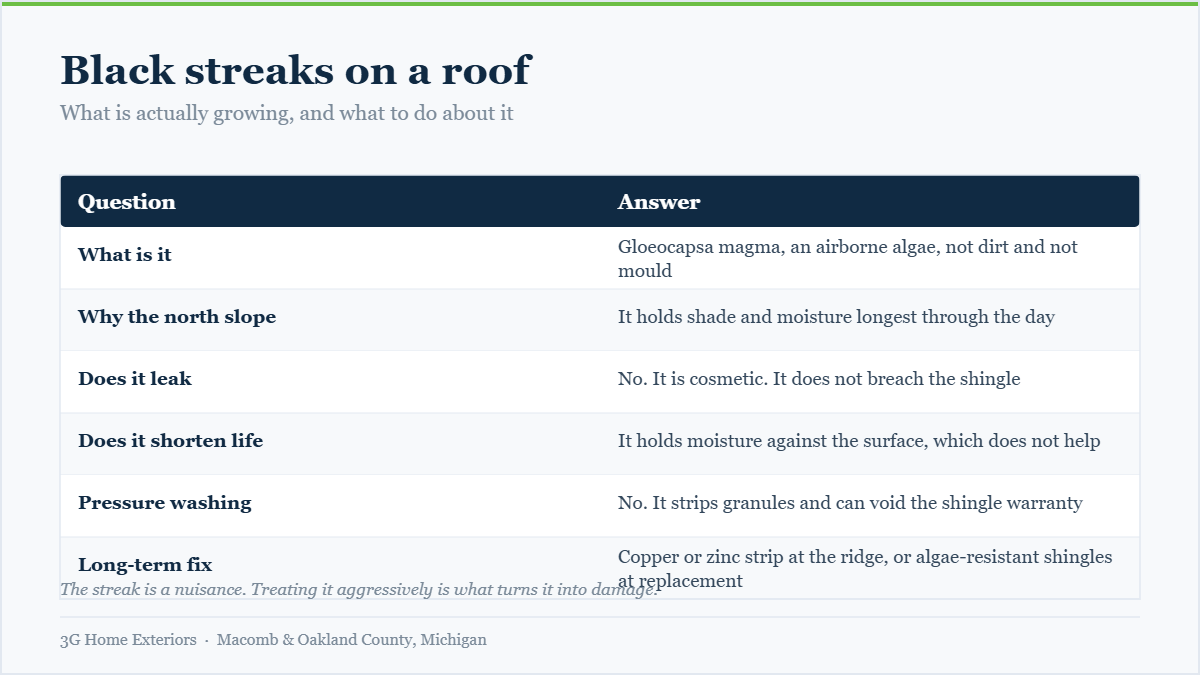
The organism is Gloeocapsa magma, a blue-green algae that travels on the wind and settles on roofs. It is not dirt, not soot, not mould, and not a sign that the shingles are breaking down.
It feeds partly on the limestone filler used in many asphalt shingles, which is why it establishes on a roof and not on the siding beside it. The dark colour comes from a protective sheath the organism develops against sunlight, which is also why it reads as a stain rather than as growth.
The streaking pattern comes from rain. Water carries the colony down the slope, so it spreads in vertical runs from the ridge downward.
Why the north slope
Algae needs moisture. A north-facing slope in Michigan gets the least direct sun through the day, holds dew longest in the morning, and dries last after rain.
South and west slopes dry quickly and take far more ultraviolet light, which suppresses growth. So you get a house with one dark slope and one clean one, which looks alarming and is simply an accounting of where the sun goes.
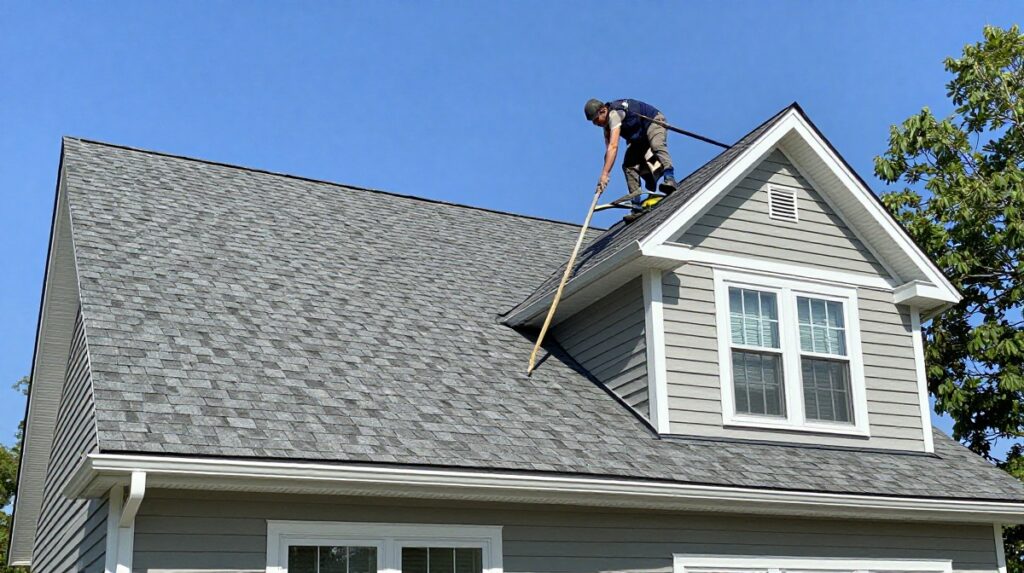
The same logic explains the other places it shows up first: under overhanging trees, below a dormer that casts shade, on the section shaded by a neighbouring house.
Does it damage the roof?
Not in the way people fear. It does not breach the shingle, it does not cause leaks, and a streaked roof can be entirely watertight.
What it does is hold moisture against the surface for longer than the surface would otherwise stay wet. In a climate that averages around 42 freeze-thaw cycles a year across the Great Lakes region, a surface that stays damp longer is not being helped. It is a marginal effect, not a dramatic one.
The honest summary: it is an appearance problem with a mild ageing side effect. It is not a reason to replace a roof, and a contractor who tells you otherwise is selling on a stain.
The wrong answer
Pressure washing an asphalt roof is the single most damaging thing you can do to it.
Granules are what protect the asphalt from sunlight. A pressure washer strips them off, so you trade a cosmetic problem for a genuine one and remove years from the roof life. Most shingle manufacturers exclude pressure washing from their warranties, which tells you how they view it.
Walking a wet, algae-covered slope is also genuinely dangerous. It is slick in a way that is hard to appreciate from the ground.
What actually works
Low-pressure cleaning with an appropriate solution. The method is chemical rather than mechanical: apply, let it work, rinse at low pressure. No scrubbing, no high-pressure nozzle. Ask specifically what is being used and what it does to landscaping below, because runoff has to go somewhere. Expect the streaks to fade over following weeks rather than disappear on the day.
A metal strip at the ridge. Copper and zinc are toxic to algae. A strip installed near the ridge releases trace metal ions every time it rains, and the runoff suppresses growth down the slope. It is the only genuinely long-term measure short of replacement, and it is why you sometimes see a clean band under a copper chimney flashing on an otherwise streaked roof.
Algae-resistant shingles at replacement time. Most manufacturers offer shingles with copper-bearing granules mixed into the surface. If your roof is near replacement anyway and streaking bothers you, specify them. The protection is warranted for a period rather than forever, but it covers the years when a new roof should look new.
Cutting back overhanging branches. More sun and more airflow on the slope means it dries faster. This also reduces what lands in the gutters, which is worth doing regardless. Under heavy cover, pair it with leaf protection.
Streaks versus something worth worrying about
Since you are already looking at the roof, some things genuinely do warrant attention:
- Moss, which is three-dimensional and green rather than flat and dark. Moss lifts shingle edges and holds substantial water. It matters more than algae.
- Bald patches where granules have gone and the surface is smooth and shiny. See what granule loss means.
- Shingles that are cupping, curling or buckling. Shape change is a structural signal in a way that colour change is not.
- Staining concentrated around a chimney, vent or valley rather than spread down the slope, which points at flashing rather than biology.
Before you sell the house
This is the practical reason most people deal with it. A streaked roof reads as neglect in photographs and in a walkthrough, and buyers routinely mistake it for a failing roof. Cleaning it costs a fraction of what it moves in perception.
Worth knowing alongside it: in Michigan, replacing a roof does not raise your assessment. See what the statute actually says.
Roofing in Rochester Hills
Rochester Hills has mature tree cover and a good deal of varied elevation, including slopes and walkout sides that put parts of a roof into permanent shade. Streaking tends to be pronounced there on north and east faces, and it usually appears earlier than on an open lot.
See roofing in Rochester Hills, or everything we handle in Rochester Hills.
Common questions
Are black streaks on a roof mould?
No. It is an algae, Gloeocapsa magma. It is not a health hazard in the way indoor mould is discussed.
Will the streaks come back after cleaning?
Yes, unless something changes the conditions. Cleaning removes the colony. A copper or zinc strip at the ridge is what stops it re-establishing.
Can I clean it myself with bleach?
Roof cleaning solutions are usually diluted and applied at low pressure with care for landscaping and for the person on the ladder. A wet algae-covered slope is genuinely slippery. Most homeowners are better served hiring it out.
Do algae-resistant shingles work?
They meaningfully delay streaking through the warranted period. They are not permanent immunity.
We will tell you if it is only cosmetic
If streaking is the only thing happening on your roof, we will say so rather than quote you a replacement. If there is more going on behind it, you will know that too.
Book a free roof inspection, or read about residential roofing across Metro Detroit.
Source: GLISA, University of Michigan, Great Lakes freeze-thaw cycle data.