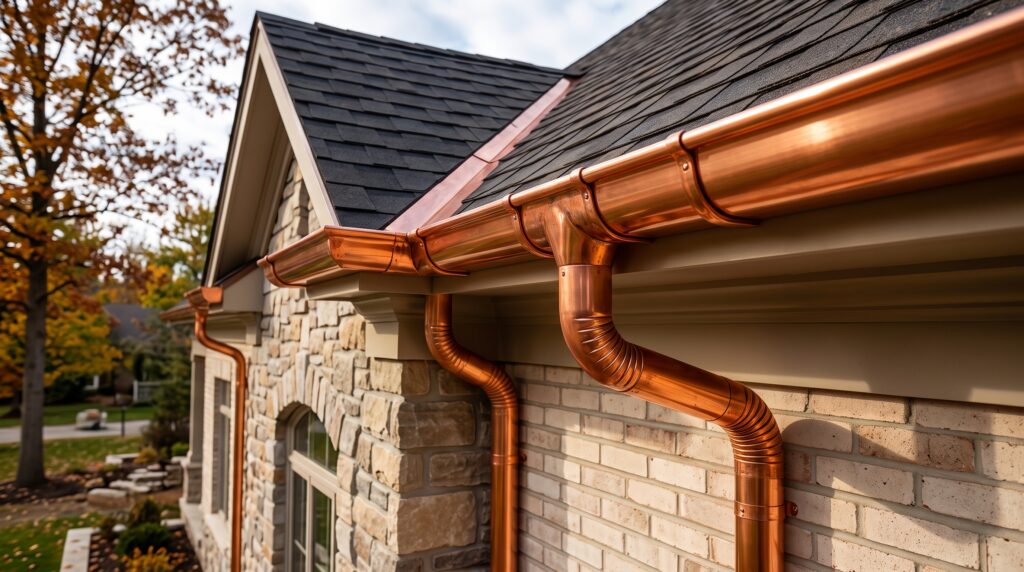
A gutter that overflows in a hard rain is usually not too small. It is usually too far from the nearest downspout.
This is the single most common thing we find on Michigan homes where the gutters “never worked right” — a long, handsome run of seamless aluminum with one outlet at the far end, doing its best to move the water from an entire roof plane through a single opening. The gutter is not the bottleneck. The outlet count is.
The building code does not answer this question
People assume there is a line in the Michigan Residential Code that says how many downspouts a house needs. There is not one for residential gutters. The code has a great deal to say about ice barrier underlayment, about how many layers of shingles you may stack, about snow load — but downspout spacing on a house is left to the installer’s judgment.
That is worth knowing, because it means the number on your estimate is a decision somebody made, not a requirement somebody met. And it is a decision you are allowed to ask about.
The number we actually use
Our working rule is one downspout for every 30 to 40 feet of gutter, and one at each end of a run regardless of length. On a 60-foot run that is typically three or four outlets, not one.
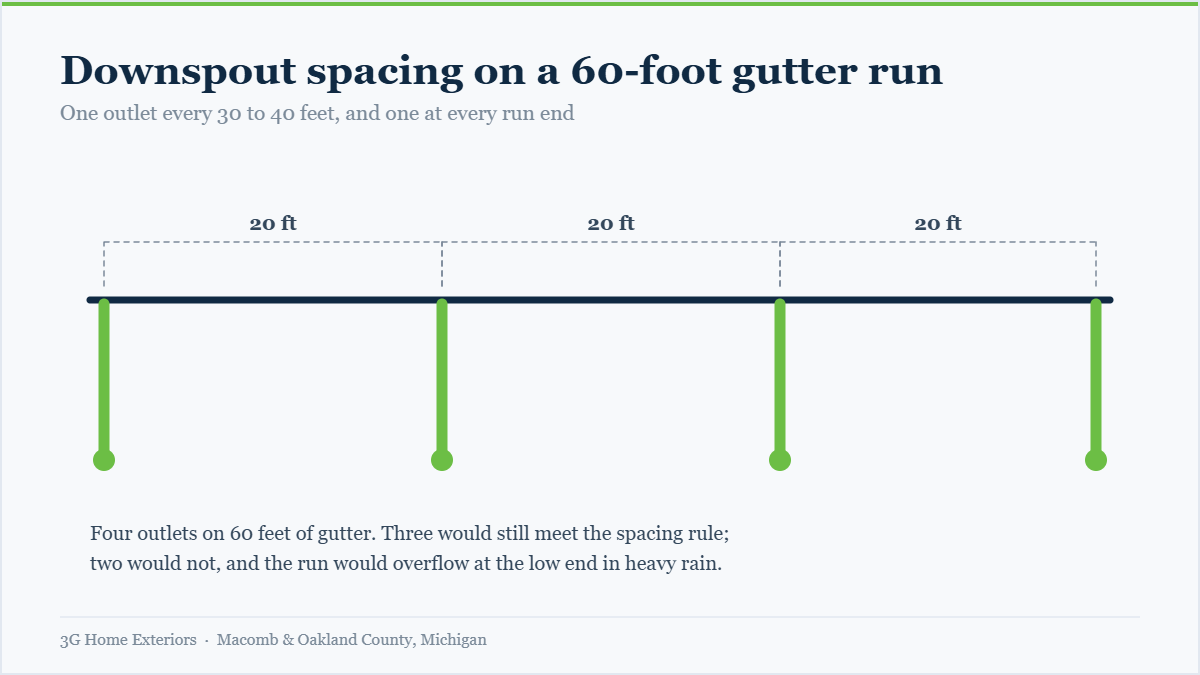
Spacing is the rough guide. The number that actually drives it is roof area. A downspout can only carry so much water per minute, and the roof above the run decides how much arrives. A 2,000 square foot roof plane feeding one gutter needs more outlets than a 700 square foot plane feeding the same length of gutter, even though the gutter measures the same.
So when we walk a house, we are not counting feet of fascia. We are looking at which roof planes drain where, and how much surface sits above each run.
Why roof shape changes the answer
Two houses with identical gutter footage can need very different outlet counts.
- A long, low ranch — common through Fraser, Warren and the older parts of Clinton Township — has big single planes and long runs. These need outlets spread evenly, and they need them at both ends.
- A two-storey colonial drops upper-roof water onto a lower roof. That lower gutter is now handling two roofs at once and almost always needs an extra outlet, or a diverter, or both.
- Valleys concentrate water into one point. A gutter that catches a valley needs an outlet close to where the valley lands, not forty feet down the run.
- Dormers and complex rooflines — the kind we see across Troy and Rochester Hills — create short runs that each need their own outlet even if they are only twelve feet long.
What Michigan adds to the problem
Detroit averages 45 inches of snow a year, with January at 14 inches and February at 12.5, according to NOAA’s 1991–2020 climate normals for Detroit Metro Airport. That snow does not leave all at once. It melts in cycles, refreezes overnight, and melts again.
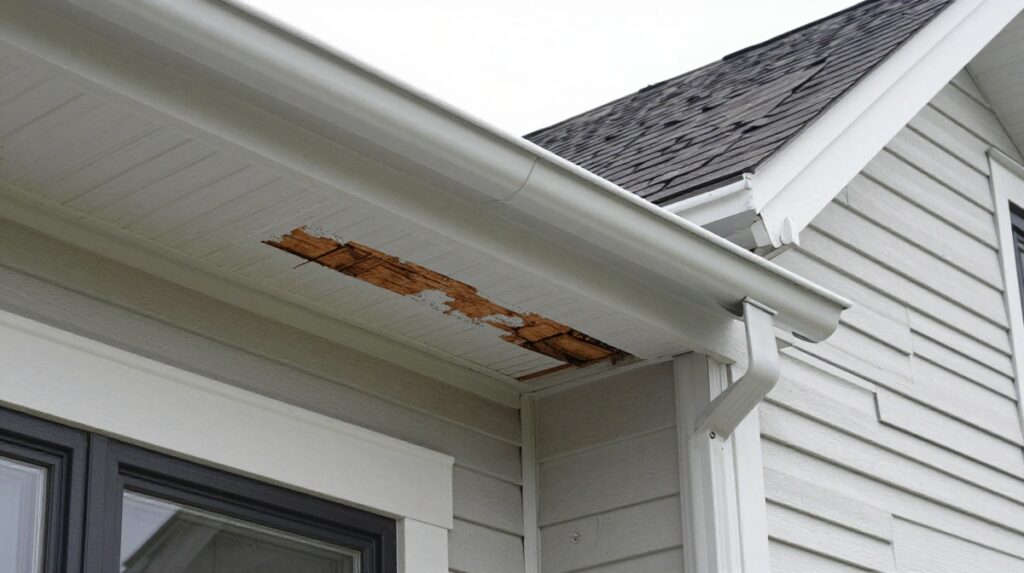
Here is what that means for outlet count. A gutter that is marginal in a summer downpour is merely annoying — it spills for ten minutes. A gutter that is marginal in February holds standing water that freezes. Ice adds weight the hangers were never sized for, and the run begins to pull away from the fascia. We see the result every spring: sagging gutters, split seams, and fascia that has been wet for four months.
More outlets mean the run drains faster between freeze cycles and holds less water when the temperature drops. That is not a small detail in this climate. We wrote about the mechanics of that in gutters in a Michigan winter.
How to tell you are short an outlet
You do not need to get on a ladder to diagnose this. Watch the house in a hard rain and look for:
- Water spilling over the front lip in one particular spot, every time, always the same place
- A run that overflows at one end while the other end stays dry
- Staining or streaking on the fascia below a specific point
- A trench, bare patch, or channel worn into the mulch or lawn directly under the gutter line
- Splashback marks on siding roughly a foot above grade
- Ice forming in a consistent spot each winter while the rest of the run stays clear
Any one of those points to a spot where water is arriving faster than the nearest outlet can take it away.
Bigger gutter or more downspouts?
Both help, and they solve different parts of the problem. Moving from 5-inch to 6-inch gutter increases how much water the trough can hold and move at once. Adding a downspout increases how fast that water can leave. On a run that overflows in one predictable spot, an outlet usually fixes it more cheaply and more completely than upsizing the whole run.
On a run that overflows along its entire length, the trough is genuinely undersized and the size change is the right answer. We go through that decision in detail in how to size a Michigan roofline.
The outlet is only half the job
Adding a downspout solves the gutter and creates a new question: where does that water land? An outlet that dumps against the foundation has moved the problem from the roofline to the basement.
Every downspout we add gets an extension, a buried line, or a connection to existing drainage — far enough out that the water is leaving the house, not circling back to it. That is the part homeowners most often inherit as a problem from a previous installer, and it is covered under our exterior drainage work.
Gutter work in Macomb Township and nearby
Macomb Township is mostly newer construction, which means most homes here are on their first set of gutters — and first-round builder gutters are where outlet count is cut most often. The trough is usually adequate. The number of outlets frequently is not, because each one is a hole in a wall and a length of pipe.
If your house went up in the last twenty years and the gutters have never quite kept up, the outlet count is the first thing worth checking. See gutter installation in Macomb Township, or the full picture of what we do in Macomb Township.
Common questions
How many downspouts should a 40-foot gutter have?
At minimum two, one at each end. If the roof plane above that run is large, or a valley empties into it, a third in the middle is often the right call.
Can you add a downspout to an existing gutter?
Yes. It does not require replacing the run. The outlet is cut into the existing trough, and the drop, elbows and extension are added below. It is one of the least expensive fixes in exterior work.
Does adding a downspout stop ice dams?
No. Ice dams are an attic heat and ventilation problem, not a gutter problem. More outlets reduce how much water sits in the gutter and refreezes, which limits gutter damage — but the dam itself forms on the roof and is fixed inside the attic.
Is a permit required to add a downspout in Michigan?
Gutter work generally falls under maintenance rather than structural alteration, and most municipalities in Macomb and Oakland County do not list it as a separate permit item. Requirements vary by city, so we confirm with the local building department before any job.
Get your gutter run looked at
If one spot on your house overflows every time it rains hard, that is a solvable problem and usually not an expensive one. We will walk the roofline, look at which planes drain where, and tell you plainly whether you need another outlet, a larger trough, or nothing at all.
Book a free gutter inspection, or read more about seamless gutter installation across Metro Detroit.
Sources: NOAA 1991–2020 U.S. Climate Normals, Detroit Metro Airport. Michigan Department of Licensing and Regulatory Affairs, Maintenance & Alteration Contractor classifications.