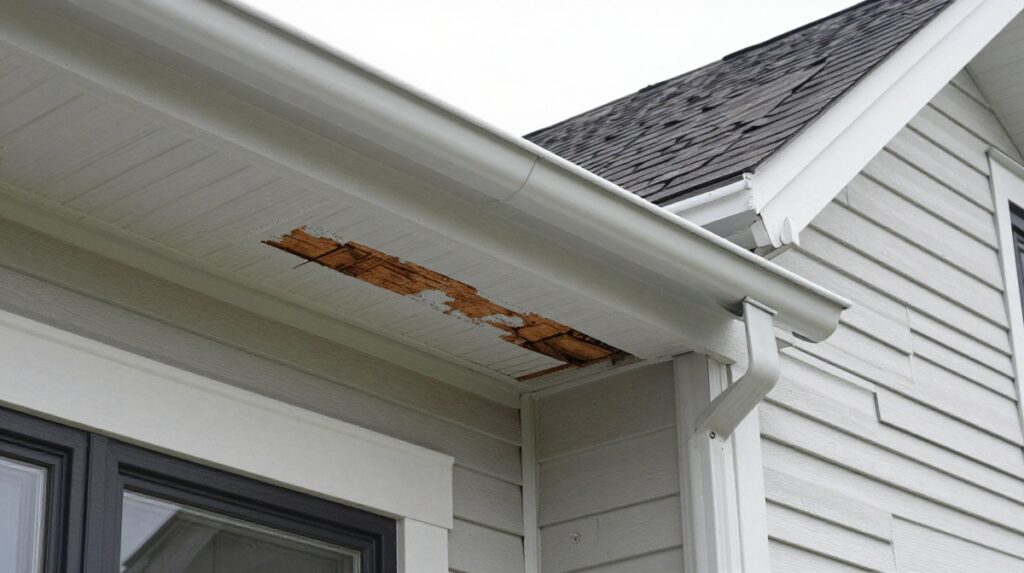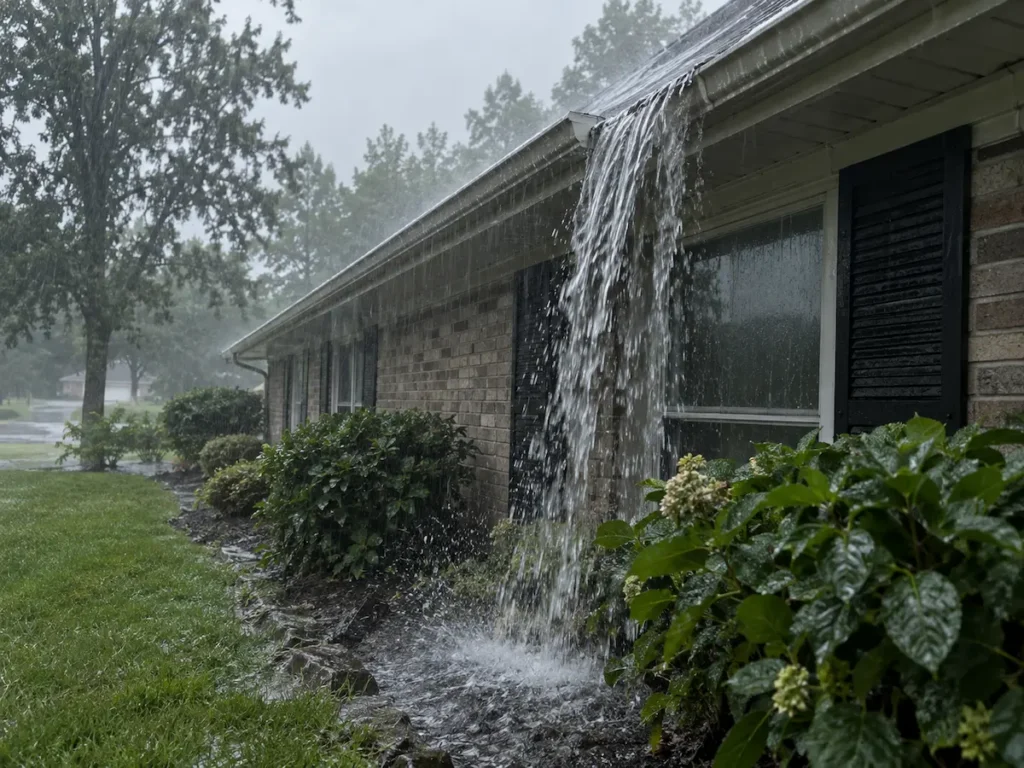
A roof sheds a great deal of water. Every inch of rain on a 2,000 square foot roof is well over a thousand gallons, and all of it arrives at four or five points around the building.
The gutters are the easy part. The question that decides whether you have a dry basement is what happens in the first ten feet after the water leaves the downspout.
The thing that matters most is free
Before any product: the ground next to the house should fall away from it. If the first few feet of soil slope back toward the foundation, no drainage accessory will save you, because you are asking a plastic pipe to fight gravity across your whole lot.
Check it with a hose on a dry day, or just stand and watch during the next real rain. Look for water pooling against the wall, mulch washed into a trench line, or a visible depression along the foundation.
Soil settles over years, and mulch and landscaping get added on top season after season, which slowly raises the bed and reverses the fall. Restoring the grade is often the cheapest fix available and the one nobody sells.
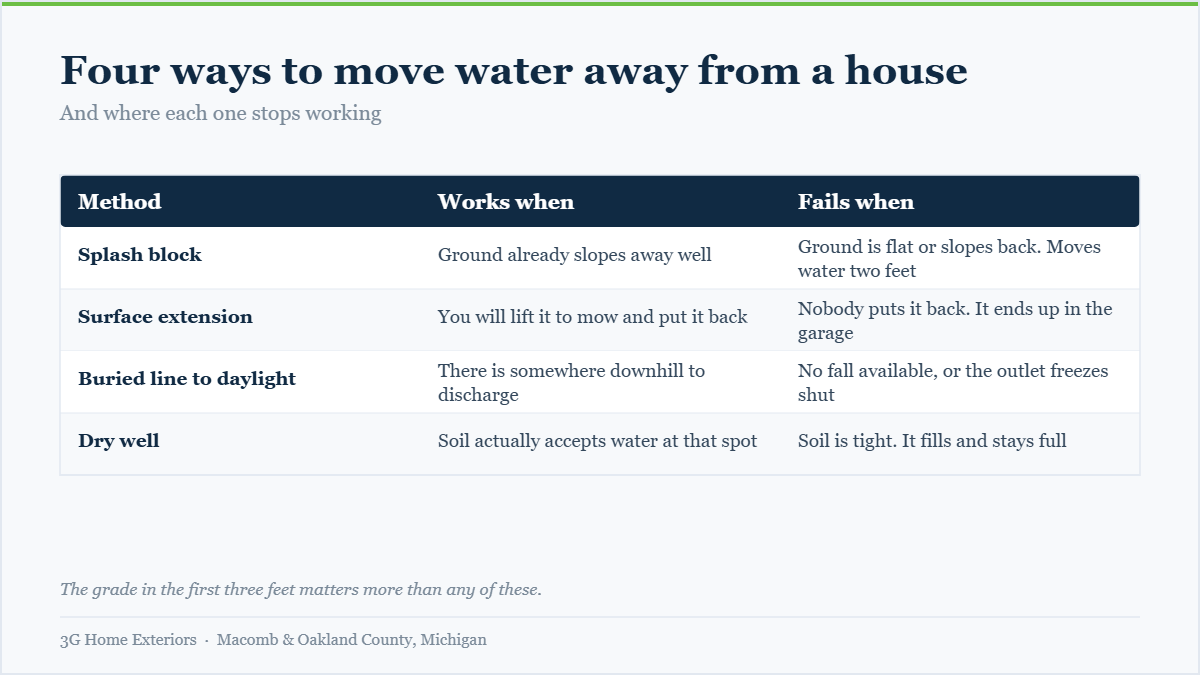
Splash blocks
The concrete or plastic tray under the downspout. Its job is to stop erosion and direct water a short distance out.
It moves water about two feet. That is sufficient where the ground already falls away properly, and close to useless where it does not. Splash blocks also shift over time and end up pointing somewhere unhelpful, so they are worth checking after winter.
Surface extensions
A length of pipe or a flexible accordion tube carrying water four to eight feet from the wall.
The honest problem with surface extensions is human. They have to be lifted to mow and replaced afterward, every time, for years. On most houses they end up detached in the garage after the second summer, and the downspout is back to discharging at the foundation.
Where they work is where the run is out of the way of mowing entirely, or where somebody genuinely will keep putting them back.
Buried lines to daylight
A solid pipe from the downspout, underground, to a discharge point somewhere lower on the property. Invisible, nothing to mow around, nothing to reattach.
Two requirements. First, there has to be fall — somewhere for the water to go that is lower than the inlet. On a flat lot there may not be. Second, the outlet has to stay open. A buried line that freezes at the discharge or silts up becomes a pipe full of standing water, and in Michigan that means a pipe full of ice.
Details that decide whether it lasts: a pop-up emitter or grated outlet that can be cleared, enough fall to self-drain rather than hold water, and access points so it can be flushed.
One thing to check locally — many municipalities have rules about where roof water may be discharged, including restrictions on connecting to the sanitary sewer and on discharging onto a neighbour property. Ask your building department before burying anything.
Dry wells
An excavated pit, filled with stone or fitted with a chamber, that takes the water and lets it soak away underground.
Useful where there is no lower point on the property to discharge to. Entirely dependent on the soil actually accepting water at that location — a dry well in tight soil fills up and stays full, and you have built an underground reservoir next to your house.
Before committing to one, the soil at that specific spot needs testing. Two houses on the same street can behave differently.
French drains are a different thing
Worth separating, because the term gets used for everything.
A French drain is a perforated pipe in a gravel trench, designed to collect water that is already in the ground or moving across the surface and carry it elsewhere. It is a collection system.
A downspout line is a solid pipe carrying a known volume from a known point. It is a conveyance.
Connecting a downspout into a perforated French drain puts a large, concentrated volume into a system meant to gather diffuse water, and it will often discharge that volume straight back into the ground beside the foundation. They are sometimes combined deliberately and correctly, but not by accident.
What Michigan adds
Detroit averages 45 inches of snow a year, and the Great Lakes region averages around 42 freeze-thaw cycles annually. Two consequences for drainage.
Discharge points freeze. A buried line that ends at a low spot where water collects will freeze shut at the outlet, and then the whole line backs up. Where the outlet sits and whether it can drain itself matters more here than in a mild climate.
Snow melt is a different load from rain. A February thaw releases weeks of accumulated snow over a day or two, often into ground that is still frozen and cannot absorb anything. That is when basements take water, and it is a scenario a system sized only for summer rain may not handle.
Where this connects back to the roofline
Drainage problems often start as gutter problems. A run that is short an outlet overflows in one place and concentrates water at the foundation there — see how many downspouts a roof needs. A run that holds water and ice ends up dumping wherever the ice allows — see why water stands in a new gutter.
Adding an outlet without planning where that water lands simply creates a new discharge point at the wall. The two decisions belong together.
Signs your current arrangement is not working
- Water pooling against the foundation after rain
- A trench or channel worn into mulch or lawn beneath the gutter line
- Splashback staining on siding about a foot above grade
- Basement or crawl space dampness that tracks with rainfall
- Efflorescence, the white powdery deposit, on foundation walls inside
- Settling or cracking in a patio or drive next to the house
- Ice sheets forming in the same spot each winter
Drainage in Clarkston
Clarkston and Independence Township sit in hilly country with lakes and heavy tree cover. Slope is an advantage for drainage and a complication for everything else — water arrives from uphill as well as off your own roof, and a system that only considers the house misses half the load. Tree cover also means outlets and emitters need checking, because what falls in autumn ends up in them.
See gutters and drainage in Clarkston, or everything we handle in Clarkston.
Common questions
How far from the house should a downspout discharge?
Further than most arrangements manage. The right distance depends on your grade and soil. What matters is that the water leaves and does not return, which on a flat lot with tight soil can mean a considerable run.
Are buried downspout lines a good idea in Michigan?
They work well when there is fall to a discharge point and the outlet can be kept clear and does not freeze shut. On a flat lot with nowhere to discharge, they are harder to do well.
Will a dry well work on my property?
Only if the soil at that spot accepts water. It needs testing at the location rather than assuming from the neighbourhood.
Can I connect my downspout to the French drain around my foundation?
Not casually. A foundation drain collects groundwater. Feeding a large concentrated roof volume into it can deliver that water straight back to the foundation.
We will look at the whole path
We look at the roofline and where the water ends up as one system, because separating them is how houses end up with good gutters and wet basements.
Book a free assessment, or read about exterior drainage across Metro Detroit.
Sources: NOAA 1991-2020 U.S. Climate Normals, Detroit Metro Airport; GLISA, University of Michigan, Great Lakes freeze-thaw cycle data. Check local discharge rules with your municipality.
Need New Gutters in Metro Detroit?
3G Home Exteriors installs seamless gutters, copper gutters and gutter guards across Macomb and Oakland County. Family-owned in Fraser since 2011, licensed and insured.
Seamless gutters near you: Fraser · Clinton Township · Sterling Heights · Macomb Township · Shelby Township · Rochester Hills · Troy · Utica