The gutters went up three weeks ago. It rained, it stopped, and there is still an inch of water sitting in the run. Nobody expects that from new work, and it is worth saying clearly: it is not normal, and it is not the material’s fault.
A gutter is a sloped channel. If water stands in it after the rain has stopped, something about the way it was hung is wrong. Here is what we check, in order.
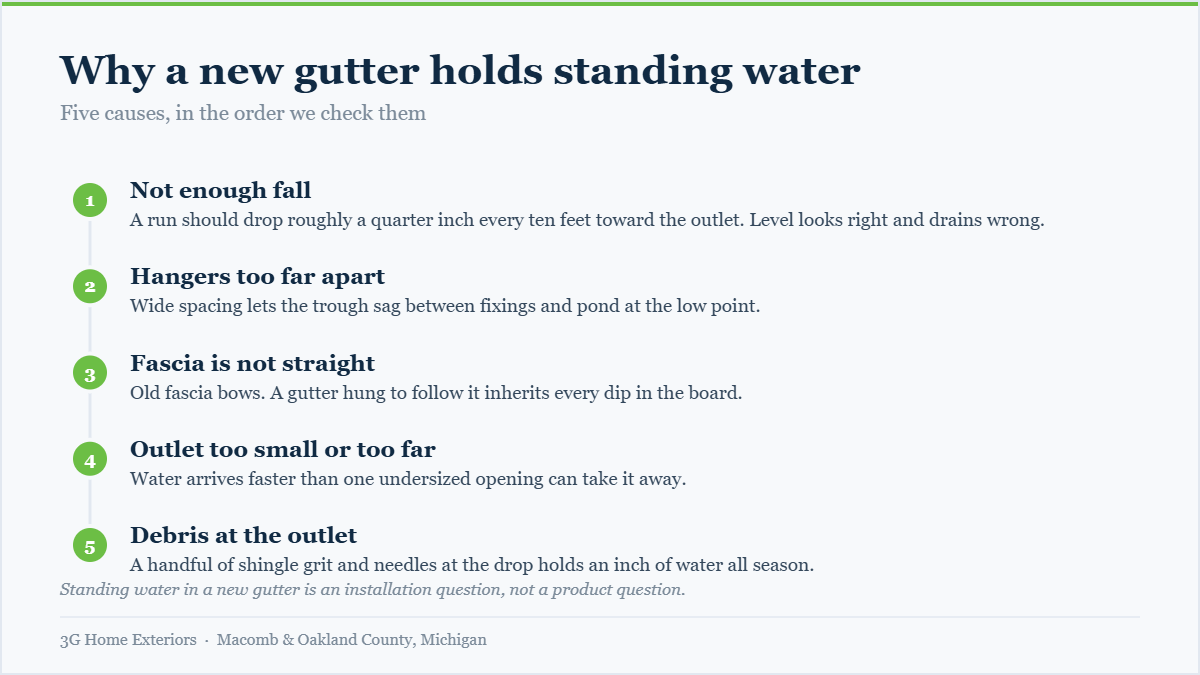
1. The run does not have enough fall
This is the cause most of the time. A gutter has to be pitched toward the outlet — our working figure is about a quarter inch of drop for every ten feet of run. On a forty-foot run that is an inch of total fall from the high end to the downspout.
That is a small number, and it is easy to lose. An installer eyeballing the line against the fascia, or setting the run dead level because level looks tidier from the ground, ends up with a trough that holds water in the middle.
The irony is that a properly pitched gutter looks very slightly crooked if you stare at it. A gutter that looks perfectly parallel to the roofline is often the one that does not drain.
2. The hangers are too far apart
Aluminum is soft. A run supported every four feet will sag between the fixings under the weight of water, and once it sags it ponds at the dip. We space hangers closer than that, and closer still on runs that carry snow load or a large roof plane above them.
You can see this one from the ground. Look along the bottom edge of the gutter against the fascia line. A gentle, even taper toward the downspout is correct. A wavy line that rises and falls between fixings is sag.
3. The fascia board is not straight
Here is the one that catches good installers on older houses. A gutter hung directly off the fascia inherits whatever shape the fascia has. On a house from the 1950s or 60s the fascia has usually taken on a bow — from age, from a previous gutter that leaked and rotted it, from settling.
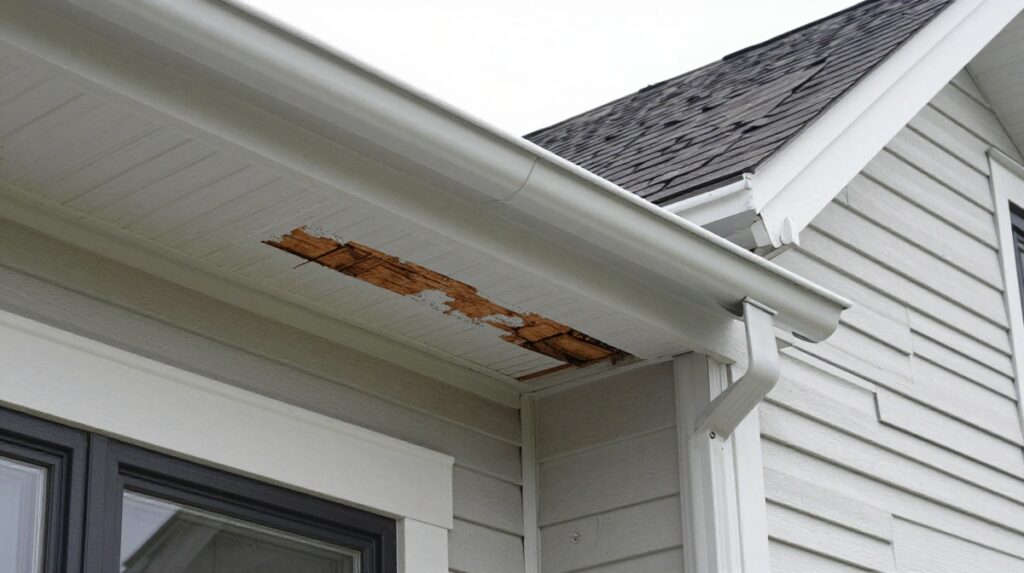
Hang a new gutter tight to a bowed board and you have just reproduced the bow in aluminum. The correct answer is to set the run to its own pitch line and shim it off the fascia where the board dips, or to replace the fascia if it has gone soft. The wrong answer, and the fast one, is to follow the board.
This is why we look at fascia and soffit condition before quoting gutters on an older house — through Royal Oak, Fraser and the older parts of Clinton Township, the board is frequently the real job.
4. The outlet is undersized or too far away
Sometimes the pitch is right and the water still cannot get out fast enough. If one outlet is serving a long run fed by a large roof plane, the trough backs up during heavy rain and drains slowly afterward.
The fix is another outlet rather than a steeper pitch. We went through how we count them in how many downspouts a Michigan roof actually needs.
5. There is debris sitting at the drop
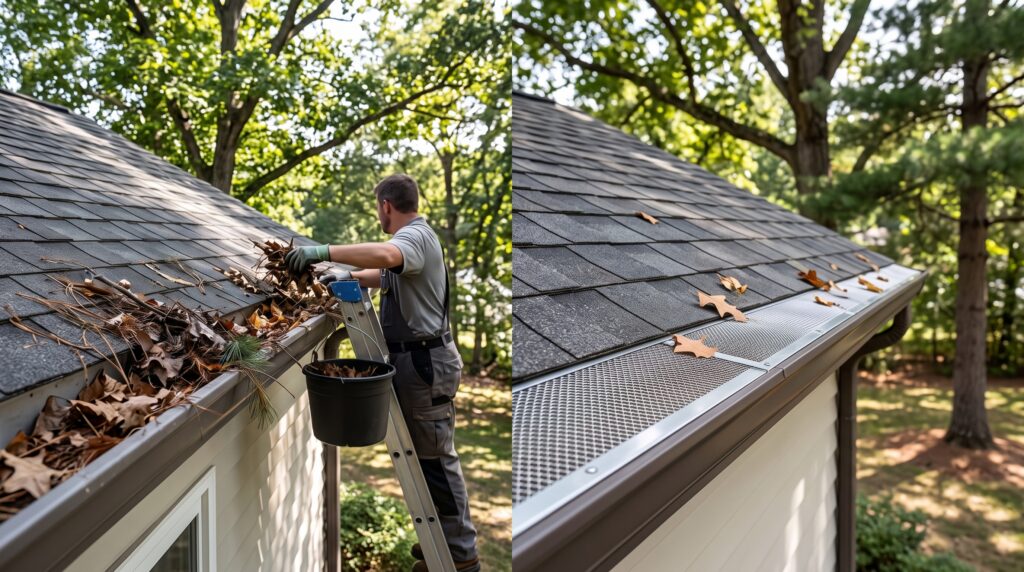
The simplest cause, and worth ruling out before anyone is blamed. New roofs shed loose granules for months. Those granules wash down, collect at the outlet, and combine with pine needles into a plug that sits right at the opening. The run drains slowly, then not at all.
Under heavy tree cover — the kind that defines Birmingham, Clarkston and much of northern Oakland County — this happens fast enough that leaf protection is worth costing out at the same time as the gutters.
Testing it yourself
You need a garden hose and ten minutes.
- Run water into the gutter at the end furthest from the downspout.
- Watch where it goes. It should move steadily toward the outlet without pooling.
- Shut the hose off and wait five minutes.
- Look along the run. A film of moisture is fine. Standing water you could measure is not.
If it pools in the middle, the pitch or the hangers are the issue. If it pools only at the far end near the outlet, look at the drop itself for a blockage or a crushed elbow.
Why standing water matters in Michigan
In July, standing water in a gutter is a mosquito nuisance and a slow corrosion problem at the seams.
In January it is structural. Detroit averages 45 inches of snow a year, and water that cannot drain freezes in place. Ice is heavy, it expands, and it works at seams and hangers. A run that ponds in summer is a run that will pull away from the fascia within a few winters — and that is how a gutter problem becomes a fascia and soffit problem.
That is the real cost of standing water. It is not the water. It is the February after it.
What to say to whoever installed it
Standing water in a run under warranty is a legitimate callback, and a reputable installer will re-pitch it. Useful phrasing:
- “This run holds water after the rain stops. Can you re-check the pitch?”
- “What fall did you set per ten feet?”
- “What is the hanger spacing on this run?”
- “Is the fascia straight here, or is the gutter following a bow?”
Those four questions will tell you quickly whether you are dealing with someone who measured or someone who eyeballed.
Gutters in Sterling Heights
Sterling Heights is the largest city in Macomb County and much of its housing stock went up between the 1960s and the 1980s — old enough that original fascia is often bowed or soft, new enough that gutters have typically been replaced once already. That combination is exactly where we find new gutters hung to old, crooked boards.
See gutter installation in Sterling Heights, or the full range of work we do in Sterling Heights.
Common questions
How much slope should a gutter have?
Roughly a quarter inch of fall per ten feet toward the outlet. Long runs are sometimes pitched from a high point in the middle toward outlets at both ends.
Is a little water in the gutter normal?
A film or a few damp spots, yes. Measurable standing water hours after the rain stopped, no.
Can standing water be fixed without replacing the gutter?
Usually. Re-pitching a run, adding hangers or shimming off a bowed fascia are all adjustments to the existing gutter.
Does standing water mean the gutter is too small?
Not by itself. Size affects how much water a run can carry during a storm. Standing water after the storm is about pitch and drainage, not capacity.
We will check the pitch
If a run on your house holds water, we will look at the pitch, the hanger spacing and the fascia behind it, and tell you which one it is — including if the honest answer is that it needs nothing but the outlet cleared.
Book a free gutter inspection, or read about seamless gutters across Metro Detroit.
Source: NOAA 1991–2020 U.S. Climate Normals, Detroit Metro Airport.