Gutters are the cheapest part of this story. By the time most people call us about sagging gutters, the gutter is no longer the problem, and replacing it on its own would be putting new metal onto wood that cannot hold a screw.
Here is how the sequence runs, and where it is still inexpensive to interrupt.
What these two things actually do
The fascia is the board running horizontally along the roof edge, closing off the ends of the rafters. It carries the gutter. Everything the gutter does depends on that board being sound.
The soffit is the underside of the overhang, the panel you see when you stand beneath the eave and look up. On most houses it is also the intake for attic ventilation, either through perforated panels or through vents set into it.
That second job is easy to overlook and it matters enormously. Attic ventilation works by drawing cool air in at the soffit and exhausting warm air at the ridge. Damage the soffit, or block it, and you have interfered with the system that keeps the attic dry.
The sequence
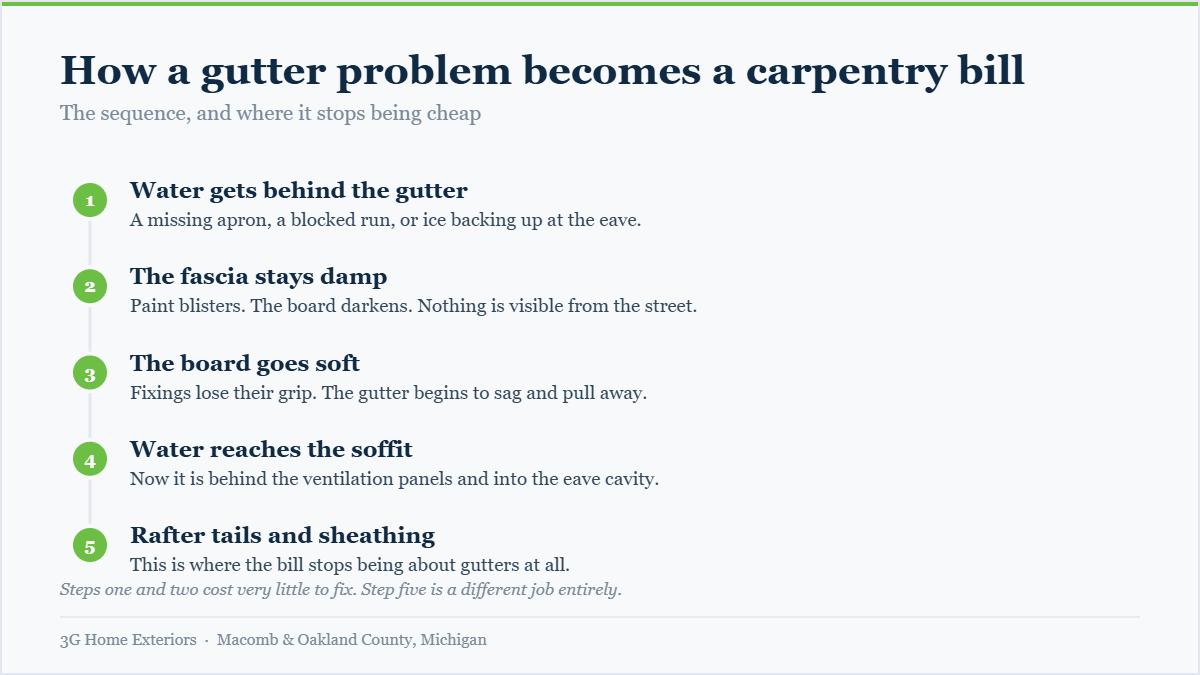
Water gets behind the gutter. Three usual routes. A missing gutter apron, so runoff from the deck edge travels down the back of the gutter rather than into it. A blocked run that overflows backward. Or ice at the eave backing meltwater up and behind.
The fascia stays damp. Paint blisters and peels. The board darkens. This stage is entirely invisible from the ground, and it can run for years.
The board goes soft. Now the gutter fixings have nothing to bite into. The run begins to sag, which makes it hold water, which puts more weight on fixings that are already losing their grip.
Water reaches the soffit. Staining appears on the underside of the eave. Panels sag or pull loose. Ventilation is compromised, which affects the attic, which affects the roof.
Rafter tails and sheathing. The ends of the roof framing are right behind the fascia. When rot reaches them the job is no longer carpentry trim, and the cost is in a different bracket.
Why Michigan runs this sequence faster
Two things.
Ice. Detroit averages 45 inches of snow a year, with January at 14 inches. A gutter that holds ice holds it for weeks, and every thaw pushes water at the eave detail. That is months of wetting per winter, not hours.
Freeze and thaw. The Great Lakes region averages around 42 freeze-thaw cycles a year. Wet wood that freezes and thaws repeatedly fails considerably faster than wood that simply gets wet and dries.
A fascia board taking runoff from behind in Metro Detroit is wet through most of the winter and frozen through much of it. That is why boards here fail in ways they do not in milder places.
Checking yours
You can do most of this from the ground, and the rest from a ladder at the eave.
From the ground:
- Sight along the gutter line. Dips, sags and sections sitting lower than others.
- Look at the fascia paint. Blistering, peeling and dark streaking are the early signals.
- Look up at the soffit from beneath. Staining, sagging panels, gaps.
- Look for daylight where the soffit meets the wall, or panels that have dropped at one end.
From a ladder, carefully:
- Press the fascia with a thumb. Sound wood does not give.
- Look at the gap between the gutter back and the board. Staining there means water has been running.
- Check whether the metal from the roof edge actually reaches into the gutter. We covered that in gutter apron versus drip edge.
Two other signs that point here
Wildlife. Squirrels, birds and wasps get into eaves through failed soffit. If something is living in your overhang, there is an opening, and openings in soffits are usually rot.
Attic problems that seem unrelated. Damaged or blocked soffit means the attic cannot draw air. That shows up as condensation, frost on nails, and ice dams. Several apparently separate problems frequently share this one cause.
The order to do the work in
This matters, and it is where money gets wasted.
Replacing gutters without addressing soft fascia is spending on metal that will sag again, because the fixings have nothing to hold. Replacing fascia without finding out why it got wet means doing it again.
The sequence that works:
- Find the water route. Missing apron, insufficient outlets, blocked run, ice.
- Replace whatever wood has failed, back to sound material.
- Restore soffit ventilation, and check the attic end of it at the same time.
- Fit the gutter, with the eave metal correct.
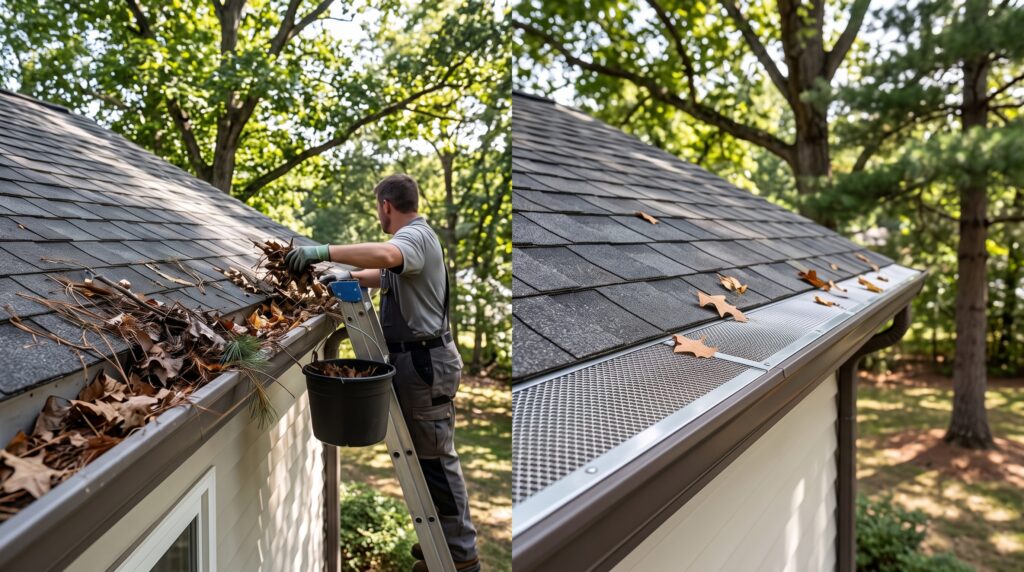
- Deal with what caused the blockage — clearing, or leaf protection under heavy tree cover.
Material choices
Fascia and soffit can be replaced in wood, in aluminium, or in a composite. Wood matches an older house and takes paint. Aluminium and composite do not rot and need far less attention.
A common and sensible middle course is aluminium wrapping over sound wood, which protects the board while keeping the structure. It only works where the wood underneath is genuinely sound — wrapping rot seals moisture in and hides the progression, which is one of the less helpful things we find on houses.
Ask specifically whether the board underneath is being replaced or covered.
Gutters and trim in Royal Oak
Royal Oak has a large stock of older homes with original trim detail worth keeping, and original fascia that has usually taken decades of runoff. It is a city where the right answer is often repair and protect rather than replace, and where it is worth looking at the board before assuming anything.
See gutter work in Royal Oak, or everything we handle in Royal Oak.
Common questions
Can fascia be replaced without replacing the gutters?
The gutters have to come off to get at the board, so it is usually done together. If the gutters are sound they can be refitted.
How do I know if my fascia is rotten?
Press it. Sound wood is firm. Soft, spongy or crumbling wood has failed. Blistering paint and dark streaking are the earlier warnings.
Does soffit damage affect my roof?
Yes. Soffit is normally the intake for attic ventilation. Damaged or blocked soffit means the attic cannot breathe, which contributes to condensation and ice dams.
Can I just wrap the fascia in aluminium?
Only if the wood behind it is sound. Wrapping rotten wood conceals the problem and keeps the moisture in.
We will check the board before quoting the gutter
Any gutter estimate from us includes looking at the fascia behind the existing run and the soffit beneath it. If the wood is sound, that is good news and we will say so. If it is not, you will know before you spend money on metal.
Book a free inspection, or read about seamless gutters across Metro Detroit.
Sources: NOAA 1991-2020 U.S. Climate Normals, Detroit Metro Airport; GLISA, University of Michigan, Great Lakes freeze-thaw cycle data.
Need New Gutters in Metro Detroit?
3G Home Exteriors installs seamless gutters, copper gutters and gutter guards across Macomb and Oakland County. Family-owned in Fraser since 2011, licensed and insured.
Seamless gutters near you: Fraser · Clinton Township · Sterling Heights · Macomb Township · Shelby Township · Rochester Hills · Troy · Utica