A brown ring on the bedroom ceiling means the roof is leaking. Usually. In a Michigan January, often not.
Every winter we get calls about ceiling stains that turn out to have nothing to do with the roof covering. The shingles are fine. The flashing is fine. The water is coming from inside the house — warm, humid indoor air rising into a cold attic and condensing on the underside of the deck, then dripping back down.
The stain looks identical. The repair is completely different, and so is the bill. Telling them apart before anyone climbs a ladder is worth doing.
Timing tells you the most
Start with one question: does the stain change when it rains, or when it gets cold?
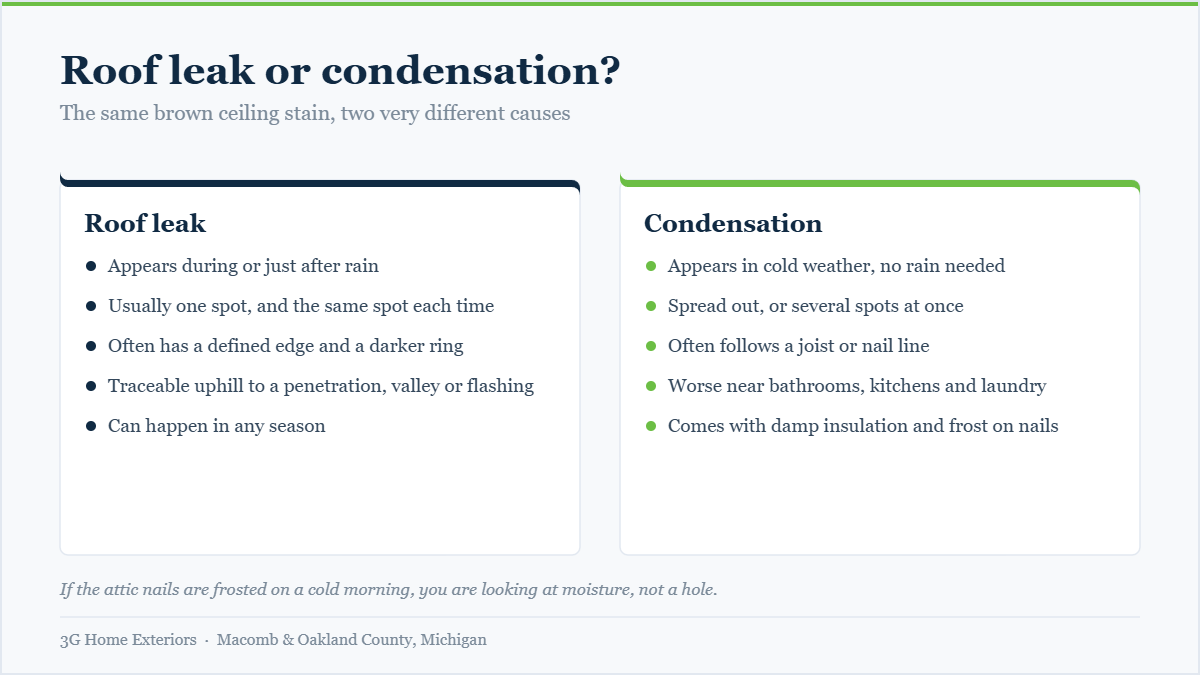
A roof leak tracks rain. It appears during a storm or shortly after, and it stops when the weather clears. It repeats with the weather, not the calendar.
Condensation tracks temperature. It shows up on the coldest stretches of the year, often with no rain at all. In Michigan that means late December through February, when Detroit averages 14 inches of snow in January alone and attic temperatures sit well below the dew point of the air rising into them.
If your stain appeared during a dry cold snap, it is not the roof covering.
Where the stain sits
Leaks are local. Water enters at one point — a nail hole, a cracked boot around a plumbing vent, a failed step flashing at a wall, a valley that has worn through — travels along the deck or a rafter, and drops at one place. You get a defined spot, usually with a darker ring, and it returns in the same spot.
Condensation is diffuse. It forms across the whole underside of the deck, so it drips in several places at once, or it soaks a stretch of insulation that then stains a broad, soft-edged area. It often follows a line — a rafter, a row of nails — because those are the coldest points where moisture condenses first.
Several stains that appeared at the same time is a strong signal you are dealing with moisture, not a hole.
What the room below is doing
Condensation has a source, and the source is usually a room that makes water vapour.
Bathrooms are the classic one, particularly where a bath fan vents into the attic rather than through the roof or the gable. That arrangement pushes a shower’s worth of steam directly into the coldest space in the house, several times a day. Kitchens and laundry rooms do the same on a smaller scale. So does a humidifier running high through the winter.
If the stain is above or near one of those rooms, and it is January, look there first.
Go and look in the attic
You can settle this yourself on a cold morning with a flashlight. Do not step off the joists, and do not go up if the access is awkward or the footing is poor.
What points to condensation:
- Frost or beads of water on the underside of the roof deck, or on the nail points coming through it
- Insulation that is damp over a broad area rather than one spot
- Rust on nail heads, on truss plates, or on ductwork
- Dark staining on the deck that covers a wide area evenly
- A bathroom fan duct that ends in the attic, or one that has come loose from its roof cap
- Soffit vents packed shut with blown-in insulation
What points to a leak:
- A single wet track running down a rafter from one high point
- Daylight visible at a penetration
- Staining concentrated around a chimney, vent pipe, skylight or the wall where a dormer meets the roof
- A clean dry deck everywhere except one path
Why Michigan houses get this so often
Southeast Michigan sits in climate zone 5A. We run heated, humidified houses for roughly five months a year against attics that are, by design, close to outdoor temperature. Every gap in the ceiling plane — a recessed light, an attic hatch, a plumbing chase, a poorly sealed top plate — lets that warm wet air up.
Insulation alone does not stop it. Air sealing and ventilation do. An attic needs air moving from the soffits to the ridge continuously, and the single most common thing we find is soffit vents blocked by insulation that was blown in without baffles. The attic then cannot breathe, and whatever moisture gets up there stays up there.
This is the same mechanism that drives ice dams, which is why the two problems so often appear in the same house in the same month. We covered that in why ice dams form and what actually stops them.
What each one actually costs to fix
A leak is a roof repair — find the entry point, address the flashing or the penetration, repair the affected deck if it has gone soft. Scope depends on how long it ran before anyone noticed.
Condensation is not roof work at all. It is ventilation, air sealing, and redirecting whatever is dumping moisture into the attic. Replacing the roof covering will not fix it, and a contractor who proposes that as the solution has either not looked in the attic or is not telling you what they saw.
That distinction is the single most valuable thing a homeowner can hold onto here. If someone quotes you a new roof for a ceiling stain without going into the attic, get a second opinion.
Roof repair in Utica
Utica’s housing stock runs older and tighter than the townships around it, and older houses tend to have retrofitted insulation, narrow soffits and bath fans added long after the house was built. That combination produces condensation calls reliably every winter.
See roofing and roof repair in Utica, or everything we cover in Utica.
Common questions
Can attic condensation stain a ceiling like a leak?
Yes, and it frequently does. Enough condensation soaks the insulation, and the ceiling below stains exactly as it would from a leak.
Will a new roof fix attic condensation?
No. Condensation is caused by warm moist air reaching a cold surface. New shingles do not change that. Ventilation, air sealing and venting bath fans to the outside do.
My stain only appears in winter. Is that still a leak?
It can be — ice damming pushes water back under shingles and produces a genuine winter-only leak. But a winter-only stain with no snow melt and no rain is far more likely to be condensation.
How do I know if my soffit vents are blocked?
From inside the attic, look along the outer edge where the roof meets the wall. You should see daylight or clear airflow channels. If blown-in insulation has drifted against that edge, the vents are shut.
We will tell you which one it is
An inspection here includes the attic, not just the roof. If your ceiling stain is a ventilation problem, we will say so — even though the fix is smaller than a roof.
Book a free inspection, or read more about roof repair in Michigan.
Sources: NOAA 1991–2020 U.S. Climate Normals, Detroit Metro Airport. Michigan EGLE residential energy code checklist, Climate Zone 5a.