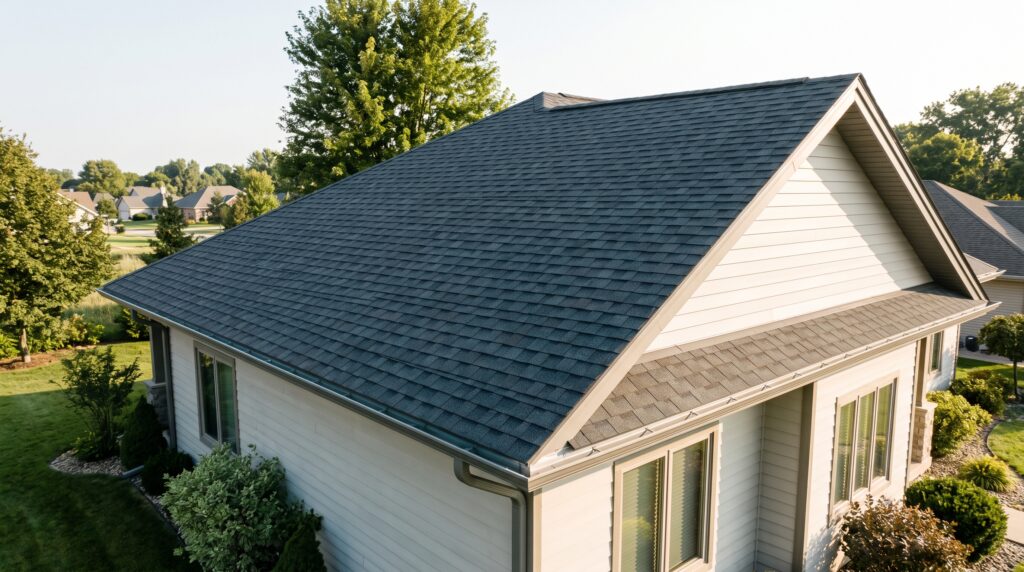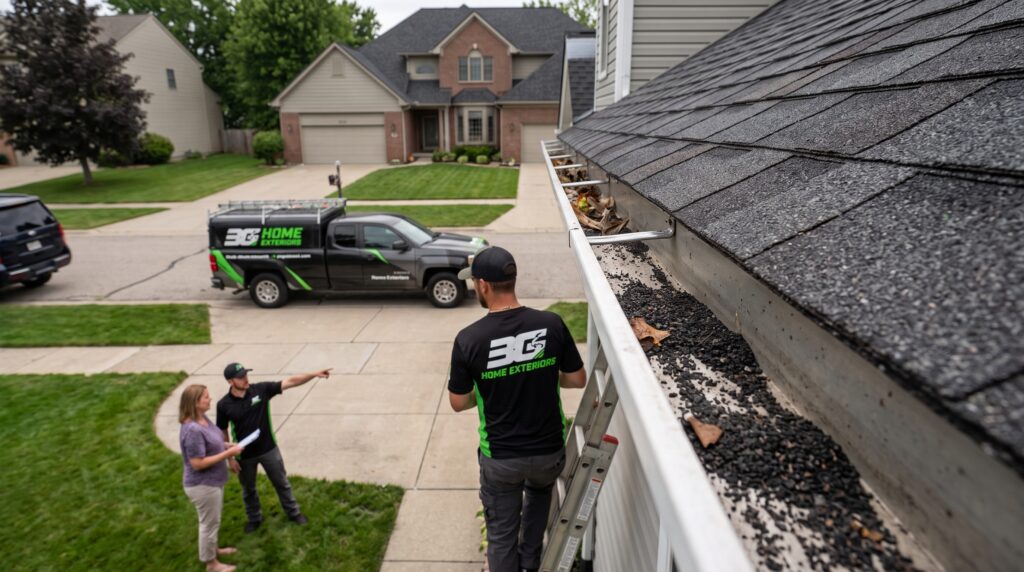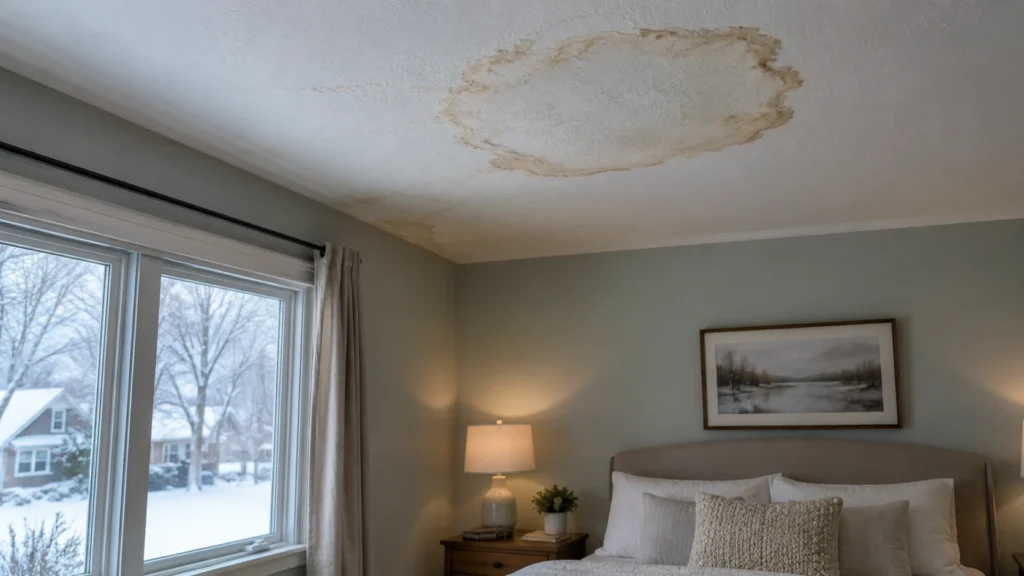
A roof tells you more by its shape than by its colour. Streaks and fading are cosmetic. Shingles that have stopped lying flat are telling you something about the deck, the attic, or the age of the material.
Three deformations come up constantly, they look similar from the ground, and they mean different things.
Cupping
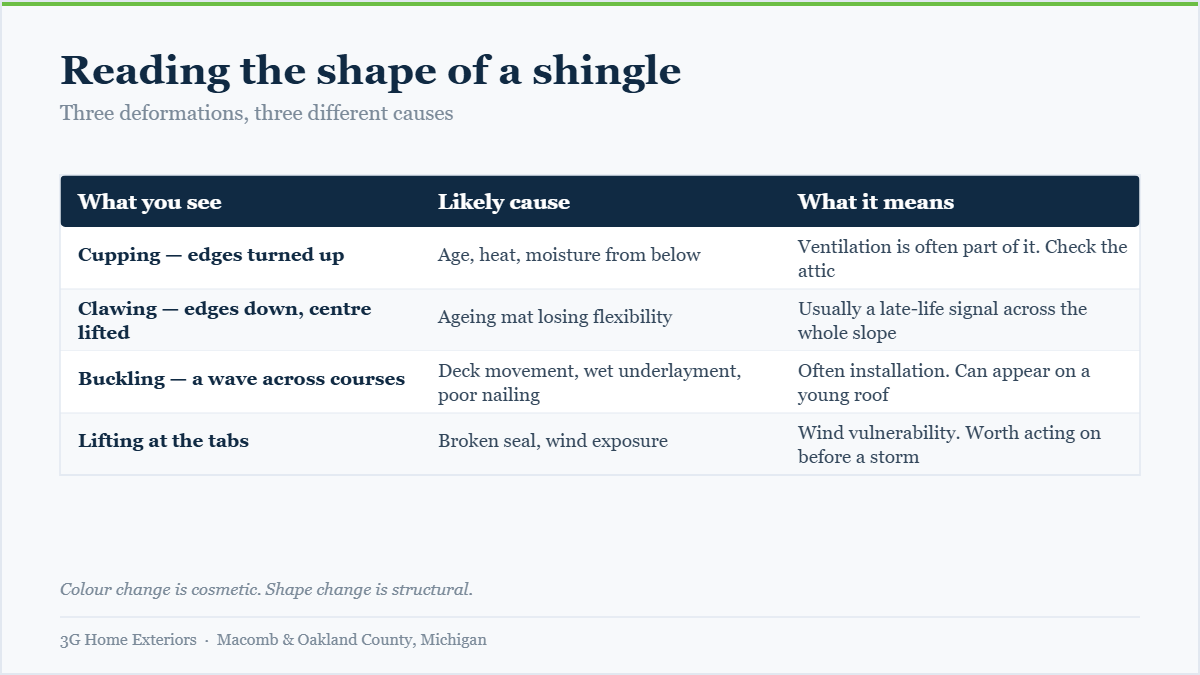
The edges of the shingle turn upward, so each one sits like a shallow dish. From the ground the slope looks textured rather than flat, and in low sun each course throws a small shadow.
Cupping is generally about moisture and heat working on an ageing shingle. Very often ventilation is part of the picture. An attic that runs hot and damp cooks the underside of the deck, and the shingle dries unevenly between its top and bottom surfaces.
Which is why cupping is worth looking at from inside as well as outside. If the attic is poorly vented, replacing the roof without fixing the ventilation puts a new surface into the same conditions that shortened the last one. We went through what to look for in telling a roof leak from attic condensation.
Clawing
The opposite shape. The edges stay down, gripping the course below, while the middle of the shingle lifts.
This is ordinarily an ageing signal. The mat has lost flexibility and is shrinking slightly against its own fastenings. Clawing across a whole slope on a roof in its second decade is usually the roof telling you where it is in its life.
Clawed shingles are also brittle. They break when walked on and they are poor candidates for spot repair, which matters if you were hoping to patch rather than replace.
Buckling
A wave or ridge running across several courses, often in a long line rather than shingle by shingle.
This one is different, because it is frequently not about age at all. Common causes include movement in the roof deck, underlayment that was wet when it was covered and has since wrinkled, or nailing that did not allow for expansion.
That makes buckling the one deformation you can see on a relatively young roof. A three-year-old roof with a wave across it is an installation question, not a wear question, and it is worth raising while workmanship coverage still exists.
Buckled shingles also sit proud of the plane, which makes them the first thing wind gets under.
Lifting tabs
Worth including because it is the most urgent of the four. Asphalt shingles have a sealant strip that bonds each course to the one below once the sun warms it. When that seal breaks, tabs lift in the wind.
You may see the tab flutter in a breeze, or you may see a course sitting slightly high. Either way the roof has lost its wind resistance in that area, and the next strong storm is where the consequence appears.
Looking at it properly, from the ground
Binoculars, early morning or late afternoon. Raking light shows deformation that midday sun hides completely.
- Walk right around the house and look at each slope separately.
- Compare slopes. South and west face the most sun and age first; a difference between them is expected.
- Note whether the shape change is everywhere or in one patch. Local usually means something specific is happening there.
- Look near valleys, below upper roofs, and at eaves where ice forms.
- Photograph with the date. The comparison in two years is worth more than any single look.
Why Michigan roofs do this
Asphalt shingles expand and contract with temperature. The Great Lakes region averages around 42 freeze-thaw cycles a year, and Detroit averages 45 inches of snow with 37 or so days of snowfall. Every cycle works at the material and at the fastenings.
Add an attic that is not ventilating properly and you have moisture and heat on the underside as well. That combination is why deformation shows up here earlier than in milder climates, and why ventilation keeps appearing as part of the answer rather than as a separate subject.
What each one means for what to do
Buckling on a young roof is worth raising with the installer now. Workmanship coverage has a time limit.
Isolated cupping or clawing can often be repaired by replacing the affected shingles, provided the surrounding material is still flexible enough to lift without cracking.
Widespread clawing or cupping across multiple slopes is a planning signal. The roof is not about to fail tomorrow, but you should be budgeting rather than patching.
Lifting tabs should be dealt with before the next storm season rather than after.
And in every case, look at the attic before deciding. Putting a new roof on a badly ventilated attic reproduces the problem on a slower timer.
Roofing in Lake Orion
Lake Orion sits with lakefront exposure and the open wind that comes with it. Wind is what finds a lifted tab or a buckled course, so shape change matters more here than on a sheltered lot, and the tab seal is the detail we look at first.
See roofing in Lake Orion, or everything we handle in Lake Orion.
Common questions
Is a curling shingle an emergency?
Usually not. It is a condition report rather than an alarm. Lifting tabs are the version worth acting on sooner, because they are a wind exposure.
Can curled shingles be flattened or glued down?
Not durably. The shape change comes from the material itself. Individual shingles can be replaced; a slope that has deformed broadly is at the end of its service life.
Why is only one side of my roof doing this?
Sun exposure and attic conditions vary by slope. South and west faces age faster. A slope over a poorly ventilated section of attic will also deform earlier than the rest.
My roof is only four years old and it is buckling. Is that normal?
No. Buckling on a young roof points at the deck, the underlayment or the installation, and it is worth raising with the installer while any workmanship coverage is still live.
We will look at the attic too
An inspection that only looks at the outside of a roof is half an inspection. If what we find is a ventilation problem, we will tell you that rather than quote you a roof.
Book a free roof inspection, or read about roof repair in Michigan.
Sources: NOAA 1991-2020 U.S. Climate Normals, Detroit Metro Airport; GLISA, University of Michigan, Great Lakes freeze-thaw cycle data.