There is no best gutter guard, and any comparison that produces a single winner has stopped describing the problem. The right choice is set by what falls on your roof, how steep that roof is, and how the gutter beneath it is sized and hung. This is a decision guide built in that order, because getting the order wrong is how homeowners end up buying the same thing twice.
Start with the gutter, not the guard
A guard is a modification to an existing drainage system. If that system is not working, the guard inherits the problem and usually amplifies it.
Three things are worth confirming before you shop:
Is the gutter big enough? Published sizing guidance derived from SMACNA’s Architectural Sheet Metal Manual puts a 5-inch K-style gutter at up to 5,520 square feet of drainage area and a 6-inch at about 7,960 — roughly 44 percent more. If water is already going over the front lip in a heavy rain, a guard narrows the intake and makes that worse, not better. Our guide to sizing 5-inch against 6-inch gutters covers the calculation.
Is it pitched correctly? The Department of Energy specifies gutters sloped at least 1/16 inch per foot of run toward the outlet. A back-pitched run holds standing water, and a guard over it simply hides the fact.
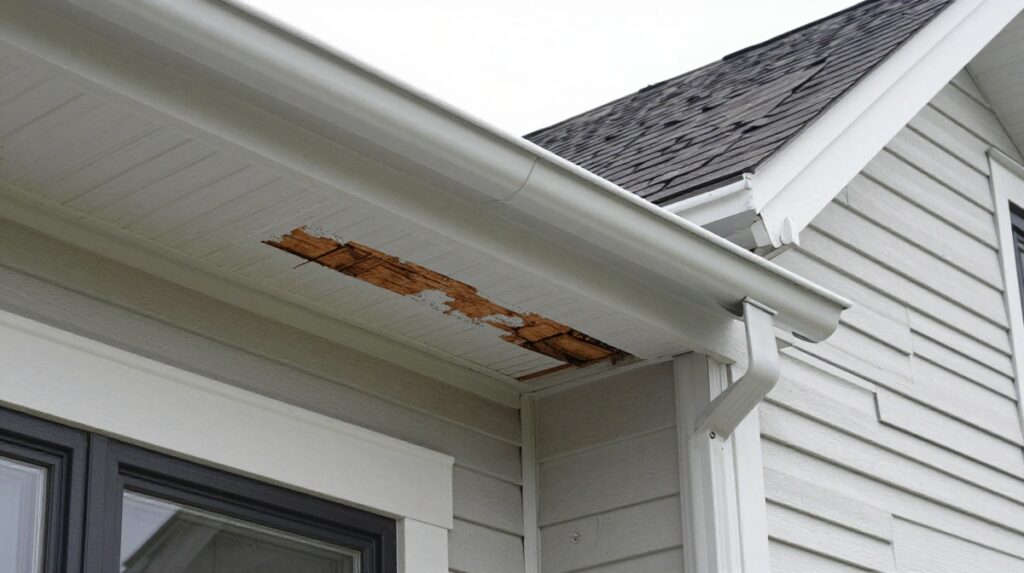
Is the fascia sound? Guards add weight and, more importantly, they add a load path for ice and wind. Screwing a system to soft fascia postpones a failure rather than preventing one. Michigan already requires drip edge at eaves and rakes; if that detail is missing or the wood behind it is spongy, that is the first job.
Match the guard to the debris
Identify what is overhanging the roof, then work from this. The distinction that matters is not leaf versus needle — it is whether the debris is larger or smaller than the openings in the product you are considering, and whether it breaks down into something sticky.
| Debris | Screen / perforated | Micro-mesh | Reverse curve | Foam or brush |
|---|---|---|---|---|
| Large deciduous leaves (oak, sycamore) | Good | Good | Good | Poor — leaves break down into the material |
| Maple seeds | Poor — they wedge in the openings | Good | Fair | Poor |
| Oak tassels (spring catkins) | Poor — they drape and mat | Fair — needs brushing off | Fair | Poor |
| Pine and spruce needles | Poor — they thread straight through | Best available answer | Poor — they follow water into the slot | Poor |
| Shingle granules and grit | Poor — passes straight through | Good | Fair | Poor |
| Pollen and pitch | Passes through | Loads the surface | Little effect | Clogs the material |
Read down your own column and the answer usually resolves itself. A pine or spruce overhanging the roof effectively eliminates screens and reverse curve from serious consideration. Pure oak and maple with no conifers opens the field considerably and makes the cheaper options genuinely viable. A wide-open lot with nothing overhanging means you are buying convenience, not necessity, and should spend accordingly.
Roof pitch changes the answer
This is the variable most buying guides leave out, and it is the reason two neighbours with the same trees get different results from the same product.
The standard sizing tables apply a roof-pitch factor to drainage area, from 1.0 on anything up to 3-in-12, rising to 1.3 at 12-in-12 or steeper. That multiplier exists because a steep roof delivers water faster and catches more wind-driven rain per square foot of footprint. The same physics governs how water behaves when it hits a guard.
Steep roofs, roughly 8-in-12 and above. Water arrives with momentum. Surface-tension reverse-curve designs are working against that momentum by definition, and overshoot is the common complaint. Filtering products cope better because the water is stopped by a surface rather than asked to turn a corner. Debris, on the other hand, self-clears much better on a steep roof — it keeps moving.
Shallow roofs, 4-in-12 and below. Water arrives slowly and debris tends to sit rather than wash off. This is where any product with a horizontal filtering surface accumulates, and where the maintenance burden of micro-mesh is highest. Reverse curve performs better here than it does on a steep roof, because the flow rate it has to capture is lower.
Valleys, at any pitch. A valley concentrates two roof planes into one discharge point. Whatever guard you fit, that spot receives a jet of water and a stream of debris that the rest of the run does not. It is worth accepting that the section under a valley may need a diverter, an additional downspout beneath it, or simply more frequent attention than the rest of the house.
Install quality is most of the outcome
The same product, fitted two ways, gives two different results. These are the details that separate them.
How it attaches at the back edge
Systems that mount by sliding under the first course of shingles put a fastener path and a lifted shingle edge into the wettest, most ice-loaded part of the roof. Systems that fasten to the gutter’s front and back lip leave the roof edge alone. Neither is automatically wrong, but the first demands care and the second is the safer default on a roof you are not replacing at the same time. Ask which method the installer uses, and ask what happens at the eave detail.
Slope of the guard surface
A filtering surface must shed what it stops. Panels set flat, or dipping backward because the gutter is back-pitched, hold debris in a wet mat and become the blockage. This is the single most common reason micro-mesh underperforms, and it is entirely an installation issue.
Continuity and end details
Gaps at corners, at end caps and where a run meets a wall are where debris enters and where wind gets under a panel. In a Michigan winter, wind getting under a panel with ice on it is how panels leave the roof.
What happens to the downspouts
Anything that gets past the guard still ends at the outlet. The DOE’s guidance is one square inch of downspout cross-section per 100 square feet of roof and downspouts every 20 to 50 feet. Fitting guards without confirming the downspouts are adequate moves the clog from a place you can see to a place you cannot.
Warranty realities
Guard warranties are usually written around a promise about clogging, and the useful question is never the length of the term. It is what triggers the obligation, who performs it, and what voids it.
Worth asking, in writing, before you buy:
- What counts as a failure? A gutter that overflows is not necessarily “clogged.” If the promise is that debris will not enter the trough, a guard shedding water over the front while staying perfectly clean inside may satisfy it exactly.
- Who is the obligor? A manufacturer’s product warranty and an installer’s workmanship warranty are separate documents with separate lifespans. Most guard problems are installation problems, which the product warranty does not touch.
- What is the remedy? Cleaning the guard, replacing panels, or refunding. These are very different outcomes.
- Is periodic maintenance a condition? Some coverage assumes the surface is kept clear. If so, the “maintenance-free” framing and the warranty terms are in tension, and the warranty wins.
- Does it transfer if you sell? Worth knowing before it matters.
- Who is still going to be here? A long term from a company that arrived in the area last spring is worth less than a shorter one from a local contractor. That applies to us as much as anyone, which is why we would rather you asked.
Why the cheapest option usually costs more
Foam and brush inserts are the cheapest things on the shelf, and they are the ones we most consistently end up removing.
The reason is not build quality — it is that both work by putting an absorbent, debris-catching material inside the trough, which is the one place you were trying to keep clear. Fine organic matter works into the cells or bristles, holds moisture against the metal, and becomes a growing medium. The Great Lakes region averages about 42 freeze-thaw cycles a year according to the University of Michigan’s GLISA program, and each one is an opportunity for a saturated insert to freeze solid in a gutter that Macomb and Oakland counties already ask to carry a 25 psf ground snow load.
Then count the real cost. The material, plus the eventual removal, plus the gutter cleaning that was deferred while the insert looked like it was working, plus in some cases a length of gutter that has to be replaced because it sat wet through several winters. Set against a guard that is fitted once and needs the surface brushed occasionally, the cheap option is rarely cheaper by the time it is finished.
The same logic applies to a well-made product fitted badly. A premium micro-mesh system installed on a back-pitched gutter over soft fascia will fail, and it will fail in a way the product warranty does not cover. Spending on installation quality is not an upsell; it is the part of the purchase that determines whether the rest of it works.
A short decision path
- Confirm the gutter is the right size for its drainage area and roof pitch, correctly pitched to the outlet, and hung on sound fascia. Fix that first, always.
- Identify the trees. Conifers present means micro-mesh. Deciduous only means screens or reverse curve are on the table.
- Check the roof pitch. Steep favours filtering products; shallow makes any horizontal surface a maintenance item.
- Look at the valleys, and plan a downspout beneath each major discharge point rather than expecting the guard to solve it.
- Ask how it mounts, whether it disturbs the shingles, and where the maintenance moves to.
- Read the warranty for its triggers, not its number.
And keep one thing separate from all of it. No guard prevents ice dams — that is an attic heat-loss problem the Department of Energy addresses with air sealing, insulation and ventilation, in that order, and we cover it in our guide to ice dams in Michigan. Buy a guard for debris. Buy the ice fix separately, and buy it in the attic.
Need New Gutters in Metro Detroit?
3G Home Exteriors installs seamless gutters, copper gutters and gutter guards across Macomb and Oakland County. Family-owned in Fraser since 2011, licensed and insured.
Seamless gutters near you: Fraser · Clinton Township · Sterling Heights · Macomb Township · Shelby Township · Rochester Hills · Troy · Utica
Call (586) 533-8343 or request your free gutter estimate.