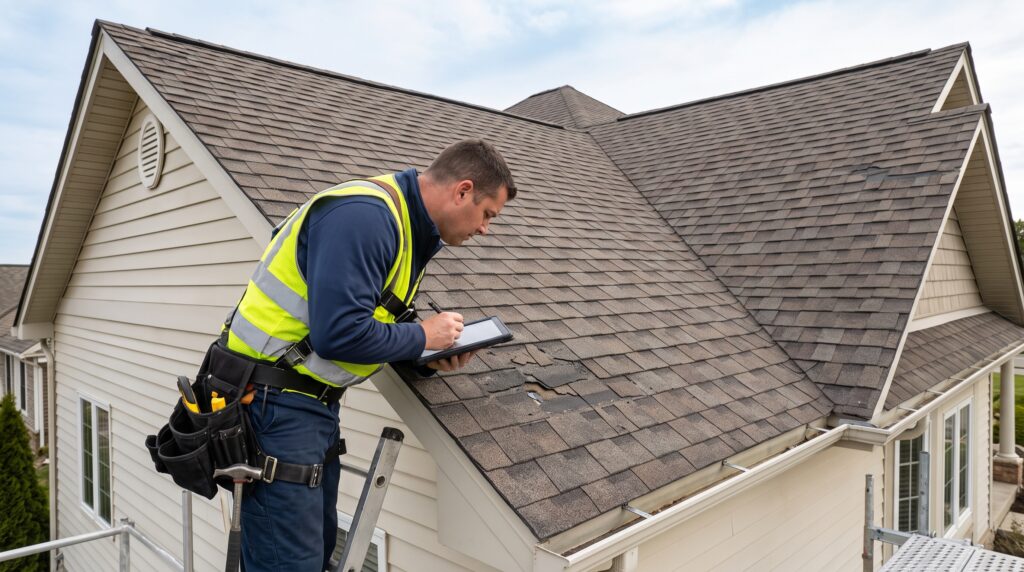
People in Metro Detroit tend to think of hail as something that happens in Texas. The record says otherwise, and it says something useful about when to look at your roof.
What the record shows
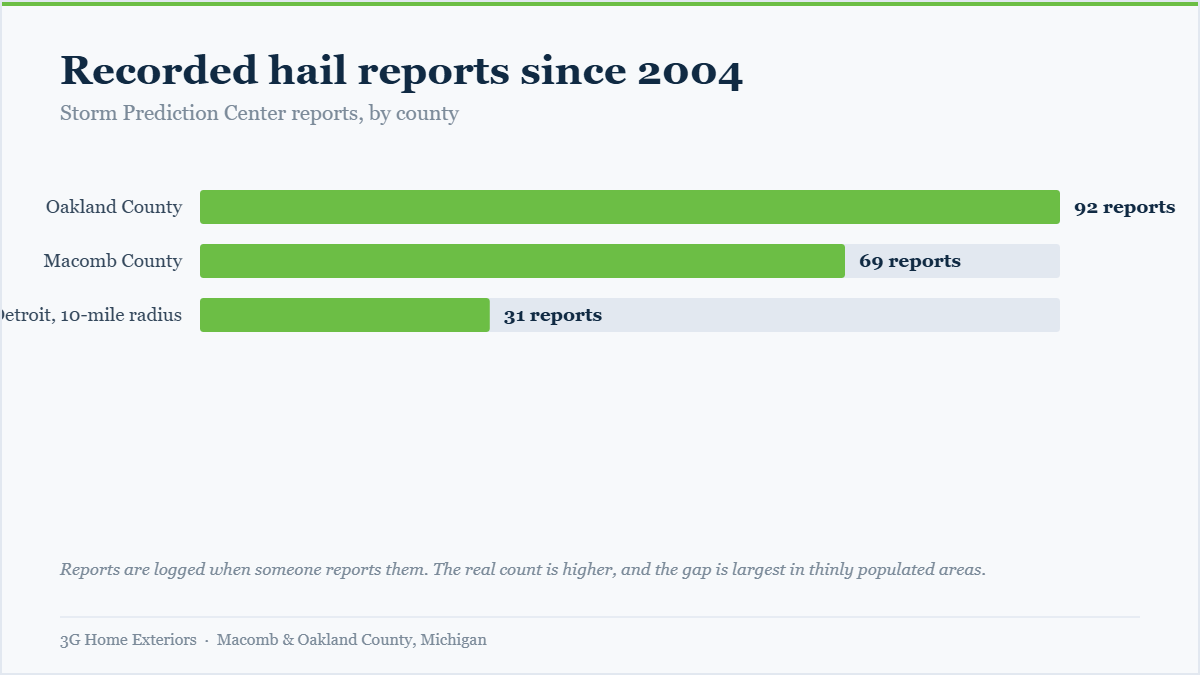
Storm Prediction Center data logs 92 hail reports in Oakland County since 2004 and 69 in Macomb County over the same period. Within ten miles of Detroit the count is 31.
Oakland has seen the larger stones. The largest report in the county is 2.50 inches near Milford, with a 2.0 inch report near South Lyon. Macomb largest is 1.75 inches near Mount Clemens. Within the Detroit radius the largest is 1.75 inches, in Oak Park.
Statewide, the 2024 Michigan Hazard Analysis puts the average at around 165 hail events a year, with average annual property damage of about $14.42 million, and notes that on average Michigan counties experience two or more hail events per year. Typical sizes are described as running from pea, a quarter inch, to golf ball, an inch and three quarters.
One thing to understand about these numbers
They are reports, not events. A hailstorm is logged when a person reports it and that report reaches the record. Storms over open country at three in the morning are under-counted, and densely populated areas produce more reports than thinly populated ones for the same weather.
So treat 92 and 69 as floors rather than totals. The practical implication: the absence of a logged report for your exact address does not mean hail did not fall there.
The years that cluster
Hail does not distribute evenly. Oakland County peak years in the record are 2012 with 15 reports, 2014 with 14, and 2008 with 11. Macomb peaks in 2012 with 11 and 2007 with 11.
That clustering is the operational fact. Most years are quiet and then a season delivers several events. Neighbourhoods get hit together, which is why contractors appear in numbers afterwards — and why the licence question matters. See your three-day right to cancel a door-knocked contract.
When it arrives
Hail travels with severe thunderstorms, so it follows the severe weather season. The National Weather Service Detroit office notes that tornado activity in Southeast Michigan peaks in June, that most tornadoes occur between April and August, and that the peak time of day is between 4pm and 6pm. Severe storms generally follow the same pattern.
Across the whole area, 331 tornadoes have been recorded since 1950 in the NWS Detroit coverage area, roughly five and a half a year, and Michigan statewide averages around 15 annually.
Practical consequence: spring and early summer are when to look at the roof, and a September inspection catches what a June storm did while there is still time to act before winter.
What size actually damages a roof
Smaller than people expect, and it depends on more than size.
Stone size is one variable. Wind speed and direction matter — hail driven sideways hits differently from hail falling vertically, which is why one elevation can be damaged and another untouched. Roof age matters, because an older, more brittle shingle bruises where a newer one absorbs. And the covering matters.
Rather than looking for a threshold size, look at the roof.
What hail damage looks like
Hail damage is not a hole. It is subtle, which is why so much of it goes unclaimed.
- Scattered circular spots where granules have been knocked away, exposing darker asphalt. Random rather than patterned
- Bruising — a soft spot you can feel but barely see, where the mat has been damaged under the surface
- Sudden heavy granule loss, appearing in gutters after one specific storm. See what granules in the gutter mean
- Dents on soft metal — gutters, downspouts, vents, flashing, and anything aluminium. Often the clearest evidence, and visible from the ground
- Marks on the air conditioning unit fins, a window screen, or a mailbox, which are the easiest places to check
Look at the soft metal first. If your gutters and vent caps are dimpled, the roof took the same storm.
Why it matters more the older the roof is
A twelve-year-old shingle has already lost flexibility and some granule coverage. Hail that a new roof would shrug off removes protection that was already thin.
The damage may not leak for years. What it does is remove life, and that lost life is frequently what a claim is actually about.
The deadline, again
Because it is the thing that costs people most: Michigan law sets the window to bring an action at one year after the loss, or longer if the policy says so. The clock runs from the storm, not from the day you noticed.
With multiple storms crossing the same neighbourhood in a season, being able to say which one caused the damage becomes harder the longer you leave it. See the one-year deadline, and what actual cash value means for what a claim actually pays.
Storm work in Troy
Troy sits in Oakland County, the county with both the higher report count and the larger recorded stones. It also has a wide range of housing eras and complex rooflines, which means elevations facing different directions on the same house can come out of one storm in very different condition.
See roofing in Troy, or everything we handle in Troy.
Common questions
Does Michigan get hail?
Regularly. The state hazard analysis puts the average at around 165 hail events a year, and Oakland County alone has logged 92 reports since 2004.
What size hail damages a roof?
There is no single threshold. Wind speed, angle, roof age and covering all matter alongside stone size. Inspect after a storm rather than judging by size.
How can I tell if my roof has hail damage from the ground?
Check the soft metal. Dents in gutters, downspouts, vent caps and the air conditioning unit fins indicate the storm was capable of damaging the roof.
How long after a hailstorm can I file a claim?
Michigan sets the window to bring an action at one year after the loss, or longer if your policy provides it. File promptly rather than relying on the outer limit.
Have it checked after a storm
If hail has been through your area, a written assessment costs nothing and creates a dated record. We will tell you plainly when there is nothing to claim.
Book a free storm damage inspection, or read about storm damage roofing in Michigan.
Sources: Storm Prediction Center hail report data for Oakland County, Macomb County and the Detroit area; 2024 Michigan Hazard Analysis, Michigan State Police EMHSD; National Weather Service Detroit/Pontiac tornado climatology; MCL 500.2833.