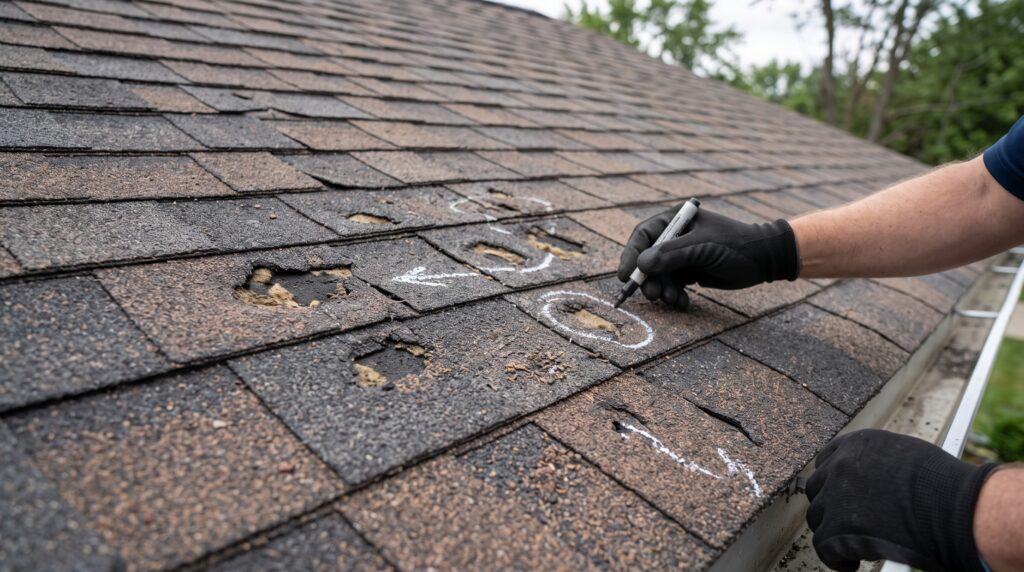
The adjuster writes a scope for eighteen thousand. The cheque arrives for nine. Most people conclude they are being cheated.
Sometimes that is right. Very often it is not, and the difference is three terms that appear in every property policy and are explained in almost none of them.
Replacement cost value
Replacement cost value, RCV, is what it costs today to replace the damaged work with materials of like kind and quality. New roof, current prices, current labour.
It is the largest number on the paperwork, and it is the number people fix on. It is not, by itself, what arrives in the post.
Actual cash value
Actual cash value, ACV, is replacement cost minus depreciation. Depreciation is the value the roof lost through age and wear before the storm ever arrived.
The reasoning is that a fourteen-year-old roof was not worth a new roof on the day the hail hit. It had used most of its life. Insurance is meant to restore what you had, not to hand you an upgrade.
Whether you ever see the depreciated portion depends entirely on which policy you bought.
The difference that matters
On an actual cash value policy, ACV is the settlement. Depreciation is subtracted and it is gone. If the roof costs eighteen thousand to replace and depreciation is eight, you receive ten thousand less your deductible and you fund the rest yourself.
On a replacement cost policy, depreciation is held back rather than removed. You receive ACV first, you have the work done, and the withheld amount is released afterwards. That withheld amount is called recoverable depreciation.
Same storm, same roof, same adjuster, very different outcome. The only variable is the policy you were sold, often years earlier, frequently on price.
How the two cheques work
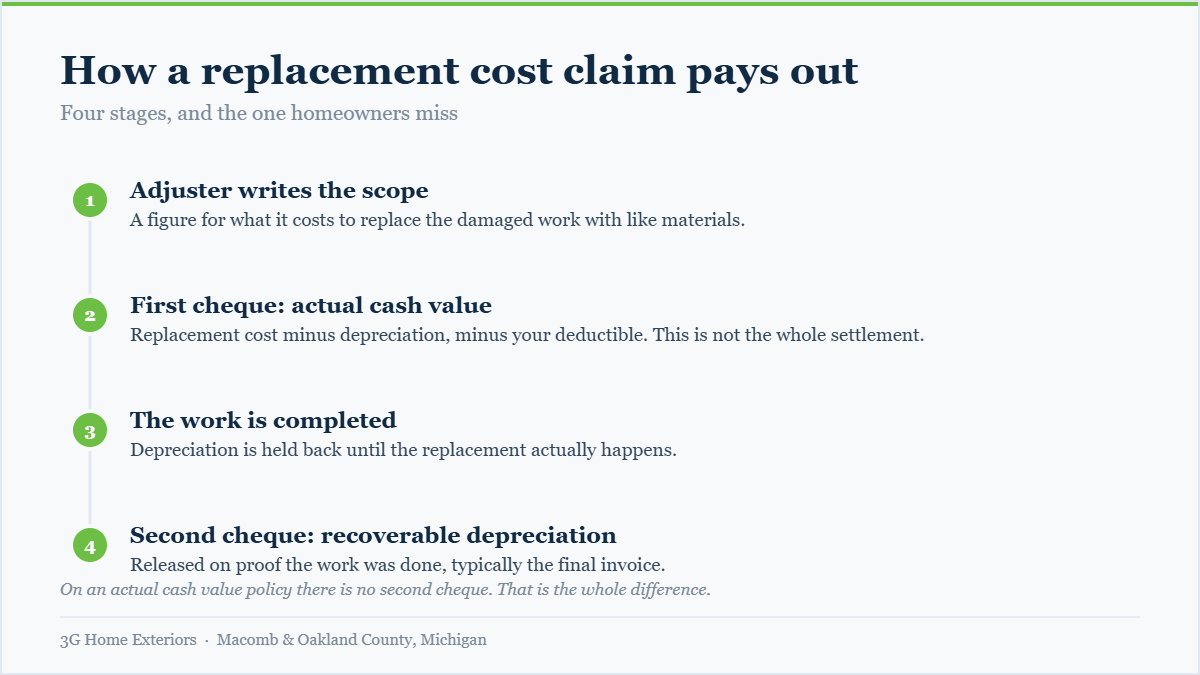
On a replacement cost policy the sequence is usually:
- The adjuster writes a scope with an RCV figure.
- Depreciation and your deductible are subtracted. That first payment is ACV.
- You have the work completed.
- You submit proof it was done, normally the contractor final invoice.
- The recoverable depreciation is released as a second payment.
Two things follow from step four. The depreciation is only recoverable if you actually do the work, and there is usually a time limit for claiming it. Policies vary. Find yours and note the date.
If a mortgage is held on the property, the lender is often named on the cheque and has its own release process. Start that conversation early rather than when a crew is on site.
Finding out which one you have
Get your declarations page. Not the policy booklet, the two-page summary listing coverages and limits.
Under dwelling coverage you are looking for the words replacement cost or actual cash value. Also look for a separate roof provision. Some policies cover the dwelling at replacement cost but schedule the roof on actual cash value once it reaches a certain age, which is a distinction that only becomes visible after a storm.
Read this before you need it. This is the single most useful ten minutes a homeowner can spend on insurance.
Your deductible comes off as well
The deductible is subtracted on top of depreciation, and it is yours to pay. Any contractor offering to absorb it, waive it, or hide it inside the invoice is proposing something that should end the conversation. We cover why separately.
Matching, and what Michigan does not require
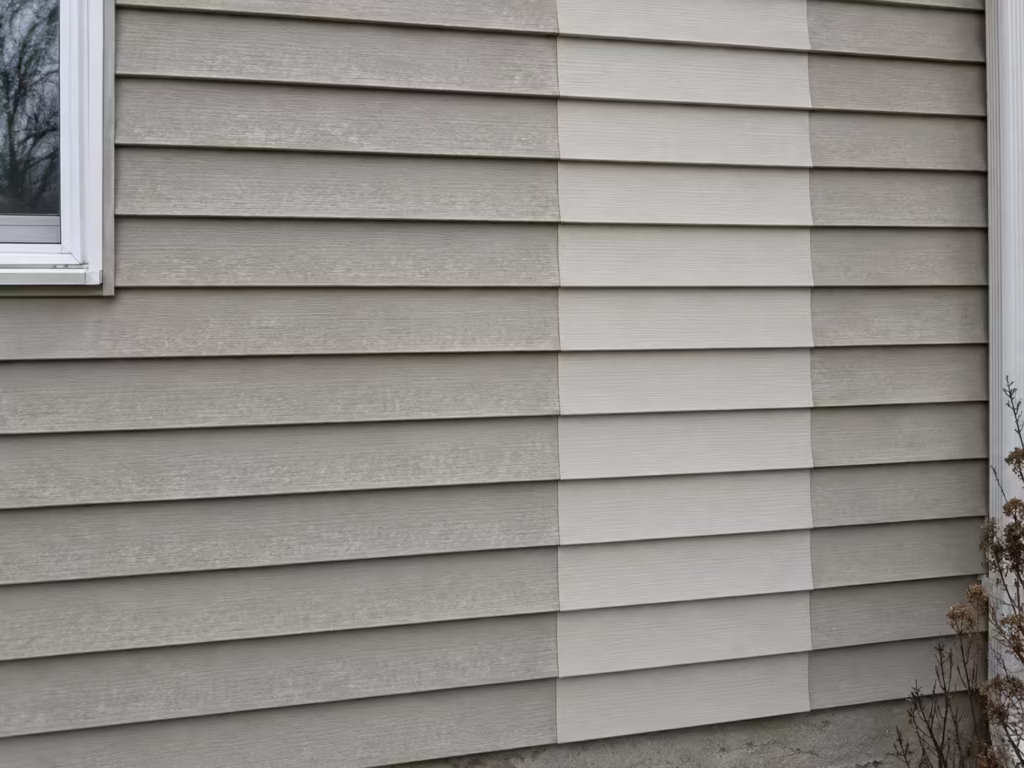
A common question on siding claims: if half the siding is damaged and the colour is discontinued, must the insurer replace all of it so the house matches?
There is no Michigan statute or regulation requiring matching. A fifty-state review of matching laws lists Michigan with none. The only Michigan federal decision on the point, Bernert v. State Farm Fire & Casualty, went in the insurer favour on a common construction provision.
That does not mean matching is never paid. It means it is a matter of your policy language and negotiation, not a right the state gives you. Anyone telling you Michigan law requires your insurer to match is wrong, and it is worth knowing before you build a strategy on it.
What your insurer owes you on timing
The Michigan Department of Insurance and Financial Services states that an insurer must tell you within 30 days of filing what information it needs to process your claim, must pay within 60 days of receiving proof of loss, and owes 12 percent simple interest on amounts overdue.
Separately, Michigan law sets the window to bring an action at one year after the loss, or longer if the policy says so. We went through that in the one-year deadline on a Michigan storm claim.
Practical notes from the field
- Get the full adjuster report, not the summary. The line items are where disagreements live.
- Have a contractor scope the damage independently before you accept a figure. Two documents are harder to wave away than one.
- Do not sign anything that assigns your claim to a contractor without reading exactly what you are giving up.
- Keep the final invoice. It is the document that releases the second payment.
- Ask about supplements. If the tear-off uncovers damage nobody could see, that goes back to the insurer as a supplement rather than onto your bill.
If it stalls
DIFS runs a consumer hotline at 877-999-6442 and accepts complaints. It regulates the insurer, which makes it a different kind of phone call from arguing with an adjuster.
Common questions
Why is my insurance cheque less than the estimate?
Depreciation and your deductible have been subtracted. On a replacement cost policy the depreciation is usually recoverable after the work is completed.
What is recoverable depreciation?
The portion withheld from the first payment, released after you complete the work and submit proof, on policies written at replacement cost.
How do I know if I have ACV or RCV?
Check the declarations page under dwelling coverage, and look for any separate provision scheduling the roof by age.
What if I decide not to do the work?
On a replacement cost policy the withheld depreciation is generally not paid if the work is not done. You keep the actual cash value payment.
We will scope it properly
An independent written assessment of storm damage costs you nothing and gives you a second document to set against the adjuster figure. We will also tell you when the honest answer is that there is no claim here.
Book a free storm damage inspection, or read about storm damage roofing in Michigan.
Sources: Michigan Department of Insurance and Financial Services consumer publication FIS-PUB 0216; MCL 500.2833; Matthiesen, Wickert & Lehrer fifty-state matching regulation chart; Bernert v. State Farm Fire & Cas. Co., E.D. Mich. 2012. General information, not legal advice. Your policy language controls.