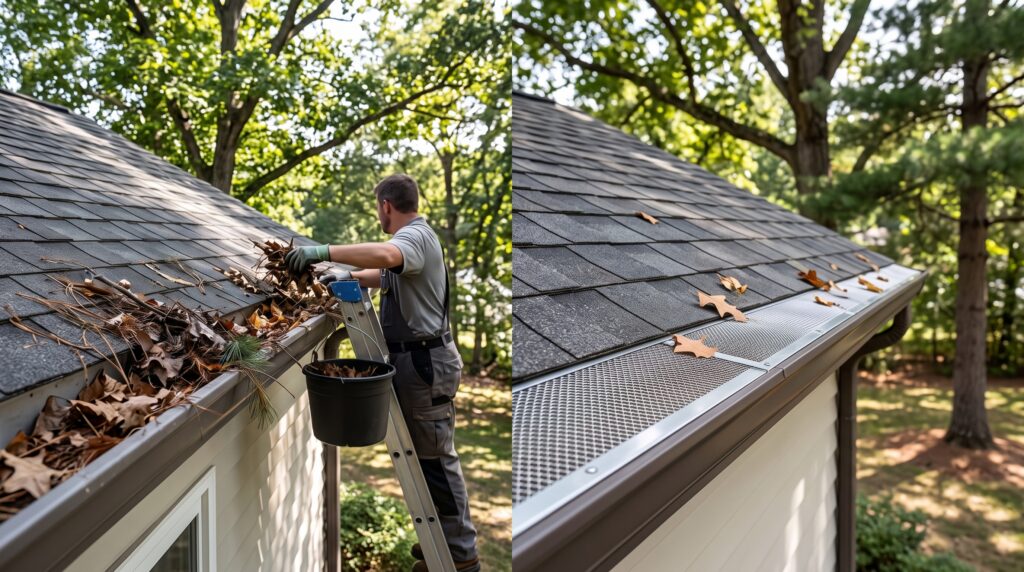
Yes, with conditions worth understanding before you spend money. Every guard type trades one problem for another, and the trade you want depends almost entirely on what is falling out of the trees over your particular roof. The honest version of this answer has a lot of “it depends” in it, and anyone selling you a single product for every house is skipping the part that determines whether you are happy in three years.
What a gutter guard is actually being asked to do
A guard has one job with two halves that pull against each other: let water in, keep solids out. Every design on the market resolves that tension differently, and every one of them fails at the edges of its design.
The physical constraint is tighter than it looks. A 5-inch K-style gutter carries roughly 5.3 square inches of cross-section. Water arriving off a steep roof in a Michigan downpour is moving fast and it is not arriving gently — it comes off the drip edge with momentum. A guard that filters finely enough to stop maple seeds has to do it without shedding that water straight over the front lip, and a guard that lets water through freely has to do it without letting debris follow.
That is the whole subject. Everything below is a different answer to it.
The five types, and what each one really does
Screen and perforated metal
Rigid panels with holes or a coarse mesh, sitting over the trough. They stop leaves, twigs and the bulk debris that blocks a downspout outright, and they let water through easily even in heavy rain because the openings are large.
What they do not stop is anything smaller than the openings. Pine needles thread through and stand up in them. Maple seeds wedge. Roof grit and the fine organic sludge that settles out of shaded gutters goes straight through and keeps accumulating in the trough, which means the gutter still needs opening periodically — and now there is a panel to remove first. On an oak- or pine-heavy lot this is the type most likely to disappoint.

Micro-mesh
A fine stainless or aluminium mesh over a rigid frame. Openings are small enough to stop shingle grit, so almost nothing enters the trough. This is the type that actually delivers on the promise of a gutter that stays clean inside.
The trade is that the filtering surface is now the maintenance item. Fine mesh loads up with pollen, pine pitch, tar-like decomposed leaf matter and shingle granules, and a loaded mesh sheds water over the front rather than through it. On an open lot the surface stays clear on its own; under heavy tree cover it needs periodic brushing off. Micro-mesh does not eliminate maintenance so much as move it from inside the gutter, where it is unpleasant and requires a ladder over the trough, to the top surface, where it is faster.
Install quality also matters more here than on any other type, because micro-mesh is only as good as its slope and its seal at the back edge. A panel that sits flat or dips backwards holds water and debris instead of shedding it.
Reverse curve (surface tension)
A solid hood that curls over the front of the gutter with a narrow slot underneath. Water clings to the curve and follows it around into the slot; debris carries on over the edge and falls to the ground. Done properly, it works, and it handles large leaf volumes better than a fine filter does because nothing has to pass through a screen.
Three real limitations. Surface tension is a finite effect — in a very heavy burst, water can overshoot the curve entirely, which is exactly the storm you bought the system for. Small debris, particularly pine needles and seed pods, follows the water into the slot rather than tumbling over, and cleaning that slot is not a homeowner job. And many reverse-curve systems mount by sliding the back edge under the first course of shingles, which puts a fastener path and a lifted shingle edge into the most water-loaded part of the roof. Michigan requires drip edge at eaves and rakes, and lifting shingles to insert a hood over a properly detailed eave is a decision to make with your eyes open.
Foam inserts
A wedge of open-cell foam pushed into the trough. Water passes through, debris sits on top. Cheap, sold in strips at any hardware store, and installable in an afternoon without tools.
It is the type we recommend against most consistently. The foam becomes the debris trap: fine organic matter works into the cells, holds moisture against the gutter, and turns into a growing medium. Seedlings sprouting out of a foam insert are a common sight on Metro Detroit rooflines. It also degrades under UV, and in a freeze-thaw climate it holds water at exactly the moment you want the trough empty. The Great Lakes region averages about 42 freeze-thaw cycles a year according to the University of Michigan’s GLISA program, which is 42 chances a year for a saturated foam wedge to freeze solid inside your gutter.
Brush
A long cylindrical bristle brush laid in the trough. Large debris rests on the bristles; water flows underneath and around.
Same fundamental problem as foam, slightly less severe. Leaves that land on it dry, break down and work into the bristles, and pulling out a 20-foot brush full of decomposed leaf matter is worse than cleaning the gutter would have been. It is genuinely useful in one narrow case: as a temporary measure on a gutter you are about to replace, or on a low outbuilding where nobody is going up a ladder either way.
| Type | Handles well | Defeated by | Maintenance moves to |
|---|---|---|---|
| Screen / perforated | Leaves, twigs, bulk debris | Pine needles, maple seeds, roof grit | Still inside the trough |
| Micro-mesh | Almost everything, including grit | Pollen and pitch loading the surface | Top of the mesh |
| Reverse curve | High leaf volume, big deciduous cover | Extreme rainfall rates; needles entering the slot | The slot — a contractor job |
| Foam insert | Very little, briefly | Fine organic matter, UV, freeze-thaw | Replacing the foam |
| Brush | Large leaves on a low roof | Anything that breaks down | Pulling and washing the brush |
Your trees decide this, not the brochure
The single most useful thing you can do before buying is look up and identify what is overhanging the roof.
Maple. The seeds are the problem, not the leaves. They are winged, they arrive in enormous numbers over a short window in late spring, and they are shaped to wedge into any opening about their own size. Coarse screens are the worst match; they hold a mat of seeds that then blocks the whole panel. Fine mesh sheds them or holds them loosely on top where wind and rain move them along.
Oak. Two separate nuisances. The tassels in spring are stringy, fibrous and fall as a tangle that drapes over anything; acorns in autumn are hard and heavy and will sit in a trough or roll into a downspout outlet. Tassels defeat coarse screens and load fine mesh; acorns are stopped by nearly anything, but the tassel season is the one that decides the outcome.
Pine and spruce. Needles are the hardest debris on the list for any guard, because they are thin enough to pass a coarse screen and long enough to bridge and mat on a fine one. They also shed steadily rather than in one season. Fine mesh with a well-pitched surface is the realistic answer; reverse curve is the poor one, because needles follow water into the slot.
Open lot with distant trees. Almost any guard performs, and screens are perfectly reasonable. Honestly, so is cleaning the gutters.
The winter question
This is where the marketing gets furthest from the building science, so it is worth being blunt.
No gutter guard prevents ice dams. The Department of Energy’s building science work establishes that an ice dam requires snow on the roof, freezing temperatures, and a poorly air-sealed or poorly insulated attic — and that the fix runs air sealing first, then insulation, then ventilation. A gutter guard touches none of those three conditions. Ice dams form on the roof surface at the eave, above and behind the gutter, and they form on houses with no gutters at all. We cover the mechanism properly in our guide to ice dams in Michigan, and it is worth reading before spending money on anything sold as an ice solution.
What guards do change in winter is more modest and cuts both ways. A solid or finely filtered surface stops the gutter from filling with wet leaves in November, and a gutter full of frozen leaf matter in January is a heavier, more damaging gutter than a clean one — Macomb and Oakland counties carry a 25 psf ground snow load in the state code tables, so there is genuine weight involved. Against that, any guard adds a horizontal surface at the eave for ice to build on and bond to, and a micro-mesh surface skinned over with ice sheds water off the front like a roof rather than accepting it.
Both things are true at once. A guard is a modest winter positive on a house whose attic is sound, and irrelevant on a house whose attic is not.
What no guard does
- Prevent ice dams. Covered above. Not the mechanism.
- Eliminate maintenance. Every type relocates it. Ask any installer where the maintenance moves to, and be sceptical of one who says nowhere.
- Fix an undersized gutter. If water is going over the front edge in a storm now, a guard narrows the opening and makes it worse. Size the run first — that is a separate calculation based on drainage area and downspout count.
- Fix a gutter that is pitched wrong. Gutters should fall at least 1/16 inch per foot toward the outlet. A guard over a back-pitched run just hides the standing water.
- Fix rotted fascia. Guards add weight and load to the same fascia board and hangers. Soft wood behind the gutter needs replacing before anything is screwed to it.
- Keep the downspouts clear on its own. Anything that gets past the guard still ends up at the outlet.
Buy a guard for what it does well: keeping bulk debris out of a correctly sized, correctly pitched, soundly hung gutter, so the system you already have works without a ladder four times a year. That is a genuinely worthwhile thing to buy. It is just not the thing most of the advertising is selling.
Need New Gutters in Metro Detroit?
3G Home Exteriors installs seamless gutters, copper gutters and gutter guards across Macomb and Oakland County. Family-owned in Fraser since 2011, licensed and insured.
Seamless gutters near you: Fraser · Clinton Township · Sterling Heights · Macomb Township · Shelby Township · Rochester Hills · Troy · Utica
Call (586) 533-8343 or request your free gutter estimate.
Gutter guard questions
Will gutter guards stop my gutters from icing up?
No. Ice in a gutter comes from meltwater running off a roof that is warmer than the outside air, which is an attic heat-loss issue. A guard can keep frozen leaf debris out, which reduces weight, and a clean trough drains faster during a thaw. But it does not change whether ice forms, and no honest installer will tell you otherwise.
Do gutter guards ever make things worse?
Yes, in three situations. On a gutter that is already undersized or badly pitched, a guard reduces the opening and accelerates overshoot. On a heavily needled lot with the wrong guard type, debris mats on the surface and sheds water over the front. And any system that mounts by lifting the first course of shingles introduces a detail at the eave that has to be executed properly or it becomes a leak path.
Which type should I buy for a wooded Michigan lot?
For mixed deciduous cover with pine or spruce in the mix, a well-pitched micro-mesh system is the realistic choice, accepting that the surface needs brushing off periodically. For heavy oak or maple with no conifers, a quality screen or a properly installed reverse curve can be perfectly adequate and costs less. Our leaf protection page walks through the options on a specific roof.
Should the same contractor do the gutters and the guards?
It helps, because the guard’s performance depends on the gutter underneath it being the right size, correctly pitched and soundly hung. In Michigan, roofing and gutters are both named trade classifications on a Residential Maintenance & Alteration Contractor licence, so one licensed contractor can properly handle the roof edge, the gutter and the guard as one detail rather than three.