After a hailstorm somebody knocks on the door and makes the offer that closes deals: we will take care of your deductible. Nothing out of pocket.
It sounds like a discount. It is not a discount, because the person offering it has no power to change the terms of your policy. Something else is happening, and there are only two possibilities.
What a deductible actually is
A deductible is not a fee the contractor charges. It is the portion of the loss your policy says you carry yourself. Your insurer calculated your premium on the assumption you would bear it.
A roofing contractor is not a party to that agreement and cannot alter it. So when the deductible disappears from your side of the ledger, it has been moved, not removed.
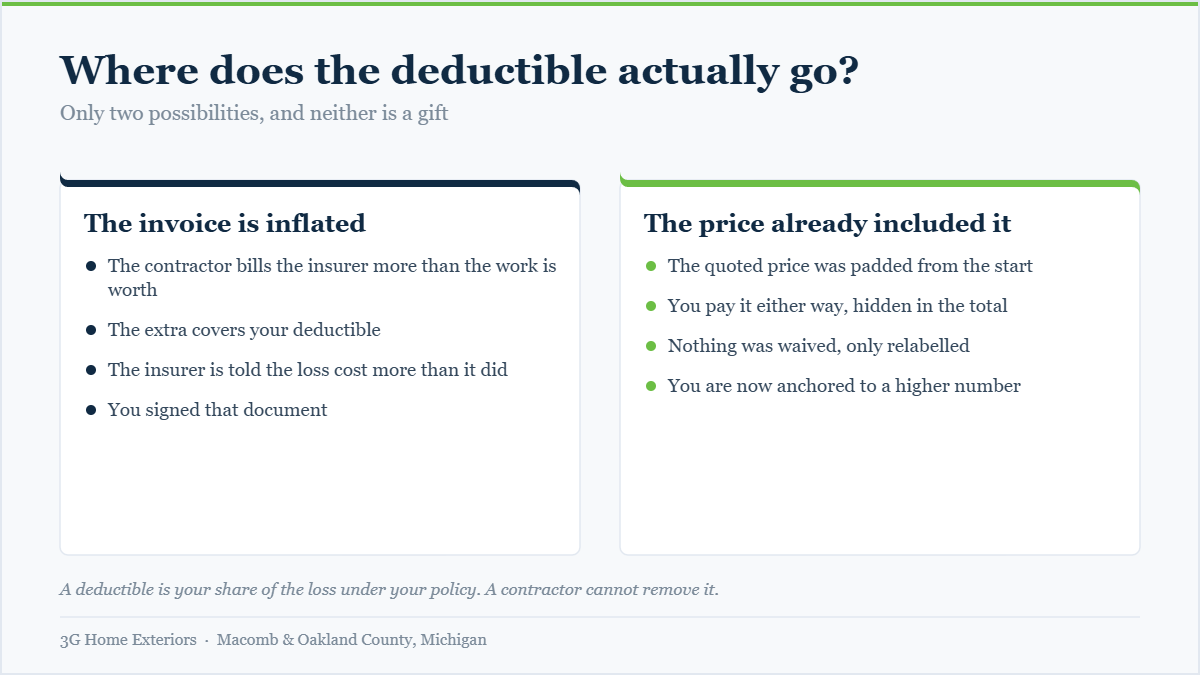
Possibility one: the invoice is inflated
The contractor bills the insurer for more than the work is worth, and the difference covers your share. The insurer pays a figure that does not reflect what the job actually cost.
That is a misrepresentation of the loss, made to an insurer, on a document connected to your claim and usually with your signature on it somewhere. Whatever the contractor understands themselves to be doing, you are the policyholder and the claim is yours.
It is worth being clear-eyed about where you sit in that arrangement. The contractor finishes the job and leaves. The claim history, the policy and the relationship with the insurer are yours to keep.
Possibility two: you already paid it
The more common version, and the more mundane one. The quoted price was built high enough to absorb the deductible from the start.
Nothing was waived. The money moved from a line you could see to a line you cannot. You are paying the same amount and you have lost the ability to compare the bid honestly against anyone else.
This version is not fraud. It is simply a worse deal presented as a better one.
Why the offer exists at all
The deductible is the single biggest obstacle between a storm and a signature. Removing it, or appearing to, converts a decision into a reflex.
That is why it surfaces most in door-to-door work after a storm. The Michigan Department of Insurance and Financial Services notes that after severe weather, people claiming to be adjusters and contractors often go door to door, and advises checking licences, references and insurance. The Michigan Attorney General has warned homeowners never to pay in cash or in full up front for home repair services after storm damage.
None of which means every contractor who mentions your deductible is a fraud. It means the offer is a reliable signal about how a business operates, and it is available to you for free, early, before you have committed to anything.
The rights you have with a door-knocked contract
Worth knowing if you have already signed something on the doorstep. The Michigan Attorney General sets out two cancellation situations: sales solicited at your home carry three days to cancel, and contracts where you agree to make payments over time to a home improvement contractor carry one day.
The statutory basis is Michigan Home Solicitation Sales Act, Act 227 of 1971. If you signed under pressure and have thought better of it, act quickly, because those windows are short.
What to do instead
- Treat the deductible as fixed and budget for it. It is part of the cost of the roof.
- Compare bids on the work — ice barrier courses, underlayment, tear-off versus overlay, flashing, ventilation — rather than on the out-of-pocket figure.
- Ask for the licence number and check it. It takes a minute, and we went through how in checking a Michigan contractor licence.
- Read anything before signing, particularly documents that assign your claim or authorise work at insurance proceeds.
- Keep your deposit modest. The Attorney General guidance suggests around one third of the contract price should generally suffice.
- Ask about financing openly. A contractor who cannot meet the deductible in a legitimate way can often discuss payment terms that are written down and lawful.
The honest version of the same conversation
There is a legitimate discussion about money after a storm and it sounds different. It sounds like: here is what the work costs, here is what your insurer is likely to cover, here is your deductible, here is the gap, and here are the ways to handle that gap.
That conversation has numbers you can check and nothing hidden in it. If the numbers do not work, you find that out honestly rather than a year later.
What else that first conversation should cover
Before anything is signed you should also know which policy type you have, because it changes the settlement far more than the deductible does. We covered that in actual cash value versus replacement cost, and the claim clock in the one-year deadline on a Michigan storm claim.
Common questions
Can a roofing contractor pay my insurance deductible?
A contractor cannot change your policy. If the deductible is not appearing on your side, it has been built into the price or into the invoice sent to the insurer.
Is it a problem if I already signed something like this?
Michigan gives three days to cancel a sale solicited at your home and one day on a contract with payments over time to a home improvement contractor. Those windows are short, so act quickly if you want out.
My contractor says everyone does it. Is that true?
It is common enough in storm work, which is a reason to be careful rather than a reason to relax. Commonness is not a defence, and you are the policyholder.
Who do I call if I think something is wrong?
DIFS handles insurance matters at 877-999-6442. The Michigan Attorney General Consumer Protection division handles business practices at 877-765-8388.
We will show you the whole number
Our estimates show the work, the price, and where your deductible sits, with nothing rolled into anything else. If that makes us look more expensive than the person at your door, compare the scopes line by line and see.
Get a free storm damage inspection, or read about storm damage roofing in Michigan.
Sources: Michigan Department of Insurance and Financial Services severe weather consumer guidance; Michigan Attorney General, Building and Remodeling advice for homeowners; Michigan Home Solicitation Sales Act, Act 227 of 1971. General information, not legal advice.