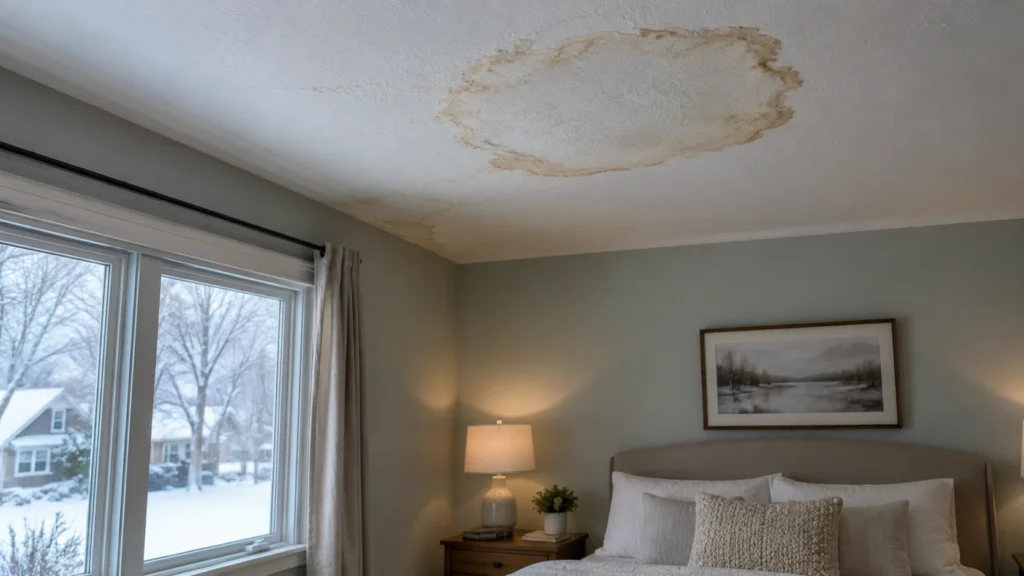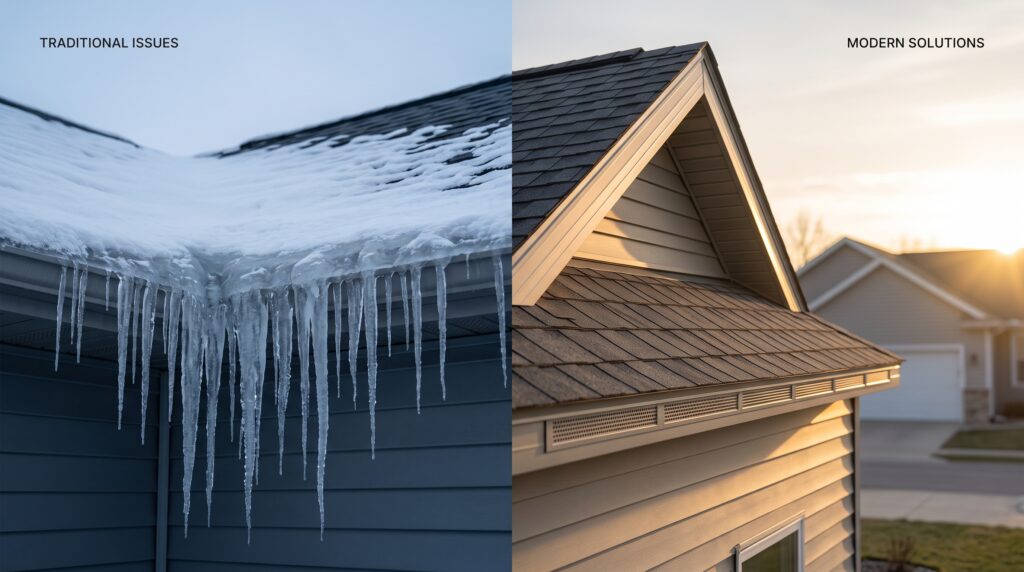
You clean the gutters and there is a layer of coarse sand in the bottom. It looks like the roof is falling apart.
Sometimes it is. Often it is entirely normal. The amount of grit tells you almost nothing on its own. What matters is the age of the roof and what the slope looks like when you step back and study it.
What granules actually do
An asphalt shingle is a mat saturated with asphalt, with crushed mineral granules embedded in the top surface. Those granules are not decoration. They are the shingle sunscreen.
Asphalt breaks down under ultraviolet light. The granule layer takes that exposure so the asphalt underneath does not. Granules also add fire resistance and some physical protection.
Which is why the question is never really whether granules are coming off. They come off from day one. The question is whether enough have come off in one place that the mat below is now exposed.
A new roof sheds, and that is expected
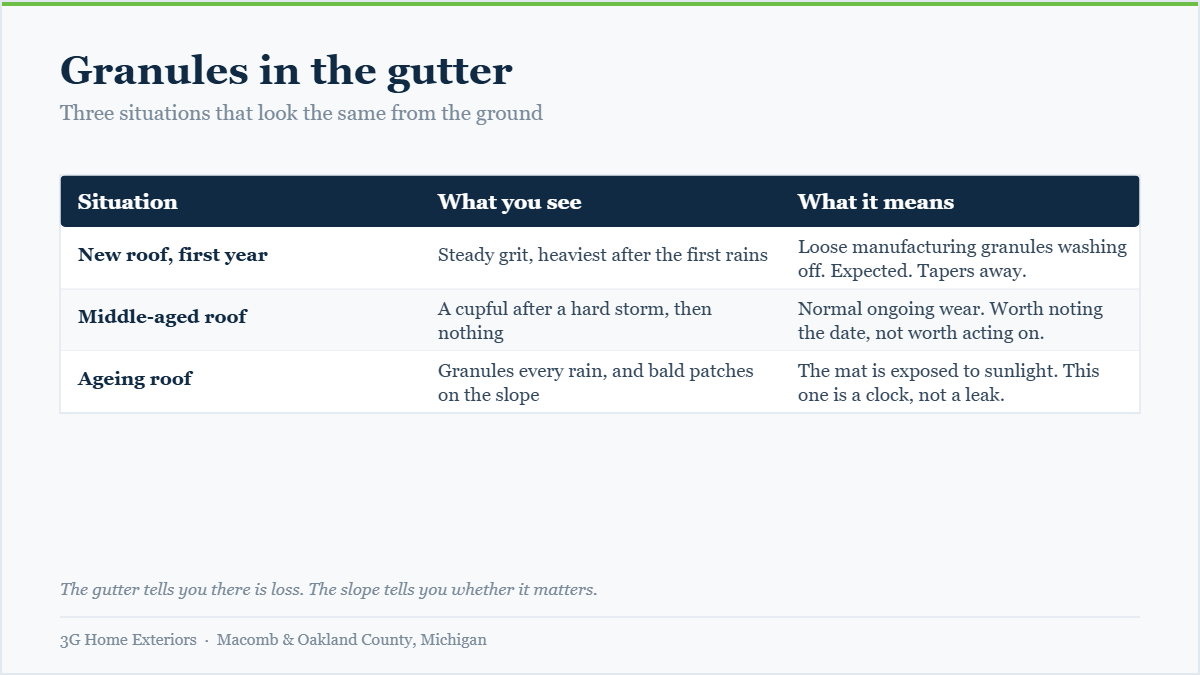
If your roof is less than a year old, grit in the gutter is almost certainly loose granules left over from manufacturing. They were never bonded. They were sitting on the surface in the bundle, and the first few rains wash them down. The volume can be startling.
It should taper off noticeably over the first year. Heavy, continuous loss from a genuinely new roof, still going after a full cycle of seasons, is worth raising with whoever installed it.
One practical consequence: those granules collect at the gutter outlet and are a common cause of a new run draining slowly. We covered that in why water stands in a brand-new gutter.
A middle-aged roof loses some, always
A roof in years five to fifteen sheds granules gradually. Hard rain and hail knock some loose. Freeze and thaw work at the bond. Detroit averages 45 inches of snow a year, and the Great Lakes region averages around 42 freeze-thaw cycles annually. Every one of those is the surface expanding and contracting.
Finding a coffee cup of grit after a violent storm on a ten-year-old roof is not an emergency. Note the date. If it happens again after the next ordinary rain, that is a change worth looking at.
When it does matter
Granule loss matters when it becomes local rather than general. Three patterns are worth acting on.
Bald patches. Areas where the shingle has gone shiny, dark and smooth. That is exposed asphalt, and from that point the shingle ages fast. Look from the ground in raking morning or evening light. The texture difference shows up far better than at midday.
Loss in a line or a stripe. A clean band of loss usually means something mechanical. Water concentrated off an upper roof with no diverter, a valley dumping onto a plane, runoff from a chimney or a dormer.
Sudden heavy loss after one storm. That is the hail signature. Hail knocks granules off in scattered circular spots and often bruises the mat underneath. Michigan averages around 165 hail events a year, and Oakland and Macomb counties have logged 92 and 69 reports since 2004. If your grit arrived on one specific day, the date of that storm matters, because there is a claim deadline attached to it. See the one-year deadline on a Michigan storm claim.
Checking it without a ladder
Most of this can be done from the ground with a pair of binoculars.
- Walk the perimeter of the house and look at each slope in turn.
- Look for colour and texture differences, smooth or shiny patches against the uniform matte of a healthy surface.
- Check below valleys and below anywhere an upper roof drains onto a lower one.
- Look at the south and west slopes first. They take the most sun and age fastest.
- Photograph what you see, with the date. In two years that photo is the comparison.
What it is not
Granule loss is not a leak. A roof can shed granules for years and stay watertight. What loss does is shorten the remaining life, because the asphalt is now ageing directly.
So the honest framing is a clock rather than an alarm. A roof with widespread bald patches is telling you to plan and budget, not to panic. That distinction matters, because a contractor who treats granule loss as an emergency is selling urgency.
Gutters, granules and the cost of ignoring both
There is a secondary problem. Accumulated granules form a dense sludge at the bottom of a gutter run. That holds water, adds weight, and in a Michigan winter freezes solid. Runs that pond and freeze pull away from the fascia, and then the fascia goes.
If you are cleaning grit out of gutters every season, the gutters are doing their job, but they need clearing rather than admiring. Under heavy tree cover that argues for leaf protection sized for grit as well as leaves.
Roof repair in Harrison Township
Harrison Township sits on Lake St. Clair with very little between the water and most roofs. Open exposure means wind-driven rain and more direct weathering on the exposed slope, and granule loss tends to show up unevenly, heavy on the lake side and ordinary on the other.
See roofing in Harrison Township, or everything we do in Harrison Township.
Common questions
Is it normal to find granules in the gutter?
Yes. Every asphalt roof sheds granules across its life. What matters is whether the loss has produced bare patches on the slope.
How many granules are too many?
There is no useful volume threshold. It depends on roof size, age and the storm. Judge by the roof surface, not by the gutter contents.
Does granule loss mean I need a new roof?
Not on its own. Widespread bald areas across multiple slopes suggest the roof is near the end of its service life. Isolated loss usually does not.
Can granule loss be repaired?
No. Granules cannot be re-bonded to a weathered shingle. Individual damaged shingles can be replaced, but a surface that has lost its granule layer broadly is at the end of its life.
Have it looked at properly
If you are finding grit and want to know whether it is a clock or nothing, we will look at the slopes and tell you which, including when the answer is that the roof has years left.
Book a free roof inspection, or read about roof repair in Michigan.
Sources: NOAA 1991-2020 U.S. Climate Normals, Detroit Metro Airport; GLISA, University of Michigan, Great Lakes freeze-thaw cycle data; 2024 Michigan Hazard Analysis, Michigan State Police EMHSD; Storm Prediction Center hail reports for Oakland and Macomb counties.