














Siding in Washington Township, MI
Washington Township is the open end of Macomb County. Lots are large, a good deal of it is still farmland and orchard, and the subdivisions that do exist sit in the middle of that openness rather than tucked behind windbreaks. Houses here are exposed on all four sides in a way that houses in Fraser or Utica are not.
Open exposure is the thread that runs through every siding job we do up here. It affects how the wall weathers, how the wind loads the gable ends, and how much snow ends up piled against the bottom course by February.
Siding work on open-exposure homes
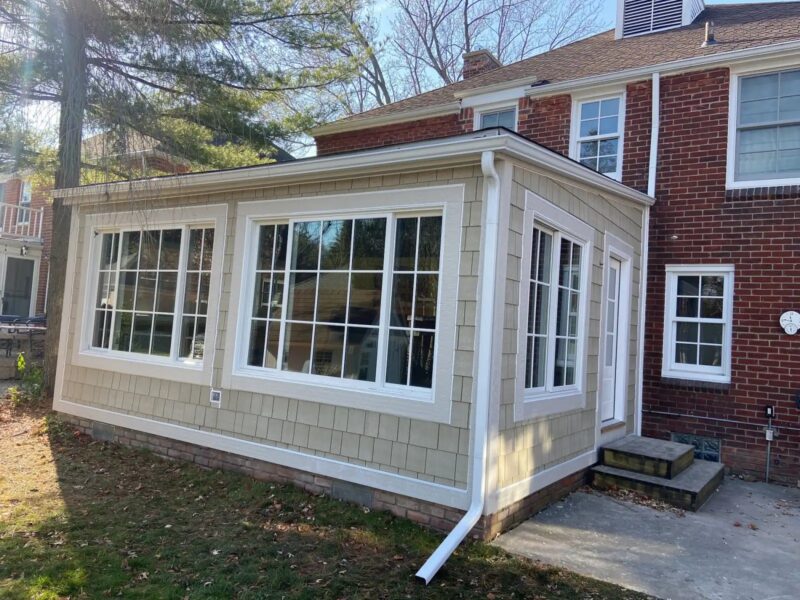
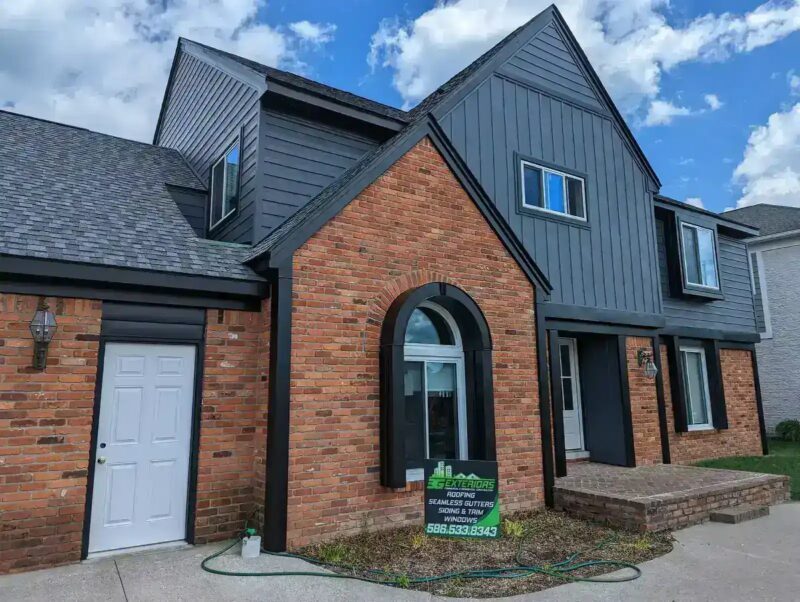
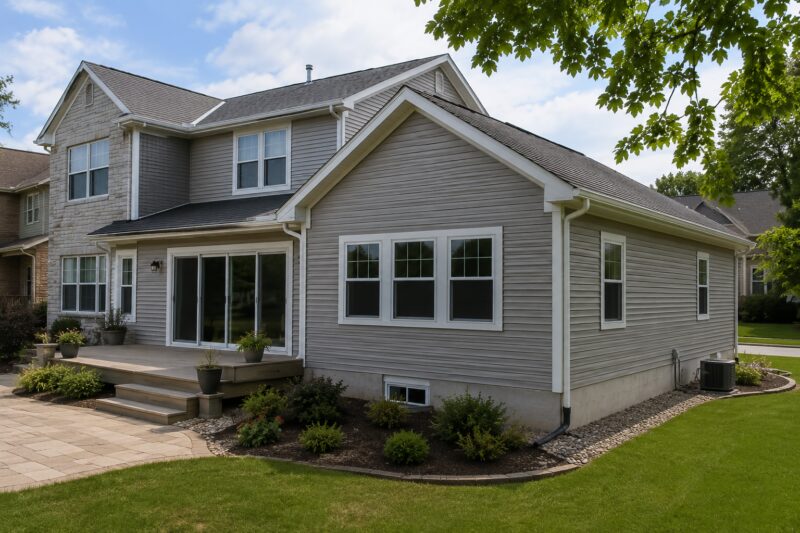
Completed 3G jobs from across Macomb and Oakland counties. At the estimate we can show you work on a similarly exposed elevation.
What an exposed lot does to a wall
A house with no shelter on any side weathers differently from one on a tight street. Five things we plan around here:
- Snow drifting against the wall. On an open lot snow does not fall evenly; it piles on the lee side. A drift that sits against the bottom course for six weeks keeps that wall wet far longer than rain ever does.
- Sun on all four elevations. Without neighbouring houses or mature trees casting shade, every wall gets a full share. Fading is more even here, which is good, but it starts earlier.
- Uplift on long gable ends. Large houses on open ground present a big sail. Fastener spacing and full panel lock are not optional details on these elevations.
- Wind-driven rain on every side. Inland but unsheltered is its own condition: no sheltered elevation means no elevation where the weather barrier can be treated as decorative.
- Debris impact. Open ground means things travel. We see more mechanical damage to lower courses here than in sheltered subdivisions.
Choosing for a large, plain elevation
Houses up here tend to have big, simple wall planes: long runs, tall gables, fewer interruptions than a Shelby Township colonial. That rewards a panel that stays flat, because any waviness reads across the whole elevation with nothing to break it up.
A heavier insulated vinyl does exactly that job and is the workhorse here. The detail on profiles and trim is on our vinyl siding and trim page. Where an owner wants a farmhouse look, board-and-batten with wide trim and a dark colour that holds, fiber cement is the material that does it without fade risk.
Dark colours are worth a specific conversation on an exposed lot. Dark vinyl on a large sunlit wall expands more and shows any fastening error more clearly. It can be done well; it cannot be done carelessly.
Working on a big lot and a long driveway
The practical side of a Washington Township job is different from a city job, and it mostly works in your favour.
What changes:
- Staging is easy. There is room to set up properly, which means the crew works faster and safer than on a tight lot.
- Material delivery needs planning. Long gravel drives and soft ground after rain decide where the truck can get to. We work that out at the estimate rather than on the morning.
- The site is more visible. With no fences and no neighbours close, offcuts and fasteners blow further. Clean-up takes longer here and it should be in the scope.
- Water and power. On larger properties the nearest outlet and tap are not always near the wall we are working on. Worth mentioning before day one.
Snow at the base of the wall
The most common damage we repair on Washington Township houses is not at the top of the wall, it is at the bottom. Drifted snow against siding freezes, thaws, refreezes and works at the starter strip and the lowest courses all winter.
Two things help. The first is making sure the starter strip and the bottom course are properly installed with a clear drainage path, so meltwater that gets behind runs out rather than sitting in the channel. The second is grade: siding should not run down into soil or mulch, and where it does we raise the issue before we hang anything.
Where snow is drifting because roof water and roof snow are being dumped in the wrong place, that is a gutter and roofline question as much as a siding one. Our Washington Township gutter page covers the sizing side of it.
What we look at with the siding
On an exposed rural lot the exterior is one system and the weakest part sets the pace:
- Gutters in Washington Township — larger elevations and open exposure change what a gutter has to carry.
- Roofing in Washington Township — open exposure and snow drifting, read from the roof.
- Drainage — where roof water goes on a large lot with no storm connection.
- Home additions — pole barns, garages and additions all meet the house somewhere, and that joint matters.
Siding questions from Washington Township homeowners
Snow piles against my back wall every winter. Is that damaging the siding?
It can be, at the bottom courses and the starter strip. It is not usually the panel that fails; it is the detail underneath it. We look at that specifically on houses where drifting is a known problem.
Is a dark colour a bad idea on a big sunny wall?
Not a bad idea, but a less forgiving one. Dark panels move more with temperature, so the fastening has to be right and the material has to be good. Fiber cement removes the question entirely if that look matters to you.
We have a pole barn as well. Can you side that?
We can look at it as part of the same visit. The detailing is simpler than a house but the same rules about fastening and exposure apply, and doing both together saves a mobilisation.
Our driveway is long gravel. Is that a problem for delivery?
Not usually, but we want to see it before the material is ordered. A loaded truck on soft gravel after heavy rain is a poor start to a job, and there is normally an easy alternative.
Serving Washington Township and nearby Romeo, Shelby Township, Macomb Township and Oakland Township.


