
Hail goes through in June. You notice the ceiling in October. You call in March.
That sequence is more common than you would think, and it is where storm claims quietly die — not because the damage was not real, but because the clock had been running the whole time from a date nobody was thinking about.
What the statute says
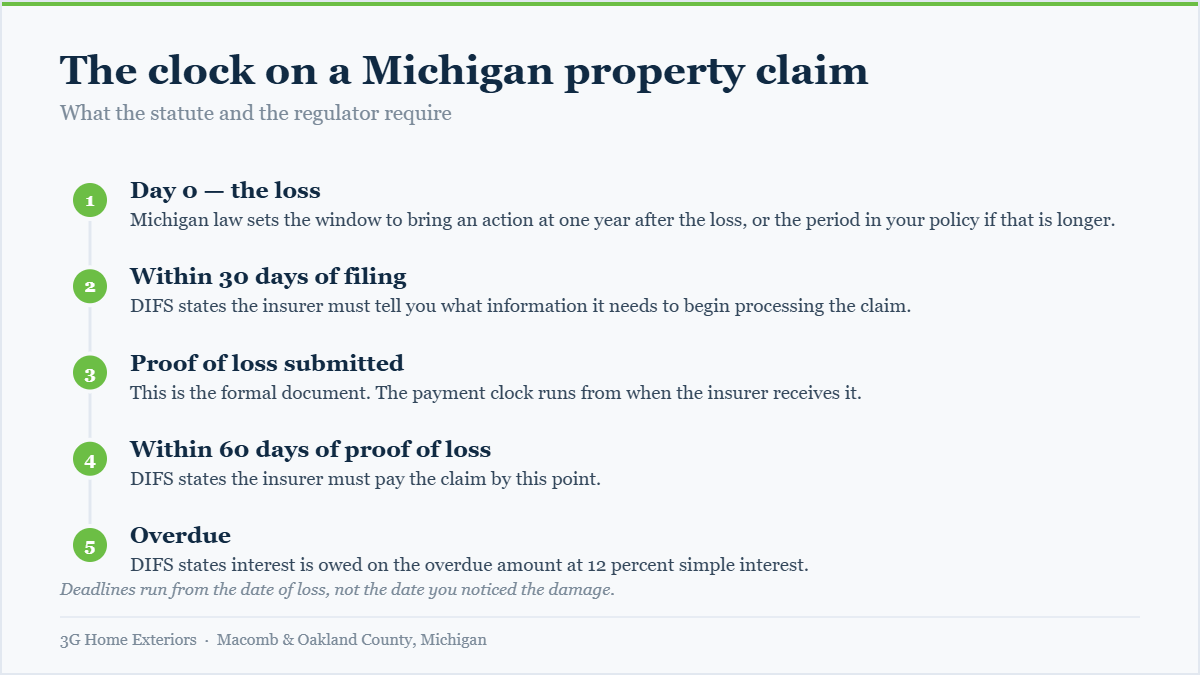
Michigan’s insurance code, at MCL 500.2833, sets out terms that must appear in a fire or property policy. One of them governs the deadline: an action must be commenced within one year after the loss, or within the time period specified in the policy, whichever is longer.
Two things follow from that sentence and both matter.
The clock starts at the loss, not at discovery. The storm is the event. Not the day the stain appeared, not the day a contractor pointed at your roof. If you are trying to remember which storm caused the damage, that difficulty is itself the problem.
Your policy may give you longer, never shorter. The statute sets a floor. Read your policy — some give more time. None can give less.
What your insurer owes you, and by when
The Michigan Department of Insurance and Financial Services — DIFS, the state regulator — publishes what an insurer must do on a property claim.
Within 30 days of filing, the insurer must tell you what information is needed to begin processing your claim.
Within 60 days of receiving proof of loss, the insurer must pay the claim.
If payment is late, DIFS states that interest is owed on the overdue amount at 12 percent simple interest.
That last one is worth holding onto. A claim that drifts for months past proof of loss is not merely frustrating; it is a situation the regulator has an opinion about.
Proof of loss is the document that starts the payment clock
This is the piece homeowners most often misunderstand. Reporting a claim is not proof of loss. Proof of loss is the formal statement of what was damaged and what it will cost, submitted to the insurer.
Until that is in their hands, the 60-day payment obligation has not begun. Claims sometimes sit because everyone is waiting and nobody has filed the document that starts the clock.
Ask your adjuster directly: has a proof of loss been submitted, and on what date? Write the answer down.
Why waiting hurts you beyond the deadline
Even well inside a year, delay costs you on the merits.
Michigan sees roughly 165 hail events a year on average, according to the state’s hazard analysis. Oakland County has logged 92 hail reports since 2004 and Macomb County 69. Several storms cross the same neighbourhood in a season.
The longer you wait, the harder it becomes to tie your damage to a specific covered event — and “we cannot establish which storm caused this” is a straightforward path to denial. It also opens the argument that the damage is wear rather than a sudden loss, which most policies treat very differently.
What to do while the clock runs
- Date the storm. Note when it happened. Local news, NWS records and your own photographs all help.
- Photograph before anything is touched. Wide shots showing the house, close shots showing the damage.
- Prevent further damage, and keep the receipts. Emergency tarping is generally expected of you and generally reimbursable. Keep documentation.
- Do not have permanent repairs done before the adjuster sees it. You remove the evidence.
- Get a written contractor assessment. An independent scope of damage gives you something to hold the adjuster’s figure against.
- Keep a log. Every call, every name, every date.
Roof age and what is actually covered
One thing to read in your own policy before a storm rather than after: whether your dwelling coverage is written on actual cash value or replacement cost, and whether the roof is on a separate schedule by age.
Those terms decide what a claim pays far more than the deadline does. We go through that distinction separately.
If the claim is denied or stalls
DIFS operates a consumer hotline at 877-999-6442, weekdays 8am to 5pm, and accepts complaints. That is a regulator with authority over the insurer, not an advocacy group.
A denial is not automatically the end of the matter. But the one-year window continues to run while you go back and forth, which is why the deadline should be in your mind from day one rather than month ten.
Storm work in Troy
Troy sits in Oakland County, which has recorded the larger hail across the two counties — including a 2.5 inch report near Milford and a 2.0 inch near South Lyon. Stones that size damage roofs that look perfectly sound from the street.
See roofing in Troy, or everything we handle in Troy.
Common questions
How long do I have to file a storm damage claim in Michigan?
Michigan law sets the window to bring an action at one year after the loss, or the period stated in your policy if that is longer. Report the claim as soon as you know about the damage rather than waiting.
Does the year start when I notice the damage?
The statute refers to one year after the loss. That is the event, not the discovery.
How long does my insurer have to pay?
DIFS states the insurer must pay within 60 days after receiving proof of loss, with 12 percent simple interest owed on amounts overdue.
Should I get a roof inspection before I file?
It helps. An independent written assessment gives you an informed account of what was damaged before the adjuster forms their own view.
Get the damage documented
If a storm has been through your area, a written assessment costs you nothing and starts the record. We will tell you plainly whether there is a claim worth filing — including when there is not.
Book a free storm damage inspection, or read about storm damage roofing in Michigan.
Sources: MCL 500.2833; Michigan Department of Insurance and Financial Services, consumer publication FIS-PUB 0216 and March 2025 severe weather release; 2024 Michigan Hazard Analysis, Michigan State Police EMHSD; Storm Prediction Center hail report data for Oakland and Macomb counties. This article describes general requirements and is not legal advice.