Harrison Township, Michigan · on Lake St. Clair
Seamless gutters, replacement, repair, soffit and fascia on the lowest ground in the region — where the Clinton River finishes its run and the wind comes straight off open water. Ten minutes from our Fraser shop.
Family-owned and operated in Michigan since 2011
Based at 31097 Fraser Dr, Fraser, MI 48026
Serving Macomb, Oakland and St. Clair counties
Free on-site inspection and a written, itemized scope before work begins






Every other community we work in gets to talk about where its water goes. Harrison Township is where it arrives. The mouth of the Clinton River is inside this township, on the northwestern shore of Lake St. Clair, and that river starts life 535 feet higher up, in the lake country around Independence Township at 1,112 feet. Here the ground is 577 feet — the lowest we work on anywhere.
The other number is the one people find hard to believe. Harrison Township covers 23.76 square miles, and 9.51 of them are water. Forty percent of the township is not land. Only 14.25 square miles is, and much of that sits close to the waterline, with Lake St. Clair Metropark along the shore and Selfridge, established here in 1917, occupying a large part of the north.
The township was formed in 1827. In 1835 David and James Conger established a settlement called Belvidere, platted the following year and given a post office in 1837. It was abandoned in 1838, because of flooding. That is not a marketing anecdote; it is in the township’s founding record, and it is a useful thing to keep in mind when someone tells you a splash block is enough on a lot half a mile from open water.
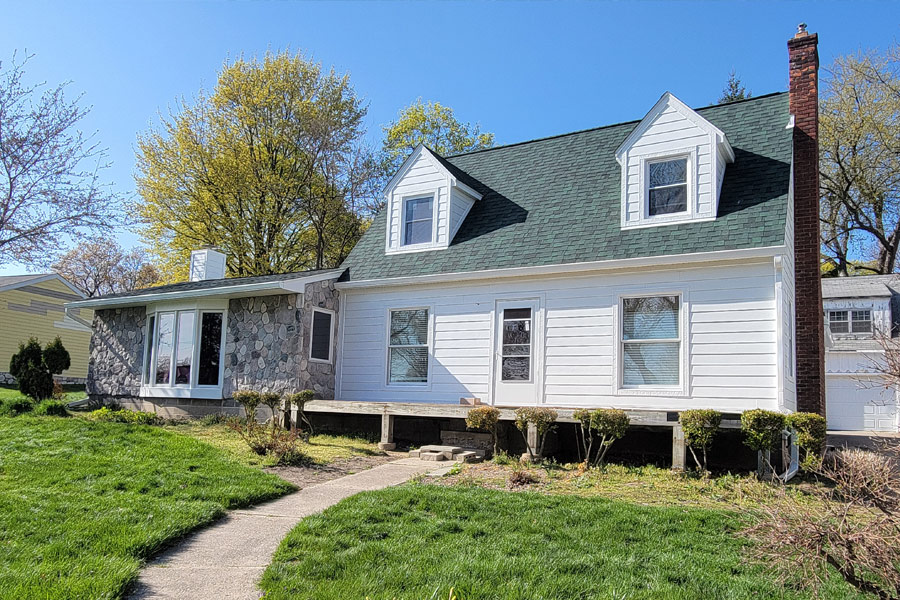
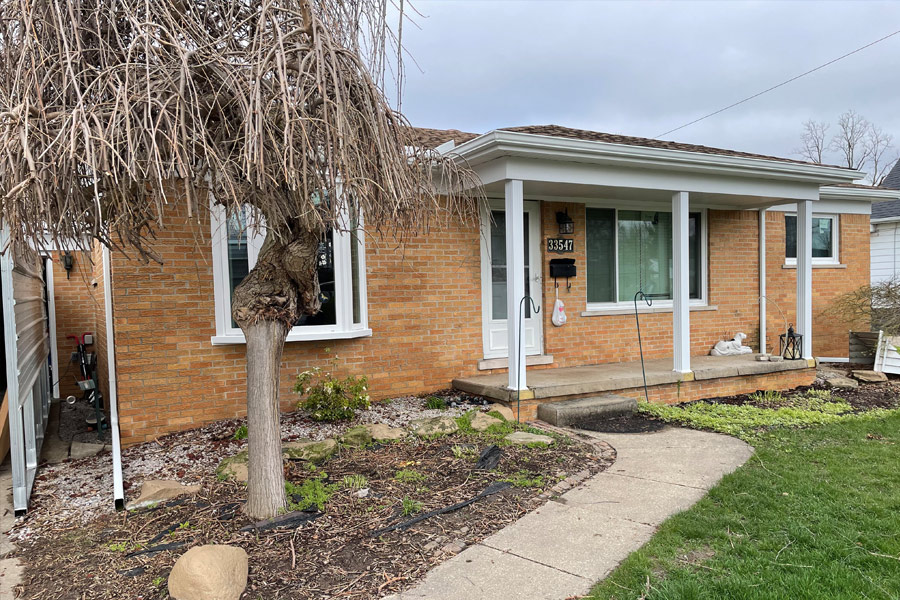
Population has been flat for a generation — 24,461 in 2000, 24,314 in 2020. A built-out township that has not grown has little new housing, so most of what we work on dates from the postwar decades through the 1980s, with a waterfront and canal layer of cottages extended and insulated into year-round houses. Those conversions are the interesting ones: roof planes added at different dates and pitches, draining into whatever gutter was already there.
Lake exposure is a real load case, not a figure of speech. A house on the shore side takes sustained wind with nothing upwind to slow it, and that wind arrives along the eave rather than at it. Gutter comes off buildings here at the fastenings, not by tearing, and the first thing we look at on a lakeside elevation is hanger type and spacing rather than the trough.
Winter is the second half of it. The code tables give Macomb County a ground snow load of 25 psf, and the University of Michigan’s GLISA program puts Great Lakes freeze-thaw cycling at an average of 42 a year. On flat, low ground meltwater does not run anywhere in particular; it stands and then freezes at the base of the discharge, which is how a downspout ends up sitting in its own ice pan by February.
Which is the real point here. At 577 feet with almost no fall, trough size is rarely the limiting factor — the discharge is. Roof water put down beside a low-lying house has nowhere to be, so it works back toward the footing. Buried solid pipe carrying it well clear of the building, to an outlet that can actually release, is the honest answer here far more often than it is further up the river. County drains fall under the Macomb County Public Works Commissioner.

Formed at the property so an exposed lakeside run has no seam for wind and ice to work at over a winter.
For systems that have been re-fastened into the same tired fascia repeatedly, or where the back edge has gone in a damp, salt-laden air.
Heavier hangers at closer spacing on the windward side, resealed corners, corrected fall, and outlets added where a cottage addition changed the roof.
Hidden hangers screwed into sound fascia at tightened spacing on exposed elevations. Spikes were never adequate here and are worse now.
Damp air and years of overflow are hard on a fascia board. We cut back to solid timber, wrap, and refit vented soffit so the eave still breathes.
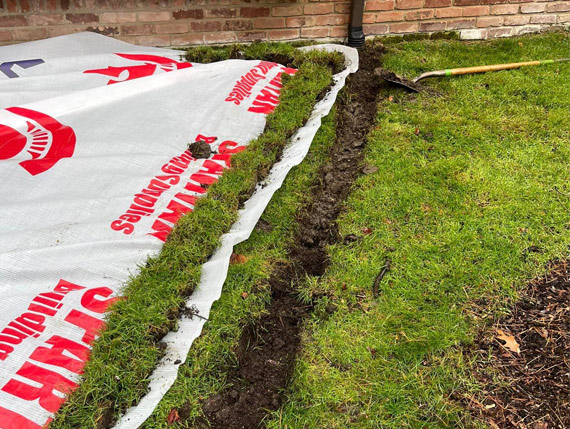
Solid buried pipe to a releasing outlet well away from the house — the difference between moving roof water and relocating it a yard.
Cottage conversions often have three roof eras meeting at one corner. Each plane needs its own outlet plan rather than a shared guess.

We measure each run, identify which roof planes feed it, test the fascia by hand, note the exposed elevations and see where every downspout currently lets go.

Size, profile, hanger type and spacing, outlet positions, fascia repairs and any buried drainage, agreed before material is ordered.

Old system off, damp and soft board replaced, the fascia line made true so new fastenings bite into something that will hold.

The system is flooded, every outlet is watched to its discharge point, the site is swept and gone over with a magnet, then we walk it with you.
Gutters, fascia, soffit and roof covering all fail together on a waterfront house, and splitting them between contractors is how the blame ends up in the middle.
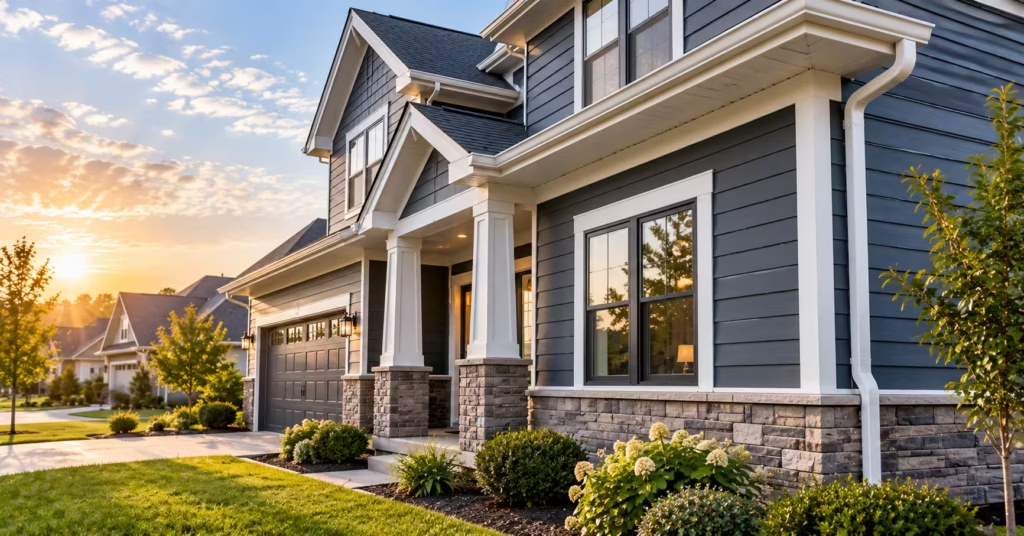
Wall repair where overflow has been feeding the same corner for years. See vinyl siding and trim.
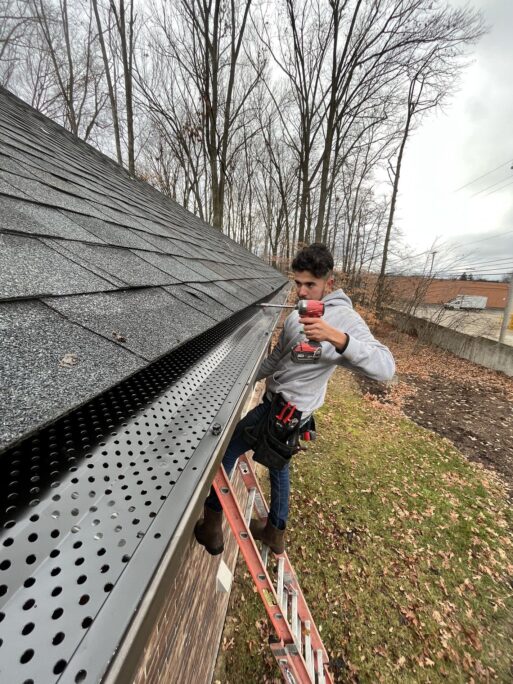
Family-run from Fraser since 2011, licensed and insured, and on this side of the county every week rather than occasionally.
On the lowest ground in the region, where the water ends up decides whether the gutter did any good at all.
Hanger type and spacing change on the lake side of a house, and the reason for that change is written into your scope.
Additions from three different decades draining into one trough is a common condition here and it needs planning per plane.
Itemized so you can compare it against another quote line by line instead of comparing two round numbers.
The feed below is live from our Google Business Profile, so what you read is whatever homeowners posted, in their own words.
EXCELLENT Based on 227 reviews
 Posted on Google
 Marguerite Johnson
 Stellar Team and Amazing Response Time.Posted on Google
 Sarah McCulloughGreat experience with Jamie and his crew for gutter replacement. Jamie gave a no nonsense quote, very straight forward. He scheduled me and got the crew out within a week. They finsihed in a few hours. I paid the final invoice. Done! Previously, I had requested four quotes from four different contractors. 3G was the cheapest and most qualified in my opinion. It's ridiculous the amount of nonsense other contractors display not knowing I'm a woman with 13 years in construction. I always play dumb, because I want to see who NOT to hire. Jamie treated me fairly and with respect from the start. He gave an appropriate price, clear terms, and provided his license and insurance without hesitation. Wonderful experience and I will be calling 3G back for my garage siding project. Very pleased with their work and professionalism.Posted on Google
 Ramsey Khalid3G Home Exteriors completed a tuck-pointing job on my front porch and my back walk-out steps. Quote was fair, crew was on time, professional and courteous. After they completed the job, they cleaned up the job site leaving no trace. Overall, it was a very good experience and I would recommend them for the same work.Posted on Google
 Dana LawrenceWindy weather bent the aluminum siding on the peaks of our home. 3G came out and fixed it like new. Friendly people and easy to work with.Posted on Google
 Steve WegnerIn Troy, MI, I hired 3G to install gutter guards and additional downspouts. In addition to a job well done I was most impressed with their excellent customer service, responsiveness and timeliness.Posted on Google
 Jill Severini3G was excellent to work with. They kept appointment times, did everything they promised. We love our new micro mesh gutter guards. No more water overflowing onto our porch. No more locust leaves or seeds to clean. Best of all, no more climbing on the roof. Would highly recommend.Posted on Google
 Sean WeaverSecond time using 3G. Reasonably priced and great work.Posted on Google
 Milton Brownlee3G gave me a fair price to repair approximately 12 pieces of Siding that was blown off due to heavy winds. I would highly recommend 3G services great customer service.Posted on Google
 Leslie LloydJamie was very pleasant individual to speak with and made sure to call to update me on any details. The roofing itself is amazing, the group that was here did a great job with clean up and taking off the old roof. No more leaking in my backroom!!!
We cover the whole southeastern corner of Macomb County, from the Clinton River mouth down the shoreline and back inland toward our own shop.
Because at 577 feet on flat ground there is nowhere for it to run to. A splash block moves water about three feet, and on a low lot near the lake three feet is not far enough for it to be gone. It soaks in and works back toward the footing. Getting it into buried pipe and out to a point that can release is the difference.
Because the discharge is standing rather than running. The ground snow load figure for Macomb County is 25 psf and regional freeze-thaw averages around 42 cycles annually, so meltwater arrives repeatedly, pools where it lands and refreezes. Buried discharge below that zone is the usual fix.
Sustained wind off open water with nothing upwind to break it, working on fastenings set for a sheltered elevation. It is a fixing problem rather than a gutter problem. Hidden hangers at tightened spacing, screwed into fascia that is actually sound, is what holds.
Where a scope requires a permit we pull it, and Harrison Township takes permit applications through BS&A Online. The township’s published fee schedule handles roofing and siding as a permit fee plus a bond and a ten percent administrative charge, with no zoning fee attached — but that schedule is dated, so we confirm the current figures with the township rather than quoting numbers off a PDF.
Sometimes, but less often than on higher ground. Capacity is only useful if the water can leave at the bottom. On this ground we usually get more out of an extra outlet and a proper discharge route than out of a wider trough.
Usually less than people expect. Open shoreline lots do not carry the canopy an inland subdivision does, and on most of the houses we look at here the money does more good spent on fixings and drainage. We will tell you which of those your house needs.
Quite a lot. Additions built at different times rarely share a pitch, so one trough can end up receiving from planes that deliver at very different rates. Each plane gets its own area calculation and outlet plan rather than a single guess for the whole side.
We measure the runs, check the fascia, look hard at the exposed elevations and follow every downspout to where it lets go. Then you get it in writing, itemized, before anyone orders material.